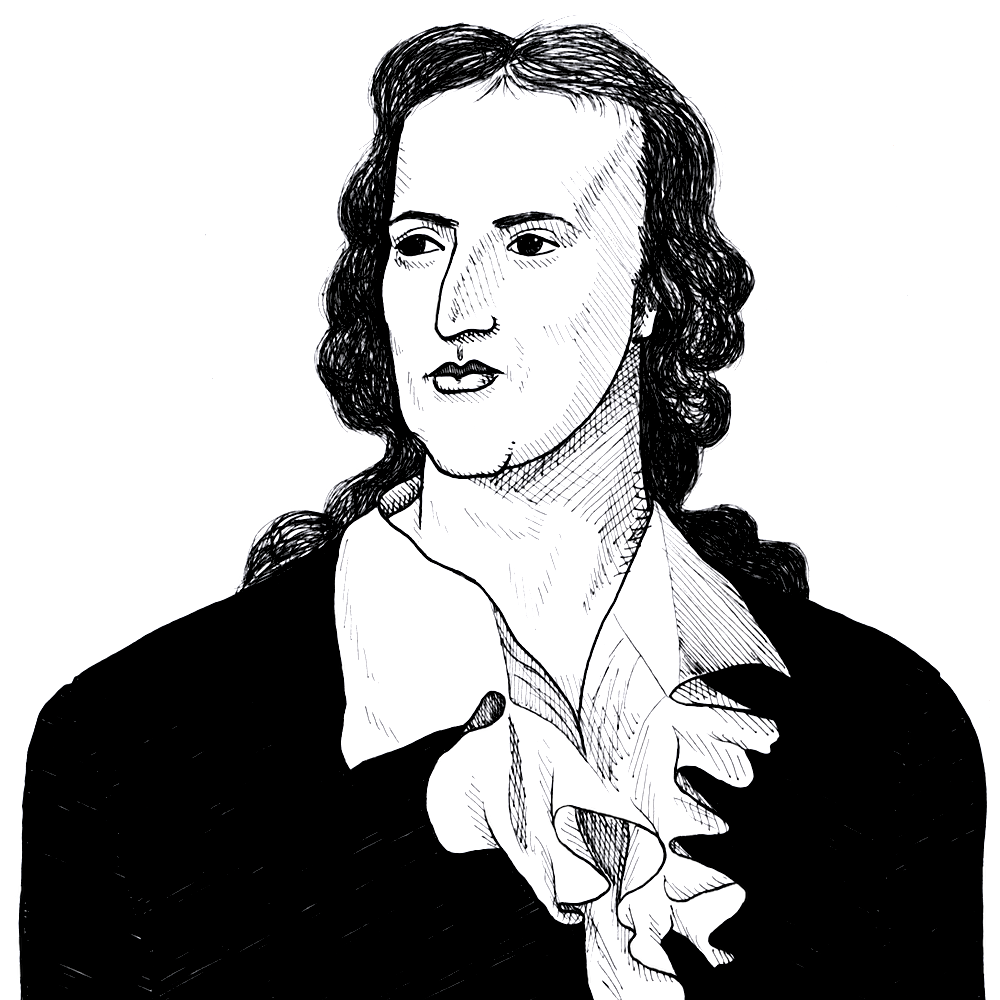
Fr Pecht del.
published by george barrie
J. L. Raab sc.
Frederick Schiller
COPYRIGHT, 1883, BY GEORGE BARRIE.
Poems.
4 5Poems
POEMS OF THE First Period.
HECTOR’S FAREWELL.
ANDROMACHE.
- ART thou, Hector, hence for ever going
- Where Achilles, with fierce vengeance glowing
- To Patroclus piles a hecatomb?
- Who, alas! will teach thine Infant truly
- Spears to hurl, the Gods to honor duly,
- When thou’rt buried in dark Orcus’ womb? 6
- For thy clashing arms I vain shall listen,
- In thy halls thy glaive will idly glisten,
- Priam’s hero-race in dust will lie;
- Thou wilt go, where day can enter never,
- Where Cocytus wails ’mid deserts ever,
- And thy Love in Lethe’s stream will die.
HECTOR.
- Dearest wife, restrain thy tearful sadness!
- For the fray my bosom pants with madness,
- This stout arm must Pergamus defend;
- For my household Gods all dangers braving,
- Should I fall, my Fatherland in saving,
- To the Stygian flood I’ll glad descend. 6
- Though the ardent hopes, the thoughts I cherish,
- All in Lethe’s silent stream may perish,
- Yet my Love shall never die!
- Hark! I hear the foe the walls assailing!
- Gird my sword around me,—cease thy wailing!
- Hector’s Love in Lethe cannot die!
AMALIA.
- ANGEL-FAIR, Walhalla’s charms displaying,
- Fairer than all mortal youths was he;
- Mild his look, as May-day sunbeams straying
- Gently o’er the blue and glassy sea.
- And his kisses!—what ecstatic feeling!
- Like two flames that lovingly entwine,
- Like the harp’s soft tones together stealing
- Into one sweet harmony divine,—
- Soul and soul embraced, commingled, blended,
- Lips and cheeks with trembling passion burn’d,
- Heav’n and Earth, in pristine chaos ended,
- Round the blissful Lovers madly turn’d.
- He is gone—and, ah! with bitter anguish
- Vainly now I breathe my mournful sighs;
- He is gone—in hopeless grief I languish,
- Earthly joys I ne’er again can prize!
A FUNERAL PHANTASY.
- LO! on high the moon, her lustre dead,
- O’er the death-like grove uplifts her head,
- Sighing flits the spectre through the gloom—
- Misty clouds are shivering,
- Pallid stars are quivering,
- Looking down, like lamps within a tomb.
- Spirit-like, all silent, pale, and wan,
- Marshall’d in procession dark and sad,
- To the sepulchre a crowd moves on,
- In the grave-night’s dismal emblems clad.
- Who is he, who, trembling on his crutch,
- Walks with gloomy and averted eye,
- And bow’d down by Destiny’s harsh touch,
- Vents his sorrow in a mournful sigh
- O’er the coffin borne in silence by?
- Was it “Father!” from the youth’s lips came?
- Soon a damp and fearful shudder flies
- Through his grief-emaciated frame,
- And his silv’ry hairs on end uprise.
- All his fiery wounds now bleed anew!
- Thro’ his soul, hell’s bitter torments run!
- “Father!” ’twas that from the youth’s lips flew,
- And the Father’s heart hath whisper’d, “Son!”
- Ice-cold, ice-cold, in his shroud he lies,—
- By thy dream, so sweet and golden erst,
- Sweet and golden, Father, thou art curst!
- Ice-cold, ice-cold, in his shroud he lies,
- Who was once thy joy, thy Paradise!
- Mild, as when, fann’d by Elysian gale,
- Flora’s son over the verdant plain skips,
- Girded with roses that fragrance exhale,
- When from the arms of Aurora he slips,—
- Onward he sped o’er the sweet-smelling field,
- Mirror’d below in the silvery flood;
- Rapturous flames in his kiss were conceal’d,
- Chasing the maidens in amorous mood.
- Boldly he sprang ’mid the stir of mankind,
- As o’er the mountains a youthful roe springs;
7
- Heav’nward ascended his wish unconfin’d,
- High as the eagle his daring flight wings.
- Proud as the steeds that in passion their manes,
- Foaming and champing, toss round in wild waves,
- Rearing in majesty under the reins,
- Stood he alike before monarchs and slaves.
- Bright as a spring-day, his life’s joyous round
- Fleeted in Hesperus’ glory away;
- Sighs in the grape’s juice all golden he drown’d,
- Sorrow he still’d in the dance light and gay.
- Worlds were asleep in the promising boy,
- Ha! when he once as a man shall be ripe,—
- Father, rejoice—in thy promising boy,
- Soon as the slumbering germ shall be ripe!
- Not so, Father—hark! the churchyard gates
- Groan, and lo, the iron hinges creak!—
- See the dreaded tomb its prey awaits!—
- Not so—let the tears course down thy cheek!
- Tow’rd Perfection, lov’d one, hasten on,
- In the sun’s bright path with joy proceed!
- Quench thy noble thirst for bliss alone
- In Walhalla’s peace, from sorrow freed!
- Ye will meet—oh, thought of rapture full!—
- Yonder, at the gate of Paradise!
- Hark! the coffin sinks with echo dull;
- As it re-ascends the death-rope sighs!
- Then, with sorrow drunk, we madly roll’d,
- Lips were silent, but the mute eye spoke—
- Stay, oh, stay!—we grudg’d the tomb so cold;
- But soon warmer tears in torrents broke.
- Lo! on high the moon, her lustre dead,
- O’er the deathlike grove uplifts her head,
- Sighing flits the spectre through the gloom,
- Misty clouds are shivering,
- Pallid stars are quivering,
- Looking down, like lamps within a tomb.
- Dully o’er the coffin earth-flakes rise,—
- All the wealth of earth for one look more!
- Now the grave barr’d up for ever lies;
- Duller, duller o’er the coffin earth-flakes rise
- Never will the grave its prey restore!
PHANTASY.
TO LAURA.
- NAME, my Laura, name the whirl-compelling
- Bodies to unite in one blest whole—
- Name, my Laura, name the wondrous magic
- By which soul rejoins its kindred soul!
- See! it teaches yonder roving Planets
- Round the sun to fly in endless race;
- And as children play around their mother,
- Checker’d circles round the orb to trace.
- Every rolling star, by thirst tormented,
- Drinks with joy its bright and golden rain—
- Drinks refreshment from its fiery chalice,
- As the limbs are nourish’d by the brain.
- ’Tis through Love that atom pairs with atom,
- In a harmony eternal, sure;
- And ’tis Love that links the spheres together—
- Through her only, systems can endure.
- Were she but effaced from Nature’s clockwork,
- Into dust would fly the mighty world;
- O’er thy systems thou wouldst weep, great Newton,
- When with giant force to Chaos hurl’d!
- Blot the goddess from the Spirit Order,
- It would sink in death, and ne’er arise.
- Were Love absent, spring would glad us never;
- Were Love absent, none their God would prize!
- What is that, which, when my Laura kisses,
- Dyes my cheek with flames of purple hue,
- Bids my bosom bound with swifter motion,
- Like a fever wild my veins runs through?
- Ev’ry nerve from out its barriers rises,
- O’er its banks the blood begins to flow;
- Body seeks to join itself to Body,
- Spirits kindle in one blissful glow.
- Powerful as in the dead creations
- That eternal impulses obey,
- O’er the web Arachne-like of Nature,—
- Living Nature,—Love exerts her sway.
- Laura, see how Joyousness embraces
- E’en the overflow of sorrows wild!
- How e’en rigid desperation kindles
- On the loving breast of Hope so mild.
- Sisterly and blissful rapture softens
- Gloomy Melancholy’s fearful night,
- And, delivered of its golden Children,
- Lo, the eye pours forth its radiance bright!
- Does not awful Sympathy rule over
- E’en the realms that Evil calls its own?
- For ’tis Hell our crimes are ever wooing,
- While they bear a grudge ’gainst heaven alone!
- Shame, Repentance, pair Eumenides-like,
- Weave round Sin their fearful serpent-coils;
- While around the eagle-wings of Greatness
- Treach’rous danger winds its dreaded toils.
- Ruin oft with Pride is wont to trifle,
- Envy upon Fortune loves to cling;
- On her brother, Death, with arms extended,
- Lust, his sister, oft is wont to spring.
- On the wings of Love the Future hastens
- In the arms of ages past to lie;
- And Saturnus, as he onward speeds him,
- Long has sought his bride—Eternity!
- Soon Saturnus will his bride discover,—
- So the mighty Oracle hath said;
- Blazing worlds will turn to marriage torches
- When Eternity with Time shall wed!
- Then a fairer, far more beauteous morning,
- Laura, on our love shall also shine,
- Long as their blest bridal-night enduring:—
- So rejoice thee, Laura—Laura mine!
TO LAURA AT THE HARPSICHORD.
- WHEN o’er the chords thy fingers stray,
- My spirit leaves its mortal clay,
- A statue there I stand;
- Thy spell controls e’en life and death,
- As when the nerves a living breath
- Receive by Love’s command!
- More gently Zephyr sighs along
- To listen to thy magic song:
- The systems formed by heav’nly love
- To sing for ever as they move,
- Pause in their endless-whirling round
- To catch the rapture-teeming sound;
- ’Tis for thy strains they worship thee,—
- Thy look, enchantress, fetters me!
- From yonder chords fast-thronging come
- Soul-breathing notes with rapturous speed,
- As when from out their heav’nly home
- The new-born seraphim proceed;
- The strains pour forth their magic might,
- As glitt’ring suns burst through the night,
- When, by Creation’s storm awoke,
- From Chaos’ giant-arm they broke.
- Now sweet, as when the silv’ry wave
- Delights the pebbly beach to lave;
- And now majestic as the sound
- Of rolling thunder gath’ring round;
- Now pealing more loudly, as when from yon height
- Descends the mad mountain-stream, foaming and bright;
- Now in a song of love
- Dying away,
- As thro’ the aspen grove
- Soft zephyrs play;
- Now heavier and more mournful seems the strain,
- As when across the desert, death-like plain,
- Whence whispers dread and yells despairing rise,
- Cocytus’ sluggish, wailing current sighs.
- Maiden fair, oh, answer me!
- Are not spirits leagued with thee?
- Speak they in the realms of bliss
- Other language e’er than this?
RAPTURE.
TO LAURA.
- FROM earth I seem to wing my flight,
- And sun myself in Heaven’s pure light,
- When thy sweet gaze meets mine
- I dream I quaff ethereal dew,
- When mine own form I mirror’d view
- In those blue eyes divine!
- Blest notes from Paradise afar,
- Or strains from some benignant star
- Enchant my ravish’d ear;
- My muse feels then the shepherd’s hour
- When silv’ry tones of magic power
- Escape those lips so dear!
- Young loves around thee fan their wings—
- Behind, the madden’d fir-tree springs,
- As when by Orpheus fir’d;
- The poles whirl round with swifter motion,
- When in the dance, like waves o’er ocean,
- Thy footsteps float untir’d!
- Thy look, if it but beam with love,
- Could make the lifeless marble move,
- And hearts in rocks enshrine;
- My visions to reality
- Will turn, if, Laura, in thine eye
- I read—that thou art mine!
THE SECRET OF REMINISCENCE.
TO LAURA.
- WHAT unveils to me the yearning glow
- Fix’d for ever to thy lips to grow?
- What the longing wish thy breath to drink,—
- In thy being blest, in death to sink
- When thy look steals o’er me?
- As when slaves without resistance yield
- To the victor in the battle-field,
- So my senses in the moment fly
- O’er the bridge of life tumultuously
- When thou stand’st before me!
- Speak! why should they from their master roam?
- Do my senses yonder seek their home?
- Or do sever’d brethren meet again,
- Casting off the body’s heavy chain,
- Where thy foot hath lighted?
- Were our beings once together twin’d?
- Was it therefore that our bosoms pin’d?
- Were we in the light of suns now dead,
- In the days of rapture long since fled,
- Into one united?
- Aye! we were so! thou wert link’d with me,
- In Æone that has ceas’d to be;
- On the mournful page of vanish’d time,
- By my muse were read these words sublime:
- Nought thy love can sever!
- And in being closely twin’d and fair,
- I, too, wondering saw it written there,—
- We were then a life, a Deity,—
- And the world seem’d order’d then to lie
- ’Neath our sway for ever.
11
- And, to meet us, nectar-fountains still
- Pour’d for ever forth their blissful rill;
- Forcibly we broke the seal of Things,
- And to Truth’s bright sunny hill our wings
- Joyously were soaring.
- Laura, weep!—this Deity hath flown,—
- Thou and I his ruins are alone;
- By a thirst unquenchable we’re driven
- Our lost Being to embrace;—tow’rd Heaven
- Turns our gaze imploring.
- Therefore, Laura, is this yearning glow
- Fix’d for ever to thy lips to grow,
- And the longing wish thy breath to drink,
- In thy Being blest, in death to sink
- When thy look steals o’er me!
- And as Slaves without resistance yield,
- To the Victor in the battle-field,
- Therefore do my ravish’d Senses fly
- O’er the bridge of Life tumultuously,
- When thou stand’st before me!
- Therefore do they from their Master roam!
- Therefore do my Senses seek their home!
- Casting off the Body’s heavy chain,
- Those long-sever’d brethren kiss again,
- Hush’d is all their sighing!
- And thou, too—when on me fell thine eye,
- What disclos’d thy cheek’s deep-purple dye?
- Tow’rd each other, like relations dear,
- As an exile to his home draws near,
- Were we not then flying?
MELANCHOLY.
TO LAURA.
- LAURA,—in thy golden gaze
- Burns the morning sunbeam’s glow,
- In thy cheek the red blood plays,
- And thy tears, that pearl-like flow,
- Rapture as their Mother know—
- He whom those fair drops bedew,
- Who therein a God can view,
- Ah, the youth who thus rewarded sighs,
- Sees new suns begin to rise!
- And thy Spirit, bright and clear,
- As the glassy waves appear,
- Turns to May the Autumn sad;
- Deserts wild, inspiring fear,
- In thy genial rays are glad.
- Distant Future, gloomy, cold,
- In thy star is turn’d to gold;
- Smil’st thou at the Graces’ harmony?
- I must weep those charms to see!
- Have not Night’s all-dreaded Powers
- Undermin’d Earth’s fastness long?
- Yes! our proudly-soaring towers,
- And our cities, stately, strong,
- All on mould’ring bones repose;
- From Decay their fragrant bloom
- Drink thy flowers; thy current flows
- From the hollow of a—tomb!
- Laura, yonder floating planets see!
- Let them of their Worlds discourse to thee!
- ’Neath their magic Circle’s sway,
- Thousand springs have pass’d away,
- Thousand thrones the skies have sought,
- Thousand fearful fights been fought.
- Wouldst thou find their trace again,
- Seek it on the iron plain!
- Earlier, later, ripe to pass
- To the grave,—the wheels, alas,
- Of the Planets clogg’d remain!
- Thrice look round,—and lo! the sun’s bright rays
- In the death-night’s Ocean quench their blaze;
- Ask me how thy beams are fann’d to flame!
- Dost thou boast thy sparkling eye,
- Or thy cheek’s fresh purple dye,
- That from crumbling Mould first came?
- For the hues he lent to thee,
- Maiden, Death with usury
- Heavy interest soon will claim!
12
- Maiden, do not scorn that mighty one!
- On the cheek a fairer, brighter dye
- Is, alas! but Death’s more beauteous throne;
- From behind that flow’ry tapestry
- Marks his prey the Spoiler for his own.
- Laura—in thy Worshipper confide!
- ’Tis tow’rd Death alone thine eyes now strain;
- And thy beaming glances only drain
- Life’s frail lamp so niggardly supplied.
- “Yet my pulses,” boastest thou,
- “Throb in joyous youthful play”—
- Ah! the Tyrant’s creatures now
- Are but hast’ning tow’rds Decay.
- And this smile the blast of Death
- Scatters, as the zephyr’s breath
- Scatters rainbow-colored foam.
- Vain thou seek’st to find its trace,
- E’en from Nature’s spring-like grace,
- E’en from Life, as from his home,
- Sallies the Destroyer base!
- Stripp’d of leaves I see thy lifeless roses,
- Pale and dead thy mouth so sweet of yore,
- And thy cheek, that dimples soft discloses,
- By the wintry tempest furrow’d o’er.
- Gloomy years will, gathering blacker, stronger,
- Cloud the silver-spring of Infancy—
- Then will Laura—Laura love no longer,
- Then will Laura lovely cease to be!
- Maiden! as an oak thy Bard still rears his head;
- Blunt against my rock-like youthful might
- Falls the death-spear’s shaft, its vigor fled;
- And my glances,—burning as the light
- Of yon Heaven,—my Soul more fiercely glowing
- Than the light of yon eternal Heaven,
- O’er its own World’s heaving Ocean driven,
- Piling rocks and overthrowing;
- Boldly through the world my thoughts are steering,
- Nothing save their barriers fearing!
- Glow’st thou, Laura?—Swells thy haughty breast?
- Learn then, Maiden, that this drink so blest,
- That this cup of god-like seeming,
- Laura, is with Poison teeming!
- Hapless they who ever trust
- Sparks divine to forge from dust!
- Ah! the boldest Harmony
- ’Mongst the notes but discord breeds,
- Genius, glowing Spark from high,
- On Life’s glimm’ring lamp but feeds.
- Lur’d from Life’s bright throne away,
- Ev’ry Gaoler marks him as his prey!
- Ah! e’en now, with shameless passion fir’d,
- ’Gainst me all my Spirits have conspir’d!
- Let—I feel it—two short springs fleet by,
- Laura—and this tott’ring house of clay
- Will with fearful ruin on me lie,
- Quenching me in my self-kindled ray!—
- Weep’st thou, Laura?—Be that tear denied
- Which as Age’s penance is supplied!
- Hence! away! thou tear, thou sinner mean!
- Wouldst thou, Laura, that my strength should sink?—
- That I trembling from that Sun should shrink
- Who the stripling’s eagle-course hath seen?
- That my bosom’s heav’nly flame so bright
- ’Neath a frozen heart’s cold touch should perish?—
- That my Spirit should be reft of sight?—
- Must I curse the Sins that most I cherish?
- No! away! thou tear, thou sinner mean!
- Break the flow’ret in its fairest bloom!
- Quench, O Youth, with that deep look of gloom,
- Quench with bitter tears my torch’s ray!
- As when o’er the scene that most enthrals
- On the tragic stage, the curtain falls
- Though each shadow flies,—the crowds all-breathless stay!
THE INFANTICIDE.
- HARK!—the bells are tolling mournfully,
- And the dial’s hand hath run its race.
- In the name of God, so let it be!
- Grave-attendants,—to the fatal place!
- Take, O World, this last departing kiss!
- Take, O World, these bitter tears away!
- Yet thy poison had a taste of bliss!—
- Bosom-poisoner, we are quit to-day!
- Fare thee well, thou happiness of Earth,
- Now to be exchang’d for crumbling mould!
- Fare ye well, ye days of rosy birth,
- That the maiden revell’d in of old!
- Fare ye well, ye gold-embroider’d dreams,
- Heaven-descended Phantasies so bright!
- Ah, they perish’d in their morning beams,
- Ne’er again to blossom to the light!
- I was deck’d with rosy ribbons fair,
- Clad in Innocence’s swan-like dress,
- And my bright and loosely flowing hair
- Rosebuds sweet then carelessly did press.
- Woe, oh woe! though garments white still grace
- Her who now is Hell’s sad sacrifice,
- Yet, alas, those rosy ribbons’ place
- Now the fillet black of Death supplies!
- Weep for me, oh, ye who never fell!
- Ye for whom the guileless lily blows,—
- On whose gentle bosoms as they swell
- Nature her heroic strength bestows!
- Woe!—this heart has felt frail passion’s charms,
- Feeling now my judgment-sword must be!
- Woe!—encircl’d in the False One’s arms,
- Slept my Virtue,—ah, too easily!
14
- Ah, forgetting me, that serpent heart
- Makes Another now perchance its prey,—
- Overflows, when I to Death depart,
- At her toilet in some amorous play!—
- Sports, it may be, with his Maiden’s hair,
- Drinks the kiss that she responsive brings,
- When upon the death-block spurting there,
- From my body, high the life-blood springs!
- Joseph! Joseph! many a weary mile
- May Louisa’s death-song follow thee!
- And the belfry’s hollow peal the while
- On thy startled ear strike fearfully!
- When Love’s soft and murmuring tones may swell
- Tow’rd thee from some Maiden’s tender lips,
- Sudden let them plant a Wound from Hell,
- Where Joy’s rosy form its Being sips!
- Traitor! heed’st thou not Louisa’s smart?—
- Not, thou Cruel one, a Woman’s shame?—
- Not the unborn Life beneath my heart?—
- Not what e’en the tiger fierce would tame?
- See! his sails now proudly leave this land,
- Sadly after them is turn’d mine eye,
- While around the Maids on Seine’s far strand,
- Breathes he forth his false and treach’rous sigh!
- And my baby,—wrapp’d in soft repose—
- Calmly lay it on its mother’s breast;
- In the beauty of the morning rose
- Sweetly on me smil’d the infant blest.
- Deadly-lovely was each feature fair
- Of its blissful image tow’rd me bent;
- While by Love and visions of Despair
- Was its mother’s tortured bosom rent.
- “Woman, where’s my Father?”—Thus it spoke
- In its innocent mute thunder-tone;
- “Woman, where’s thy Spouse?”—responsive broke
- From my inmost heart, with heavy groan.
- Him who now may other children kiss,
- Orphan, thou, alas, wilt seek in vain!
- Thou wilt curse the moment of our bliss,
- When the Bastard’s name inflicts its stain.
- And thy mother—in her heart is Hell!
- Lonely sits she in wide Nature’s All,
- Thirsting ever at the blissful well,
- Which thy sight converts to bitter gall.
- Ah! with ev’ry sound from thee arise
- Madden’d feelings of departed joy,
- And Death’s bitter arrow ’gainst me flies,
- From the smiling glances of my Boy.
- Hell surrounds me when thy form I miss;
- Hell, whene’er mine eyes thy form behold!
- And the Furies’ lash is now thy kiss,
- That from his lips ravish’d me of old!
- From the Grave his Oath still thunders back,
- Ever does his Perjury kill on—
- Here around me twined the Hydra black,
- And the work of Murder soon was done!
- Joseph! Joseph! many a weary mile
- May the phantom dread thy steps pursue,
- Catch thee in its ice-cold arms the while,
- From thy dream of rapture wake thee, too!
- May thine infant’s dying gaze so sad
- Glare down from the softly glimm’ring star,
- Meet thee in its bloody vesture clad,
- Scourge thee back from Paradise afar!
- See! there lay it lifeless at my feet,—
- Coldly staring-with a mind confus’d
- Saw I then its Life-blood’s current fleet,
- And my own Life with that current ooz’d;—
- Fearfully the messengers of doom
- Knock e’en now,—more fearfully my heart!
- Gladly haste I, in the chilly tomb
- Evermore to quench my burning smart.
- Joseph! thou may’st pardon’d be by Heaven,
- Thou art pardon’d by the Sinner, too!
- To the Earth my wrongs be henceforth given!
- Rake, ye Flames, the Death-pile thro’ and thro’!
- Joy! oh, Joy! His letters burn on high,
- And a conquering flame his oath devours,
- While his kisses upwards blazing fly!—
- Yet was aught so dear in happier hours!
- Sisters, trust your youthful roses ne’er,
- Trust them ne’er to false Man’s treach’rous vow!
- Beauty for my Virtue laid its snare,—
- On the Place of Death I curse it now!
- Tears?—From stranglers’ eyes can tears, then, gush?
- Let my face the bandage quickly veil.
- Hangman, canst not thou a lily crush?
- Do not tremble, Hangman pale!
THE GREATNESS OF THE WORLD.
- THROUGH the world which the Spirit creative and kind
- First form’d out of Chaos, I fly like the wind,
- Until on the strand
- Of its billows I land,
- My anchor cast forth where the breeze blows no more,
- And Creation’s last boundary stands on the shore.
- I saw infant stars into Being arise,
- For thousands of years to roll on through the skies;
- I saw them in play
- Seek their goal far away,—
- For a moment my fugitive gaze wander’d on,
- I look’d round me, and lo!—all those bright stars had flown!
- Madly yearning to reach the dark Kingdom of Night,
- I boldly steer on with the speed of the light;
- All misty and drear
- The dim Heavens appear,
- While embryo systems and seas at their source
- Are whirling around the Sun - Wanderer’s course.
- When sudden a Pilgrim I see drawing near
- Along the lone path,—“Stay! What seekest thou here?”
- “My bark, tempest-tost,
- “Seeks the world’s distant coast,
- “I sail tow’rd the land where the breeze blows no more,
- “And Creation’s last boundary stands on the shore.”
- “Stay, thou sailest in vain! ’Tis Infinity yonder!”—
- “Tis Infinity, too, where thou, Pilgrim, wouldst wander!
- “Eagle thoughts that aspire,
- “Let your proud pinions tire!
- “For ’tis here that sweet Phantasy, bold to the last,
- “Her anchor in hopeless dejection must cast!”
ELEGY ON THE DEATH OF A YOUNG MAN.
- MOURNFUL groans, as when a Tempest lowers,
- Echo from the dreary house of Woe;
- Death-notes rise from yonder Minster’s towers!
- Bearing out a youth, they slowly go;
- Yes! a youth—unripe yet for the Bier,
- Gather’d in the spring-time of his days,
- Thrilling yet with pulses strong and clear,
- With the flame that in his bright eye plays—
- Yes! a Son—the Idol of his Mother,
- (Oh, her mournful sigh shows that too well!)
- Yes! my Bosom-friend,—alas, my Brother!—
- Up! each Man, the sad Procession swell!
- Do ye boast, ye Pines, so grey and old,
- Storms to brave, with thunderbolts to sport?
- And, ye Hills, that ye the Heavens uphold?
- And, ye Heavens, that ye the Suns support?
- Boasts the greybeard, who on haughty Deeds
- As on billows, seeks Perfection’s height?
- Boasts the Hero, whom his Prowess leads
- Up to future Glory’s Temple bright?
- If the gnawing worms the flow’ret blast,
- Who can madly think he’ll ne’er decay?
- Who above, below, can hope to last,
- If the young man’s life thus fleets away?
- Joyously his days of youth so glad
- Danced along, in rosy garb beclad,
- And the world, the world was then so sweet!
- And how kindly, how enchantingly
- Smiled the Future,—with what golden eye
- Did Life’s Paradise his moments greet!
- While the tear his Mother’s eye escap’d,
- Under him the Realm of Shadows gap’d,
- And the Fates his thread began to sever,—
- Earth and Heaven then vanish’d from his sight,
- From the Grave - Thought shrank he in affright—
- Sweet the World is to the Dying ever!
- Dumb and deaf ’tis in that narrow place,
- Deep the Slumbers of the Buried One!
- Brother! Ah, in ever-slack’ning race
- All thy hopes their circuit cease to run!
- Sunbeams oft thy native hill still lave,
- But their glow thou never more canst feel;
- O’er its flowers the Zephyr’s pinions wave,
- O’er thine ear its murmur ne’er can steal;
- Love will never tinge thine eye with gold,
- Ne’er wilt thou embrace thy blooming bride,
- Not e’en though our tears in torrents roll’d—
- Death must now thine eye for ever hide!
- Yet ’tis well!—for precious is thy Rest;
- In that narrow house the Sleep is calm;
- There, with Rapture, Sorrow leaves the breast,—
- Man’s afflictions there no longer harm.
- Slander now may wildly rave o’er thee,
- And Temptation vomit Poison Fell,
- O’er thee wrangle on the Pharisee,
- Murd’rous bigots banish thee to Hell!
- Rogues beneath Apostle-masks may leer,
- And the Bastard Child of Justice play,
- As it were with dice, with mankind here,
- And so on, until the Judgment Day!
- O’er thee Fortune still may juggle on,
- For her minions blindly look around,—
- Man now totter on his staggering throne,
- And in dreary puddles now be found!
- Blest art thou, within thy narrow cell!
- To this stir of tragi-comedy,
- To these Fortune-Waves that madly swell,
- To this vain and childish Lottery,
- To this busy crowd effecting naught,
- To this rest with labour teeming o’er,
- Brother!—to this Heaven with Devils fraught,
- Now thine eyes have closed for evermore.
- Fare thee well, oh, thou to memory dear,
- By our blessings lull’d to slumbers sweet!
- Sleep on calmly in thy prison drear,—
- Sleep on calmly till again we meet!
- Till the loud Almighty trumpet sounds,
- Echoing through these corpse-encumber’d hills,—
- Till God’s storm-wind, bursting through the bounds
- Placed by Death, with Life those Corpses fills—
- Till, impregnate with Jehovah’s blast,
- Graves bring forth, and at His menace dread,
- In the smoke of Planets melting fast,
- Once again the tombs give up their Dead!
- Not in Worlds, as dreamt of by the Wise,
- Not in Heavens, as sung in Poets’ song,
- Not in e’en the People’s Paradise—
- Yet we shall o’ertake thee, and ere long.
- Is that true which cheer’d the Pilgrims’ gloom?
- Is it true that Thoughts can yonder be?
- True, that Virtue guides us o’er the tomb?
- That ’tis more than empty Phantasy?
- All these riddles are to thee unveil’d!
- Truth thy Soul ecstatic now drinks up,
- Truth in radiance thousandfold exhal’d
- From the Mighty Father’s blissful cup.
- Dark and silent Bearers draw, then, nigh!
- To the Slayer serve the Feast the while!
- Cease, ye Mourners, cease your wailing cry!
- Dust on dust upon the Body pile!
- Where’s the Man who God to tempt presumes?
- Where the eye that thro’ the Gulf can see?
- Holy, holy, holy art Thou, God of Tombs!
- We, with awful trembling, worship Thee!
- Dust may back to native dust be ground,
- From its crumbling house the Spirit fly,
- And the storm its ashes strew around,—
- But its Love, its Love shall never die!
THE BATTLE.
- STORM-CLOUD like, overhead,
- With a dull, heavy tread,
- Moves the march through the wide plain so green;
- And the field for the strife,
- Where the stake is man’s life,
- In its boundless expanse is now seen.
- Tow’rd the ground every eye is uneasily cast,
- And each warrior’s heart ’gainst his ribs beateth fast.
- To the front now the Major with thundering pace
- Gallops on past each pallid and death-lighted face—
- Halt!
- And the regiments obey that stern word of command,
- While in silence unbroken the front takes its stand.
- Glittering in the morning beam,
- See ye on yon hill the gleam?
- Is’t the banner of the foe?
- Yes, their waving flag we know!
- Wife and children of my love,
- God protect ye from above!
- Now merrily, merrily rise on the ear
- The roll of the drum and the fife’s note so clear;
- Oh! hark to the wildly harmonious tone,
- How it thrills through the marrow and thrills through the bone!
- God be with ye, comrades brave,—
- We shall meet beyond the grave!
- Soon the vivid lightning flashes,
- Soon the rolling thunder crashes
- From the fierce artillery;
- Eyelids quiver,—loud are heard
- Fearful sounds,—the signal word
- Through each rank runs rapidly.
- In God’s name, so let it be!—
- Every breast now breathes more free.
- Death is loose, the din grows louder,—
- Sharper rings the musketry;
- Driven by the deadly powder
- Iron bullets fill the sky.
- Almost touching each other the armies now stand,—
- From platoon to platoon runs the word of command:
- “Make ready!” with thundering roar;
- And sudden the foremost on knee sinking low,
- Their death-laden weapons discharge on the foe;
- But many, alas! rise no more.
- By the grapeshot resistless whole ranks are o’erthrown;
- But as fast as the ranks in the front are mown down,
- O’er their bodies the hinder ranks pour.
- Devastation spreads around,
- Whole battalions bite the ground.
- The sun now sinks to rest,—hot burns the fight,
- While o’er the armies broods the murky night.
- God be with ye, comrades brave,—
- We shall meet beyond the grave!
- The life-blood in torrents spurts high as the head,
- The living confusedly mix with the dead;
- The foot as it moves stumbles over the slain.
- While the conflict ’gins raging more wildly again.
- “What, Frank! And thou, too?”—“Kiss my Charlotte for me!”
- “Aye, Friend, that I will! . . . Good God! Comrades, see, see,
- “How the grapeshot bursts full on our rear!
- “. . . I will kiss her for thee! Now in peace slumber on,
- “While I, left, alas! in the world all-alone,
- “Seek the fast-falling balls without fear.”
- Now hither, and now thither bends the fight,
- Still murkier o’er the armies broods the night.
- God be with ye comrades brave—
- We shall meet beyond the grave.
- What means this sudden trampling sound?
- The Adjutants are flying round,
- Dragoons are rattling ’gainst the foe,
- Whose thund’ring guns are lying low,
- While they in all directions fly,—
- Hurrah, my Comrades, Victory!
- Their coward limbs in terror shrink,
- And down their boasting banners sink!
- Decided is the fearful fight,
- The day gleams brightly through the night!
- And hark, how triumphantly rise on the ear,
- The roll of the drum and the fife’s note so clear!
- Farewell, ye perish’d comrades brave—
- Oh, we shall meet beyond the grave!
ROUSSEAU.
- MONUMENT of our own Age’s shame,
- On thy Country casting endless blame,
- Rousseau’s Grave, how dear thou art to me!
- Calm repose be to thy ashes blest!
- In thy life thou vainly sought’st for rest,
- But at length ’twas here obtain’d by thee!
- When will ancient wounds be cover’d o’er?
- Wise men died in heathen days of yore;
- Now ’tis lighter—yet they die again.
- Socrates was kill’d by Sophists vile,
- Rousseau meets his death through Christians’ wile,—
- Rousseau—who would fain make Christians men!
FRIENDSHIP.
From the “Letters of Julius to Raphael;” an unpublished Romance.
- TEMPERATE is the Being - Ruler, Friend!—
- On those Thinkers mean let Shame attend
- Who so anxiously seek Laws to solve!
- Living-Worlds, and Regions of the Soul
- On one Flywheel, tow’rd their limit roll;
- Here my Newton saw that Wheel revolve!
- Spheres,—the slaves of but one rein,—it tells
- Round the mighty World’s heart, as it swells,
- Labyrinthine paths to cause to rise—
- Spirits, in entwining Systems laced,
- Tow’rd the mighty Spirit-Sun to haste,
- As the stream to join the ocean flies.
- Was’t not this Machinery divine,
- That compell’d our Bosoms to entwine
- In the blest and endless bonds of Love?
- Raphael, on thine Arm—oh, ecstasy!
- Tow’rd that mighty Spirit-Sun, e’en I
- On Perfection’s path would gladly rove.
- Joy, oh, Joy! Thou now art found by me!
- I, of millions, have embraced but thee,
- And, of millions, mine art thou alone—
- Let this World in Chaos still be lost,
- Atoms in confusion wild be tost,
- Into one our Hearts for aye have flown!
- Must not I, from out thy flaming gaze,
- Of my Rapture seek the answering rays?
- ’Tis in thee alone myself I view—
- Fairer still appears the earth so fair,
- Brighter in the Loved One’s features there
- Heaven is mirror’d,—of more dazzling hue.
- Sweeter from the Passions’ storm to rest,
- Melancholy casts upon Love’s breast
- All the burden of her tearful gloom;
- Does not e’en tormenting Rapture seek,
- In thine eyes that eloquently speak,
- Eagerly to find a blissful tomb?
- Stood I in Creation all alone,
- Spirits I would dream into each stone,
- And their forms with kisses then would greet,—
- When my wailings echoed far and wide,
- Would be happy, if the Rocks replied,
- Fool, enough! to Sympathy so sweet.
- Lifeless groups are we, if hate we prove,
- Gods—if we embrace in kindly love!
- While we languish for the Fetters blest—
- Upwards through the thousand-varying scale
- Of unnumber’d Souls that nought avail,
- Does this godlike impulse raise the breast.
- Arm in arm, tow’rd some still higher sphere,
- From the Mongol to the Grecian seer,
- Who is with the last of seraphs bound,
- Roam we on, in dancing orbit bright,
- Till in yonder Sea of endless light
- Time and Measure evermore are drown’d!
- Friendless was the Mighty Lord of Earth,
- Felt a Want—so gave the Spirit birth,
- Mirror blest where His own glories shine!—
- Ne’er his Like has found that Being high,—
- Nought e’er gushes—save Infinity—
- From the Spirit-Region’s Cup Divine!
GROUP FROM TARTARUS.
- HARK! Like the sea in wrath the Heav’ns assailing,
- Or like a brook through rocky basin wailing,
- Comes from below, in groaning agony,
- A heavy, vacant, torment-breathing sigh!
- Their faces marks of bitter torture wear,
- While from their lips burst curses of despair;
- Their eyes are hollow, and full of woe.
- And their looks with heartfelt anguish
- Seek Cocytus’ stream that runs wailing below,
- For the bridge o’er its waters they languish.
- And they say to each other in accents of fear,
- “Oh, when will the time of Fulfilment appear?”
- High over them boundless Eternity quivers,
- And the scythe of Saturnus all-ruthlessly shivers!
ELYSIUM.
- THOSE groans of deep anguish no longer resound,
- Each accent of sorrow, each sigh, is now drown’d
- In Elysium’s banquets so bright;
- In bliss never-ending, in rapturous song,
- As when thro’ the meadows a brook sings along,
- Elysium’s days take their flight.
- A May-day enduring, a ne’er changing spring
- All gently its youthful and balm-laden wing
- Waves over the sweet smiling plain;
- In visions ecstatic the days fleet apace,
- The Spirit expands through the wide realms of space,
- And Truth rends the Cov’ring in twain.
- ’Tis here that the bosom is swelling alone,
- With rapture eternal and free from alloy;
- The name of affliction is here e’er unknown,
- And sorrow means nought but a more tranquil joy.
- The pilgrim beneath these cool shades lays to rest
- His feverish limbs by long wand’ring opprest,
- His burden behind him forever he leaves;
- The sickle escapes from the hand of the reaper,
- And, lull’d by the harp’s strains seraphic, the sleeper
- Beholds in his vision the harvest’s ripe sheaves
- He whose banner war’s fierce thunder woke,
- On whose ears the din of slaughter broke,
- ’Neath whose foot the mountain quak’d in fear,
- Slumbers calmly by the streamlet’s side,
- While its silv’ry waters onward glide,
- And forgets his wildly-clanging spear.
- Here all faithful lovers meet again,
- Kiss each other on the verdant plain,
- Scented by the balmy zephyr’s breath;
- Love here finds once more his crown of gold
- ’Gins his endless marriage-feast to hold,
- Safe for ever from the stroke of Death!
THE FUGITIVE.
- THE air is perfum’d with the morning’s fresh breeze,
- From the bush peer the sunbeams all purple and bright,
- While they gleam through the clefts of the dark-waving trees,
- And the cloud-crested mountains are golden with light.
- With joyful, melodious, ravishing strain,
- The lark, as he wakens, salutes the glad sun,
- Who glows in the arms of Aurora again,
- And blissfully smiling, his race ’gins to run.
- All hail, light of day!
- Thy sweet gushing ray
- Pours down its soft warmth over pasture and field;
- With hues silver-tinged
- The Meadows are fringed,
- And numberless suns in the dewdrop reveal’d.
- Young Nature invades
- The whispering shades,
- Displaying each ravishing charm;
- The soft zephyr blows,
- And kisses the rose,
- The plain is sweet-scented with balm.
- How high from yon city the smoke-clouds ascend!
- Their neighing, and snorting, and bellowing blend
- The horses and cattle;
- The chariot-wheels rattle
- As down to the valley they take their mad way;
- And even the forest with life seems to move,
- The eagle, and falcon, and hawk soar above,
- And flutter their pinions in Heaven’s bright ray.
- In search of repose
- From my heart-rending woes,
- Oh, where shall my sad spirit flee?
- The earth’s smiling face,
- With its sweet youthful grace,
- A tomb must, alas, be for me!
- Arise, then, thou sunlight of morning, and fling
- O’er plain and o’er forest thy purple-dyed beams!
- Thou twilight of evening, all noiselessly sing
- In melody soft to the world as it dreams!
- Ah, sunlight of morning, to me thou but flingest
- Thy purple-dyed beams o’er the grave of the past!
- Ah, twilight of evening, thy strains thou but singest
- To one whose deep slumbers for ever must last!
artist: edmund kanoldt.
THE FUGITIVE.
THE FLOWERS.
- YE offspring of the morning sun,
- Ye flowers that deck the smiling plain,
- Your lives, in joy and bliss begun,
- In Nature’s love unchanged remain.
- With hues of bright and godlike splendor
- Sweet Flora graced your forms so tender,
- And clothed ye in a garb of light;
- Spring’s lovely children, weep for ever,
- For living Souls she gave ye never,
- And ye must dwell in endless night!
- The nightingale and lark still sing
- In your tranced ears the bliss of love;
- The toying sylphs, on airy wing,
- Around your fragrant bosoms rove.
- Of yore, Dione’s daughter twining
- In garlands sweet your cup so shining,
- A pillow form’d where Love might rest!
- Spring’s gentle children, mourn for ever,
- The joys of Love she gave ye never,
- Ne’er let ye know that feeling blest!
- But when ye’re gather’d by my hand,
- A token of my love to be,
- Now that her mother’s harsh command
- From Nanny’s sight has banish’d me,—
- E’en from that passing touch ye borrow
- Those heralds mute of pleasing sorrow,
- Life, language, hearts, and souls divine;
- And to your silent leaves ’tis given,
- By him who mightiest is in Heaven,
- His glorious Godhead to enshrine
ODE TO SPRING.
- THOU’RT welcome, lovely stripling!
- Thou Nature’s fond delight!
- With thy basket fill’d with flowers,
- Thou’rt welcome to my sight!
- Huzza! once more we greet thee!
- How fair and sweet thou art!
- To usher in thy presence
- We haste with joyful heart!
- Remember’st thou my Maiden?
- Thou never canst forget!
- My Maiden lov’d me dearly,—
- My Maiden loves me yet!
- For my Maiden many a flow’ret
- I begg’d of yore from thee—
- Once more I make entreaty,
- And thou?—thou giv’st them me!
- Thou’rt welcome, lovely stripling!
- Thou Nature’s fond delight!
- With thy basket fill’d with flowers,
- Thou’rt welcome to my sight!
TO MINNA.
- AM I dreaming? Is mine eye
- Dimm’d by some deceiving ray?
- Is’t my Minna passing by,
- Turning her cold look away?
- She, who vain of each fair charm,
- Fans herself so haughtily,
- Leaning on some fopling’s arm,—
- Is’t my Minna?—’Tis not she!
- On her light hat, feathers proud,
- Once my gift, are waving yet;
- While her breast-knots cry aloud,
- Saying: “Minna, ne’er forget!”
- Flowers still grace her breast, her brow,
- Foster’d by my loving care;
- Ah, that breast is faithless now,—
- Yet those flowers still blossom there!
- Go! Ador’d by empty wits,
- Go! Without a thought of me!
- Prey to venal hypocrites—
- Scorn is all I feel for thee!
- Go! for thee once throbb’d a heart
- Fill’d with stainless purity,
- Great enough to bear the smart
- That it throbb’d for such as thee!
- ’Tis by beauty thou’rt betray’d—
- By thy features, shameless one!
- But their roses soon will fade,
- Soon their transient charms be gone!
- Swallows that in spring-time play,
- Fly when north winds cold return;
- Age will scare thy wooers gay,
- Yet a friend thou now canst spurn!
- Ah! methinks I hear thee sigh,
- Wreck of what thou once hast been,
- Looking back with streaming eye
- To thy May-day’s flowery scene.
- They who once thy kisses sought,
- On the wings of rapture borne,
- Make thy vanish’d youth their sport,
- Laugh thy winter sad to scorn.
- ’Tis by beauty thou’rt betray’d—
- By thy features, shameless one!
- But their roses soon will fade,
- Soon thy transient charms be gone!
- How I then will scoff and jeer!—
- Scoff! Great Heavens! oh, pardon me!
- I will weep full many a tear—
- Tears of anguish weep for thee!
THE TRIUMPH OF LOVE.
A HYMN.
- SURE Love doth bless the Gods on high!
- Frail man becomes a Deity
- When love to him is given;
- ’Tis Love that makes the Heavens shine
- With hues more radiant, more divine,
- And turns dull Earth to Heaven!
- In Pyrrha’s rear (so poets sang
- In ages past and gone),
- The world from rocky fragments sprang—
- Mankind from lifeless stone.
- Their soul was but a thing of night,
- Like stone and rock their heart;
- The flaming torch of Heav’n so bright
- Its glow could ne’er impart.
- Young Loves, all gently hov’ring round,
- Their souls as yet had never bound
- In soft and rosy chains;
- No feeling Muse had sought to raise
- Their bosoms with ennobling lays,
- Or sweet, harmonious strains.
- Around each other lovingly
- No garlands then entwin’d;
- The sorrowing Springs fled tow’rd the sky,
- And left the Earth behind.
- From out the sea Aurora rose
- With none to hail her then;
- The sun unhail’d, at daylight’s close,
- In ocean sank again.
- In forests wild, man went astray,
- Misled by Luna’s cloudy ray,—
- He bore an iron yoke;
- He pin’d not for the stars on high,
- With yearning for a Deity
- No tears in torrents broke.
- * * * * *
- But see! from out the deep-blue Ocean
- Fair Venus springs with gentle motion;
- The graceful Naiad’s smiling band
- Conveys her to the gladden’d strand.
- A May-like, youthful, Magic power
- Entwines, like morning’s twilight hour,
- Around that form of godlike birth,
- The charms of air, sea, heaven and earth.
- The day’s sweet eye begins to bloom
- Across the forest’s midnight gloom;
- Narcissuses, their balm distilling,
- The path her footstep treads are filling.
- A song of Love sweet Philomel
- Soon caroll’d through the grove;
- The streamlet, as it murmuring fell,
- Discours’d of nought but Love.
- Pygmalion! Happy one! Behold!
- Life’s glow pervades thy marble cold!
- Oh, Love, thou conqueror all-divine,
- Embrace each happy child of thine!
- * * * * *
- By Love are blest the Gods on high,—
- Frail man becomes a Deity
- When Love to him is given;
- ’Tis Love that makes the Heavens shine
- With hues more radiant, more divine,
- And turns dull Earth to Heaven!
- * * * * *
- The Gods their days forever spend
- In banquets bright that have no end,—
- In one voluptuous morning-dream,
- And quaff the Nectar’s golden stream.
- Enthron’d in awful majesty,
- Kronion wields the bolt on high:
- In abject fear Olympus rocks
- When wrathfully he shakes his locks.
26
- To other Gods he leaves his throne,
- And fills, disguis’d as Earth’s frail son,
- The grove with mournful numbers;
- The thunders rest beneath his feet,
- And lull’d by Leda’s kisses sweet,
- The Giant-Slayer slumbers.
- Through the boundless realms of light
- Phœbus’ golden reins so bright,
- Guide his horses white as snow,
- While his darts lay Nations low.
- But when Love and Harmony
- Fill his breast, how willingly
- Ceases Phœbus then to heed
- Rattling dart and snow-white steed!
- See! Before Kronion’s spouse
- Every great Immortal bows;
- Proudly soar the peacock pair
- As her chariot throne they bear,
- While she decks with crown of might
- Her ambrosial tresses bright.
- Beauteous Princess, ah! with fear
- Quakes, before thy splendor, Love,
- Seeking, as he ventures near,
- With his power thy breast to move!
- Soon from her immortal throne
- Heaven’s great Queen must fain descend,
- And in prayer for Beauty’s zone,
- To the Heart-Enchainer bend!
- * * * * *
- By Love are blest the Gods on high,
- Frail man becomes a Deity
- When Love to him is given;
- ’Tis Love that makes the Heavens shine
- With hues more radiant, more divine,
- And turns dull Earth to Heaven!
- * * * * *
- ’Tis Love illumes the realms of Night,
- For Orcus dark obeys his might,
- And bows before his magic spell:
- All-kindly looks the King of Hell
- At Ceres’ daughter’s smile so bright,—
- Yes—Love illumes the realms of Night!
- In Hell were heard, with heavenly sound,
- Holding in chains its warder bound,
- Thy lays, O Thracian one!
- A gentler doom dread Minos pass’d,
- While down his cheeks the tears cours’d fast,
- And e’en around Megæra’s face
- The serpents twin’d in fond embrace,
- The lashes’ work seemed done.
- Driven by Orpheus’ lyre away,
- The Vulture left his Giant-prey;
- With gentler motion roll’d along
- Dark Lethe and Cocytus’ River,
- Enraptur’d, Thracian, by thy song,—
- And Love its burden was for ever!
- * * * * *
- By Love are blest the Gods on high,
- Frail man becomes a Deity
- When Love to him is given;
- ’Tis Love that makes the Heavens shine
- With hues more radiant, more divine,
- And turns dull Earth to Heaven!
- * * * * *
- Wherever Nature’s sway extends,
- The fragrant balm of Love descends,
- His golden pinions quiver;
- If ’twere not Venus’ eye that gleams
- Upon me in the moon’s soft beams,
- In sun-lit hill or river,—
- If ’twere not Venus smiles on me
- From yonder bright and starry sea,
- Not stars, not sun, not moonbeams sweet
- Could make my heart with rapture beat.
- ’Tis Love alone that smilingly
- Peers forth from Nature’s blissful eye,
- As from a mirror ever!
- Love bids the silv’ry streamlet roll
- More gently as it sighs along,
- And breathes a living, feeling Soul
- In Philomel’s sweet plaintive song;
- ’Tis Love alone that fills the air
- With strains from Nature’s lute so fair.
- Thou Wisdom with the glance of fire,
- Thou mighty Goddess, now retire,
- Love’s power thou now must feel!
- To victor proud, to monarch high,
- Thou ne’er hast knelt in slavery,—
- To Love thou now must kneel!
- Who taught thee boldly how to climb
- The steep, but starry path sublime,
- And reach the seats Immortal?
- Who rent the mystic Veil in twain,
- And showed thee the Elysian plain
- Beyond Death’s gloomy portal?
27
- If Love had beckon’d not from high,
- Had we gain’d Immortality?
- If Love had not inflam’d each thought,
- Had we the Master Spirit sought?
- ’Tis Love that guides the Soul alone
- To Nature’s Father’s heavenly throne!
- By Love are blest the Gods on high,
- Frail man becomes a Deity
- When Love to him is given;
- ’Tis Love that makes the Heavens shine
- With hues more radiant, more divine,
- And turns dull Earth to Heaven!
FORTUNE AND WISDOM.
- ENRAGED against a quondam friend,
- To Wisdom once proud Fortune said:
- “I’ll give thee treasures without end,
- “If thou wilt be my friend instead.
- “My choicest gifts to him I gave,
- “And ever blest him with my smile;
- “And yet he ceases not to crave,
- “And calls me niggard all the while.
- “Come, Sister, let us friendship vow!
- “So take the money, nothing loth:
- “Why always labor at the plough?
- “Here is enough, I’m sure, for both!”
- Sage Wisdom laugh’d,—the prudent elf!—
- And wip’d her brow, with moisture hot:
- “There runs thy friend to hang himself,—
- “Be reconcil’d—I need thee not!”
MAN’S DIGNITY.
- I AM a man!—Let ev’ry one
- Who is a man too, spring
- With joy beneath God’s shining sun,
- And leap on high, and sing!
- To God’s own image fair on earth
- Its stamp I’ve power to show;
- Down to the font, where heaven has birth
- With boldness I dare go.
- ’Tis well that I both dare and can!
- When I a maiden see,
- A voice exclaims: thou art a man!
- I kiss her tenderly.
- And redder then the maiden grows,
- Her bodice seems too tight—
- That I’m a man the maiden knows,
- Her bodice therefore’s tight.
- Will she, perchance, for pity cry,
- If unawares she’s caught?
- She finds that I’m a man—then, why
- By her is pity sought?
- I am a man; and if alone
- She sees me drawing near,
- I make the emperor’s daughter run,
- Though ragged I appear.
28
- This golden watchword wins the smile
- Of many a princess fair;
- They call—ye’d best look out the while,
- Ye gold-laced fellows there!
- That I’m a man is fully shown
- Whene’er my lyre I sweep;
- It thunders out a glorious tone—
- It otherwise would creep.
- The spirit that my veins now hold,
- My manhood calls its brother!
- And both command, like lions bold,
- And fondly greet each other.
- From out this same creative flood
- From which we men have birth,
- Both godlike strength and genius bud,
- And ev’ry thing of worth.
- My talisman all tyrants hates,
- And strikes them to the ground;
- Or guides us gladly through life’s gates
- To where the dead are found.
- E’en Pompey, at Pharsalia’s fight,
- My talisman o’erthrew;
- On German sand it hurl’d with might
- Rome’s sensual children too.
- Didst see the Roman, proud and stern,
- Sitting on Afric’s shore?
- His eyes like Hecla seem to burn,
- And fiery flames outpour.
- Then comes a frank and merry knave,
- And spreads it through the land:
- “Tell them that thou on Carthage’ grave
- Hast seen great Marius stand!”
- Thus speaks the son of Rome with pride,
- Still mighty in his fall;
- He is a man, and nought beside,—
- Before him tremble all.
- His grandsons afterwards began
- Their portions to o’erthrow,
- And thought it well that ev’ry man
- Should learn with grace to crow.
- For shame, for shame,—once more for shame!
- The wretched ones!—they’ve even
- Squander’d the tokens of their fame,
- The choicest gifts of Heaven.
- God’s counterfeit has sinfully
- Disgrac’d his form divine,
- And in his vile humanity
- Has wallow’d like the swine.
- The face of earth each vainly treads,
- Like gourds, that boys in sport
- Have hollow’d out to human heads,
- With skulls, whose brains are—nought
- Like wine that by a chemist’s art
- Is through retorts refin’d,
- Their spirits to the deuce depart,
- The phlegma’s left behind.
- From ev’ry woman’s face they fly,
- Its very aspect dread,—
- And if they dar’d—and could not—why,
- ’Twere better they were dead.
- * * * * *
- They shun all worthies when they can,
- Grief at their joy they prove—
- The man who cannot make a man,
- A man can never love!
- The world I proudly wander o’er,
- And plume myself and sing:
- I am a man!—Whoe’er is more?
- Then leap on high and spring!
artist: alexander wagner.
COUNT EBERHARD, THE GROANER OF WÜRTEMBURG.
TO A MORALIST
- WHY teach that Love is nought but
- Trifling vain?—
- Why cavil at our youthful joyous play?
- Thou art benumb’d in Winter’s icy chain,
- And yet canst view with scorn the golden May!
- When erst thou didst assail the Nymph’s bright charms,
- A Hero of the Carnival,—didst trip
- In German Waltz,—held’st Heaven within thine arms,
- And from the lips of Maidens balm didst sip,—
- Ha, Seladon! if then Earth’s pond’rous ball
- Had from its axis slipp’d with mighty groan,
- Thine ears would not have heard the heavy fall,
- In Love-knot twin’d with Julia into one!
- Oh, look back now upon thy rosy days!
- Learn that Philosophy degenerates,
- E’en as the pulse with feebler motion plays;
- Thy knowledge, man Immortal ne’er creates.
- ’Tis well when, through the ice of Sense refin’d
- The fervent blood more fiercely can expand!
- What ne’er can be accomplish’d by mankind,
- Leave to the inmates of a better Land!
- And yet in prison walls the Guide of Earth
- Confines the Soul whose life in Heaven began;
- He will not let me rise to Angel-worth,—
- I fain would follow him, to be a Man!
COUNT EBERHARD, THE GROANER OF WÜRTEMBURG.
A WAR SONG.
- NOW hearken, ye who take delight
- In boasting of your worth!
- To many a man, to many a knight,
- Belov’d in peace and brave in fight;
- The Swabian land gives birth.
- Of Charles and Edward, Louis, Guy,
- And Frederick, ye may boast;
- Charles, Edward, Louis, Frederick, Guy,—
- None with Sir Eberhard can vie—
- Himself a mighty host!
- And then young Ulerick, his son,
- Ha! how he lov’d the fray!
- Young Ulerick, the Count’s bold son,
- When once the battle had begun,
- No foot’s-breadth e’er gave way.
- The Reutlingers, with gnashing teeth,
- Saw our bright ranks reveal’d:
- And, panting for the victor’s wreath,
- They drew the sword from out the sheath,
- And sought the battle-field.
- He charged the foe,—but fruitlessly,—
- Then, mail-clad, homeward sped;
- Stern anger fill’d his father’s eye,
- And made the youthful warrior fly,
- And tears of anguish shed.
- Now, rascals, quake!—This griev’d him sore,
- And rankled in his brain;
- And by his father’s beard he swore,
- With many a craven townsman’s gore
- To wash out this foul stain.
30
- Ere long the feud raged fierce and loud,—
- Then hasten’d steed and man
- To Döffingen in thronging crowd,
- While joy inspir’d the youngster proud,—
- And soon the strife began.
- Our army’s signal-word that day
- Was the disastrous fight;
- It spurr’d us on like lightning’s ray,
- And plunged us deep in bloody fray,
- And in the spears’ black night.
- The youthful Count his pond’rous mace
- With lion’s rage swung round;
- Destruction stalk’d before his face,
- While groans and howlings fill’d the place,
- And hundreds bit the ground.
- Woe! Woe! A heavy sabre-stroke
- Upon his neck descended;
- The sight each warrior’s pity woke,—
- In vain! In vain! No word he spoke—
- His course on earth was ended.
- Loud wept both friend and foeman then,
- Check’d was the victor’s glow;
- The Count cheer’d thus his Knights again—
- “My Son is like all other men,—
- “March, children, ’gainst the Foe!”
- With greater fury whizz’d each lance,
- Revenge inflam’d the blood;
- O’er corpses mov’d the fearful dance—
- The townsmen fled in random chance
- O’er mountain, vale and flood.
- Then back to camp, with trumpets’ bray,
- We hied in joyful haste;
- And wife and child, with roundelay,
- With clanging cup and waltzes gay,
- Our glorious triumph graced.
- And our old Count,—what now does he?
- His son lies dead before him;
- Within his tent all woefully
- He sits alone in agony,
- And drops one hot tear o’er him.
- And so, with true affection warm,
- The Count our Lord we love;
- Himself a mighty hero-swarm—
- The thunders rest within his arm—
- He shines like star above!
- Farewell, then, ye who take delight
- In boasting of your worth!
- To many a man, to many a knight,
- Belov’d in peace, and brave in fight,
- The Swabian land gives birth!
POEMS OF THE SECOND PERIOD.
HYMN TO JOY.
- FILLED with rapture, to the portal
- Of thy holy fane we come,
- Joy, thou Goddess, fair, immortal,
- Offspring of Elysium!
- Fashion’s laws, indeed, may sever,
- But thy magic joins again;
- All mankind are brethren ever
- ’Neath thy mild and gentle reign.
CHORUS.
- Welcome, all ye myriad creatures!
- Brethren, take the kiss of love!
- Yes, the starry realms above
- Hide a father’s smiling features!
- * * *
- He, that noble prize possessing—
- He that boasts a friend that’s true,
- He whom woman’s love is blessing,
- Let him join the chorus too!
- Aye, and he who but one spirit
- On this earth can call his own!—
- He who no such bliss can merit,
- Let him mourn his fate alone!
CHORUS.
- All who nature’s tribes are swelling
- Homage pay to Sympathy;
- For she guides us up on high,
- Where the Unknown has his dwelling.
- * * *
- From the breasts of kindly Nature
- All of Joy imbibe the dew;
- Good and bad alike, each creature
- Would her roseate path pursue.
- ’Tis through her the wine-cup maddens
- Love and friends to man she gives!
- Bliss the meanest reptile gladdens,—
- Near God’s throne the Cherub lives!
CHORUS.
- Bow before him, all creation!
- Mortals, own the God of love!
- Seek him high the stars above,—
- Yonder is his habitation!
- * * *
32
- Joy, in Nature’s wide dominion,
- Mightiest cause of all is found;
- And ’tis Joy that moves the pinion,
- When the wheel of time goes round;
- From the bud she lures the flower—
- Suns from out their orbs of light;
- Distant spheres obey her power,
- Far beyond all mortal sight.
CHORUS.
- As through Heaven’s expanse so glorious,
- In their orbits suns roll on,
- Brethren, thus your proud race run,
- Glad as warriors all-victorious!
- Joy from Truth’s own glass of fire
- Sweetly on the Searcher smiles;
- Lest on Virtue’s steeps he tire,
- Joy the tedious path beguiles.
- High on Faith’s bright hill before us,
- See her banner proudly wave!
- Joy, too, swells the Angels’ chorus,—
- Bursts the bondage of the grave!
CHORUS.
- Mortals, meekly wait for Heaven!
- Suffer on in patient love!
- In the starry realms above,
- Bright rewards by God are given.
- * * *
- To the Gods we ne’er can render
- Praise for every good they grant;
- Let us, with devotion tender,
- Minister to Grief and Want.
- Quench’d be hate and wrath for ever,
- Pardon’d be our mortal foe—
- May our tears upbraid him never,
- No repentance bring him low!
CHORUS.
- Sense of wrongs forget to treasure—
- Brethren, live in perfect love!
- In the starry realms above,
- God will mete as we may measure.
- * * *
- Joy within the goblet flushes,
- For the golden nectar, wine,
- Ev’ry fierce emotion hushes,—
- Fills the breast with fire divine.
- Brethren, thus in rapture meeting,
- Send ye round the brimming cup,—
- Yonder kindly Spirit greeting,
- While the foam to Heaven mounts up!
CHORUS.
- He whom Seraphs worship ever,
- Whom the stars praise as they roll,
- Yes—to Him now drain the bowl—
- Mortal eye can see Him never!
- * * *
- Courage, ne’er by sorrow broken!
- Aid where tears of virtue flow;
- Faith to keep each promise spoken!
- Truth alike to friend and foe!
- ’Neath kings’ frowns a manly spirit!—
- Brethren, noble is the prize—
- Honor due to ev’ry merit!
- Death to all the brood of lies!
CHORUS.
- Draw the sacred circle closer!
- By this bright wine plight your troth
- To be faithful to your oath!
- Swear it by the Star-Disposer!
- * * *
- Safety from the Tyrant’s power!
- Mercy e’en to traitors base!
- Hope in death’s last solemn hour!
- Pardon when before His face!
- Lo, the dead shall rise to Heaven!
- Brethren hail the blest decree:
- Ev’ry sin shall be forgiven,
- Hell forever cease to be!
CHORUS.
- When the golden bowl is broken,
- Gentle sleep within the tomb!
- Brethren, may a gracious doom
- By the Judge of Man be spoken!
THE INVINCIBLE ARMADA.
- SHE comes, she comes—Iberia’s proud Armada—
- The waves beneath the heavy burden sigh;
- Laden with bigotry and chains, the invader,
- Charged with a thousand thunders, now draws nigh;
- And as she sweeps along in stately motion,
- With trembling awe is fill’d the startled Ocean.
- Each ship a floating citadel,
- Men call her “The Invincible!”
- Why should she boast that haughty name?
- The fear she spreads allows her claim.
- With silent and majestic step advancing,
- Affrighted Neptune bears her on his breast;
- From ev’ry port-hole fierce destruction glancing,
- She comes, and lo! the tempest sinks to rest.
- And now at length the proud fleet stands before thee,
- Thrice-happy Island, Mistress of the Sea!
- Mighty Britannia, danger hovers o’er thee,
- Those countless galleons threaten slavery!
- Woe to thy freedom-nurtur’d nation!
- Yon cloud is big with desolation!
- How came that priceless gem in thy possession,
- Which raised thee high above each other State?
- Thyself it was, who, struggling ’gainst oppression,
- Earn’d for thy sons that statute wise and great—
- The Magna Charta—’neath whose shelt’ring wings
- Monarchs but subjects are, and subjects kings!
- To rule the waves, thy ships have prov’d their right,
- Defeating each brave foe in ocean-fight.
- All this thou ow’st,—ye nations, blush to hear it!—
- To thy good sword alone, and dauntless spirit!
- See where the monster comes—unhappy one!
- Alas, thy glorious race is well-nigh run!
- Alarm and terror fill this earthly ball,
- The hearts of all free men are beating madly,
- And ev’ry virtuous soul is waiting sadly
- The hour when thy great name is doom’d to fall.
- God the Almighty look’d down from his throne,
- And saw thy foe’s proud “Lion-Banner” flying,
- And saw the yawning grave before thee lying,—
34
- “What!” He exclaim’d, “shall my lov’d Albion,
- And all her race of heroes, now so free,
- Pine in the galling bonds of slavery?
- Shall she, whose name with dread all tyrants hear,
- Be swept for ever from this hemisphere?”
- “Never,” he cried, “shall Freedom’s Eden true,
- That bulwark of all human rights, be shatter’d!”—
- God the Almighty blew,
- And to the winds of heaven the fleet was scatter’d!
THE CONFLICT.
- NO longer will I fight this conflict weary,
- The giant fight that Duty bids me wage;
- Why, Virtue, ask a sacrifice so dreary,
- If thou my bosom’s pangs canst not assuage?
- I’ve sworn it,—yes! I solemnly have sworn it,
- Upon my passions to impose a rein;
- Behold thy garland!—yet, though long I’ve worn it,
- Take it back now, and let me sin again!
- Dissolv’d be ev’ry vow between us spoken—
- She loves me!—What is now thy crown to me?
- Happy the man who, wrapp’d in bliss unbroken,
- His deep, deep fall can view so tranquilly!
- She sees the worm my youthful bloom assailing,
- She sees my days in sorrow fleeting on;
- And my heroic efforts gently hailing,
- Awards the prize she deems me to have won.
- Fair soul! mistrust this virtue angel-seeming,
- For on to crime thy pity hurries me.
- In the unbounded realms where life is beaming,
- Is there another, fairer prize than thee?
- Or than that sin so dreaded by my spirit?—
- Oh cruel, all-relentless tyranny!
- The only prize my virtue e’er can merit
- Must, in the moment, see that virtue die!
RESIGNATION.
- YES! even I was in Arcadia born,
- And in mine infant ears,
- A vow of Rapture was by Nature sworn;
- Yes! even I was in Arcadia born,
- And yet my short Spring gave me only—tears!
- Once blooms, and only once, Life’s youthful May;
- For me its bloom hath gone.
- The Silent God—O Brethren, weep to-day—
- The Silent God hath quench’d my Torch’s ray,
- And the vain dream hath flown.
- Upon thy darksome bridge, Eternity,
- I stand e’en now, dread thought!
- Take, then, these Joy-Credentials back from me!
- Unopen’d I return them now to thee,
- Of Happiness, alas, know nought!
- Before thy throne my mournful cries I vent,
- Thou Judge, conceal’d from view!
- To yonder Star a joyous Saying went:
- With Judgment’s scales to rule us thou art sent,
- And call’st thyself requited, too!
- Here,—say they,—terrors on the Bad alight,
- And joys to greet the Virtuous spring.
- The bosom’s windings thou’lt expose to sight,
- Riddle of Providence wilt solve aright,
- And reckon with the Suffering!
- Here to the Exile be a home outspread,
- Here end the meek man’s thorny path of strife!
- A god-like child, whose name was Truth, they said,
- Known but to few, from whom the many fled,
- Restrain’d the ardent bridle of my life.
35
- “It shall be thine another Life to live,—
- Thy youth to me surrender!
- To thee this surety only can I give”—
- I took the surety in that Life to live;
- And gave to her each youthful joy so tender.
- “Give me the woman precious to thy heart,
- Give up to me thy Laura!
- Beyond the grave will usury pay the smart”—
- I wept aloud, and from my bleeding heart
- With resignation tore her.
- “The obligation’s drawn upon the Dead!”
- Thus laugh’d the World in scorn;
- “The Lying One, in league with Despots dread,
- For Truth, a Phantom palm’d on thee instead,
- Thou’lt be no more, when once this Dream has gone!”
- Shamelessly scoff’d the Mockers’ serpent-band:
- “A Dream that but Prescription can admit
- Dost dread? Where now thy God’s protecting hand
- (The sick world’s Saviours with such cunning plann’d),
- Borrow’d by Human need of Human wit?
- “What Future is’t that graves to us reveal?
- What the Eternity of thy discourse?
- Honor’d because dark veils its form conceal,
- The giant-shadows of the awe we feel,
- View’d in the hollow mirror of Remorse!
- “An Image false of shapes of living mould,
- (Time’s very mummy, she!)
- Whom only Hope’s sweet balm hath power to hold
- Within the chambers of the grave so cold,—
- Thy fever calls this Immortality!
- “For empty hopes,—corruption gives the lie—
- Didst thou exchange what thou hadst surely done?
- Six thousand years sped Death in silence by,—
- Has corpse from out the grave e’er mounted high,
- That mention made of the Requiting One?”
- I saw Time fly to reach thy distant shore,
- I saw fair Nature lie
- A shrivell’d corpse behind him evermore,—
- No dead from out the grave then sought to soar
- Yet in that Oath divine still trusted I.
- My ev’ry joy to thee I’ve sacrific’d,
- I throw me now before thy Judgment-throne!
- The Many’s scorn with boldness I’ve despis’d,
- Only thy gifts by me were ever priz’d,—
- I ask my wages now, Requiting One!
- “With equal love I love each child of mine!”
- A Genius hid from sight exclaim’d.
- “Two flowers,” he cried, “ye Mortals, mark the sign,—
- Two flowers to greet the Searcher wise entwine,—
- Hope and Enjoyment they are nam’d.
- “Who of these flowers plucks one, let him ne’er yearn
- To touch the other sister’s bloom.
- Let him enjoy, who has no faith; eterne
- As earth, this truth!—Abstain, who faith can learn!
- The World’s long story is the world’s own doom.
- “Hope thou hast felt,—thy wages, then, are paid;
- Thy Faith ’twas form’d the rapture pledg’d to thee.
- Thou might’st have of the Wise inquiry made,—
- The minutes thou neglectest, as they fade,
- Are given back by no Eternity!”
THE GODS OF GREECE.
- WHILST the smiling earth ye govern’d still,
- And with Rapture’s soft and guiding hand
- Let the happy Nations at your will,
- Beauteous Beings from the Fable-land!
- Whilst your blissful worship smil’d around,
- Ah, how diff’rent was it in that day!
- When the people still thy temples crown’d,
- Venus Amathusia!
- When the magic veil of Poesy
- Still round Truth entwin’d its loving chain—
- Through creation pour’d Life’s fulness free,
- Things then felt, which ne’er can feel again.
- Then to press her ’gainst the breast of Love,
- They on Nature nobler power bestow’d,—
- All, to eyes enlighten’d from above,
- Of a God the traces show’d.
- There, where now, as we’re by Sages told,
- Whirls on high a soulless fiery ball,
- Helios guided then his car of gold,
- In his silent majesty, o’er all.
- Oreads then these heights around us fill’d,
- Then a Dryad dwelt in yonder tree,
- From the Urn of loving Naiads rill’d
- Silver streamlets foamingly.
- Yonder Laurel once imploring wound,
- Tantal’s daughter slumbers in this stone;
- From yon rush rose Syrinx’ mournful sound,
- From this thicket, Philomela’s moan.
- Yonder brook Demeter’s tears receiv’d,
- That she wept for her Persephone,
- From this hill, of her lov’d friend bereav’d,
- Cried Cythere, fruitlessly!
- To Deucalion’s race from realms of air
- Then the great Immortals still came down;
- And to vanquish Pyrrha’s daughter fair,
- Then a shepherd’s staff took Leto’s son.
- Then ’tween Heroes, Deities and Men,
- Was a beauteous bond by Eros twin’d,
- And with Deities and Heroes then
- Knelt in Cyprus’ Isle, mankind.
- Gloomy sternness and denial sad
- Ne’er were in your service blest descried;
- Each heart throbb’d then with emotions glad,
- For the Happy were with you allied.
- Nothing then was Holy, save the Fair;
- Of no rapture was the God asham’d,
- When the modest Muse was blushing there,—
- When their sway the Graces claim’d!
- Palace-like, then smil’d your Temples all,
- Ye were honor’d in the hero-sport
- At the Isthmus’ crown-clad festival,
- And the goal the thund’ring chariots sought.
- Beauteous dances that a Spirit breath’d
- Circled round your altars bright and fair;
- Round your brows the crown of triumph wreath’d,
- Garlands graced your fragrant hair.
- Thyrsus-swingers’ loud Evoë then,
- And the panther-team that shone afar,
- Welcom’d Him who Rapture brought to men;
- Fauns and Satyrs reel’d before his Car!
- Round him sprang the Mænads’ raving crew,
- While their dances show’d his wine’s great worth,
- And the Host’s full cheeks of tawny hue
- Pointed to the cup with mirth.
- In those days, before the bed of Death
- Stood no ghastly form. Then took away
- From the lips a kiss the parting breath,
- And a Genius quench’d his torch’s ray.
- Even Orcus’ rigid judgment-scales
- By a Mortal’s offspring once were held,
- And the Thracian’s spirit-breathing wails
- E’en the angry Furies quell’d.
- Once again within Elysium’s grove
- Met the happy Shade his joys so dear;
- Lover faithful found his faithful Love,
- And his path regain’d the charioteer;
- Linus’ lute gave back each wonted strain,
- Admet clasp’d Alcestis to his heart,
- And Orestes found his friend again,
- Philoctetes found his dart.
artist: fritz roeber.
THE GODS OF GREECE.
- Nobler prizes then the wrestler crown’d,
- Who the arduous path of Virtue press’d;
- Glorious workers then of deeds renown’d
- Clamber’d up to join the Spirits blest.
- All the Band of Silent Gods the while
- Bow’d to Him who summon’d back the Dead;
- From Olympus’ height the twin-stars’ smile
- O’er the waves the Pilot led.
- Beauteous World, where art thou gone? Oh, thou,
- Nature’s blooming youth, return once more!
- Ah, but in Song’s fairy region now
- Lives thy fabled trace so dear of yore!
- Cold and perish’d, sorrow now the plains,
- Not one Godhead greets my longing sight;
- Ah, the Shadow only now remains
- Of yon living Image bright!
- All those lovely blossoms now are gone,
- Scatter’d by the North-wind’s piercing breath;
- To enrich, amongst the whole, but one,
- All this God-like world was doom’d to death.
- Sadly turn I to the stars on high—
- Thou, Selene, canst not there be found!
- Through the forest, through the waves I cry—
- Ah, they echo back no sound!
- Feeling not the joy she bids me share,
- Ne’er entranced by her own majesty,
- Knowing her own guiding spirit ne’er,
- Ne’er made happy by my ecstasy,
- Senseless even to her Maker’s praise,
- Like the pendule-clock’s dead, hollow tone,
- Nature Gravitation’s law obeys
- Servilely,—her Godhead flown.
- That to-morrow she herself may free,
- She prepares her sepulchre to-day;
- And on spindle balanced equally,
- Up and down the Moons alternate play.
- Idly homeward to the Poet-land
- Go the Gods—a world they’d serve in vain,
- That’s upheld by its own motive hand,
- Casting off the guiding-rein.
- Aye! they homeward go,—and they have flown,
- All that’s bright and fair they’ve taken too,
- Ev’ry color, ev’ry living tone,—
- And a soulless world is all we view.
- Borne off by the Time-flood’s current strong,
- They on Pindus’ height have safety found:
- All that is to live in endless song,
- Must in Life-time first be drown’d!
THE CELEBRATED WOMAN.
A LETTER FROM ONE HUSBAND TO ANOTHER.
- SHALL I lament thy lot? Dost curse thy marriage vows,
- With tears of grief and rage combin’d?
- And why? Because thy faithless Spouse
- Seeks in another’s arms to find
- What she no more obtains from thee?—
- Friend, hearken to Another’s cares,
- And bear thine own more easily!
- It pains thee that a Second shares
- Thy rights?—How truly enviable thy case!
- My wife belongs to the whole human race.
- E’en from the Belt to the Moselle,
- To Apennine’s high walls as well,
- Even in fashion’s native city,
- She is exposed for sale in ev’ry shop,
- And may be handled (more’s the pity!)
- By ev’ry pedant, ev’ry silly fop
- On board the packet, on the coach’s top,—
- Beneath the cockney’s stare must patient be,
- And, as each dirty critic may desire,
- Must walk on flowers or coals of fire
- To the Pantheon or the pillory.
- A Leipzig fellow—may the rascal meet his due!—
- As of a fortress, takes her topographic measure,
- And parts for sale he offers to the public view,
- Which none but I should know about, had I my pleasure!
- Thy wife,—thanks to the canon law, ’tis true,—
- The name of consort holds all-duly priz’d;
- She knows its meaning and its practice too.
- As Ninon’s husband I’m but recogniz’d.
- Thou’rt grieved that at the Faro-table, in the Pit,
38
- When thou appear’st, each tongue exerts its wit?
- Oh, happy man! How fortunate is he
- Who can say that! Good brother, as for me,
- A whey-cure purchased me, at length, the honor
- At her left side to humbly wait upon her.
- Me no one sees, and ev’ry look is thrown
- Upon my haughty spouse alone.
- The veil of night is scarcely rent,
- When lo! the staircase swarms with blue and yellow coats,
- With unpaid letters, packages and notes,
- To “The Illustrious Lady” sent.
- How sweet her sleep!—to wake her though’s my duty:
- “Madam, the last Berlin and Jena News!”
- Sudden her eyelids opes the sleeping Beauty;
- The first thing that they meet are—the Reviews.
- Her fair blue eye for me has not one look,
- A trump’ry Paper’s all that it can brook.
- Soon from the nursery comes a roaring cry,
- And, asking for her little ones, she lays it by.
- Her dressing-table now is set,
- But half-looks only on her glass she flings;
- A grumbling and impatient threat
- To her affrighted Maid gives wings.
- The Graces all have fled from her toilette,
- And in the place of Cupids young and fair,
- Furies upon her wait to dress her hair.
- The sound of carriage-wheels has now begun,
- And nimble lacqueys from behind dismount,
- To crave an audience with the Famous One:
- First for the scented Abbé, then the Count,
- Or Englishman, who German scorns to know,
- Grossing and Son, or Messrs. So and So.
- A thing that in the corner meekly takes its place,—
- A Husband call’d,—is star’d at in the face.
- Here may the dullest fool, the poorest wight (And this thy rival surely would not do),
- Express his admiration at her sight,—
- Express it in my presence, too!
- And I, for fear of being thought uncivil,
- Must beg he’ll stop to dine—(the devil!)
- At table, Friend, begins my misery,
- Quickly each flask’s contents are dried!
- With Burgundy, that Doctors strictly keep from me,
- Her flatterers’ throats I needs must keep supplied.
- The meat that I so hardly earn’d at first
- Her hungry parasites’ lean-paunches lines;
- This fatal immortality accurs’d
- Has been the death of all my choicest wines—
- The plague take every hand that dares to print!
- What, think’st thou, are my thanks? A scornful hint,
- A gesture or a rude and vulgar sneer,—
- Dost guess the meaning? Oh, ’tis very clear?
- That any woman, who is such a jewel,
- Should be possess’d by such a clown, seems cruel!
- The spring-time comes. O’er meadow and o’er plain
- Nature now throws her carpet, many-hued;
- The flowers are clothed in smiling green again—
- Sweet sings the lark, with life teems ev’ry wood.
- —To her no joy does spring impart,
- The songstress of the feelings blest of love,
- The witness of our sports—the beauteous grove,—
- Appeal no longer to her heart.
- The nightingales have never learned to read—
- The lilies never to admire.
- The joyous choruses all creatures lead,
- In her—an Epigram inspire!
- But no!—The season’s fine for travelling—
- How very crowded Pyrmont now must be!
- And all in Carlsbad’s praises, too, agree.
- Presto, she’s there!—Amongst that honor’d ring,
- Where lords and sages are combining,—
- All kinds of folk, in fact, of note,
- Lovingly pair’d, as if in Charon’s boat,
- All at one board together dining;
- Where, from a distance thither lur’d,
- The bleeding virtues of their wounds are cur’d,
- And others—for temptation praying are,
- That they may ward it off with more éclat.
- There, Friend,—Oh, bless thy happier lot in life!
- Leaving me seven young Orphans,—goes my wife.
- Oh, happy golden time of love’s young day!
- How soon,—alas, how soon thou’rt flown away!
- A Woman who no equal has, or had—
- A very Goddess, in her graces glad,
- With radiant spirit, with a mind clear-sighted,
- And feelings soft, to pity open wide,—
- I saw her thus, while each heart she delighted,
- Like a fair May-day sporting by my side;
- Her beauteous eyes appear’d to falter
- The blissful words: I love thee well!
artist: hoffman-zeitz.
THE CELEBRATED WOMAN.
- And so I led her to the altar;
- My rapture then, oh, who could tell!
- Of enviable years a blooming field
- From out this mirror sweetly on me smil’d;
- A perfect heaven was then to me reveal’d.
- Soon round me sported many a lovely child;
- Amongst them all, the fairest She;
- The happiest, She, amid the throng;
- And Mine by spirit-harmony,
- By heart-alliance, firm and strong.
- But now,—Oh, may he be accurs’d!—appear’d
- A Great Man, aye, a Shining Spirit, too.
- The Great Man did a deed!—and overthrew
- The house of cards that I tow’rd heaven had rear’d.
- What have I now?—What sad exchange is this?—
- Awaken’d from my madd’ning dream of bliss,
- What of this Angel now remains to me?
- A spirit strong within a body weak,
- Hermaphroditic, so to speak;
- Alike unfit for love or mystery—
- A child, who with a giant’s weapons rages,
- A cross between baboons and sages!
- One that has fled the fairer race,
- To gain among the stronger a vain place,
- Hurl’d headlong from a throne eternal,
- Flying the mysteries by Charm controll’d—
- Eras’d from Cytherea’s Book of Gold,
- To gain a corner—in a Journal.
VERSES WRITTEN IN THE ALBUM OF A YOUNG LADY.
- E’EN yet, the world, like some fair infant blest,
- Radiant with sportive grace, around thee plays;
- Still ’tis not as depicted in thy breast—
- Not as within thy soul’s fair glass, its rays
- Are mirror’d. The respectful fealty
- That my heart’s nobleness hath won for thee,
- The miracles thou workest ev’rywhere,
- The charms thy being to this life first lent,—
- To it, mere charms to reckon thou’rt content,
- To us, they seem humanity so fair.
- The witchery sweet of ne’er-polluted youth,
- The talisman of innocence and truth—
- Him I would see, who these to scorn can dare!
- Thou revellest joyously in telling o’er
- The blooming flowers that round thy path are strown,—
- The glad, whom thou hast made so evermore,—
- The souls that thou hast conquer’d for thine own.
- In thy deceit so blissful be thou glad!
- Ne’er let a waking disenchantment sad
- Hurl thee despairing from thy dream’s proud flight!
- Like the fair flow’rets that thy beds perfume,
- Observe them, but ne’er touch them as they bloom,—
- Plant them, but only for the distant sight.
- Created only to enchant the eye,
- In faded beauty at thy feet they’ll lie,
- The nearer thee, the nearer their long night!
THE ARTISTS.
- WITH graceful mien, O Man, and green palm-bough,
- Upon the waning Century standest thou,
- In proud and noble manhood’s prime,
- With unlock’d Senses, with a Spirit freed,
- Of Firmness mild,—though silent, rich in deed,
- The ripest son of Time,
- Through meekness great, through precepts strong,
- Through treasures rich, that time had long
- Hid in thy bosom, and through Reason free,—
- Master of Nature, who thy fetters loves,
- And who thy strength in thousand conflicts proves,
- And from the Desert soar’d in pride with thee!
- Flush’d with the glow of Victory,
- Never forget to prize the hand
- That found the weeping Orphan child
- Deserted on Life’s barren strand,
- And left a prey to hazzard wild,—
- That, ere thy Spirit-honor saw the day,
- Thy youthful heart watch’d over silently,
- And from thy tender bosom turn’d away
- Each thought that might have stain’d its purity;
- That kind One ne’er forget who, as in sport,
- Thy youth to noble aspirations train’d,
- And who to thee in easy riddles taught
- The secret how each Virtue might be gain’d;
- Who, to receive him back more perfect still,
- E’en into strangers’ arms her favorite gave—
- Oh, may’st thou never with degenerate will,
- Humble thyself to be her abject slave!
- In Industry, the Bee the palm may bear;
- In Skill, the Worm a lesson may impart;
- With Spirits blest thy Knowledge thou dost share,
- But thou, O Man, alone hast Art!
- Only through Beauty’s morning gate
- Didst thou the land of Knowledge find.
- To merit a more glorious fate,
- In Graces trains itself the Mind.
- What thrill’d thee through with trembling blest,
- When erst the Muses swept the chord,
- That Power created in thy breast,
- Which to the mighty Spirit soar’d.
- What first was seen by doting Reason’s ken,
- When many a thousand years had pass’d away,
- A Symbol of the Fair and Great e’en then.
- Before the childlike Mind uncovered lay.
artist: woldemar friedrich.
THE ARTISTS.
- Its blest form bade us honor Virtue’s cause,—
- The honest Sense ’gainst Vice put forth its powers,
- Before a Solon had devis’d the Laws
- That slowly bring to light their languid flowers.
- Before Eternity’s vast scheme
- Was to the Thinker’s mind reveal’d,
- Was’t not foreshadow’d in his dream,
- Whose eyes explor’d yon starry field?
- Urania,—the majestic dreaded One,
- Who wears a Glory of Orions twin’d
- Around her brow, and who is seen by none
- Save purest Spirits, when, in splendor shrin’d,
- She soars above the Stars in pride,
- Ascending to her sunny throne,—
- Her fiery chaplet lays aside,
- And now, as Beauty, stands alone;
- While, with the Graces’ girdle round her cast,
- She seems a Child, by children understood;
- For we shall recognize as truth at last,
- What here as beauty only we have view’d.
- When the Creator banish’d from his sight
- Frail Man to dark Mortality’s abode,
- And granted him a late return to Light,
- Only by treading Reason’s arduous road,—
- When each Immortal turn’d his face away,
- She, the Compassionate, alone
- Took up her dwelling in that house of clay,
- With the deserted, banish’d One.
- With drooping wing she hovers here
- Around her darling, near the Senses’ land,
- And on his prison wall so drear
- Elysium paints with fond deceptive hand.
- While soft Humanity still lay at rest,
- Within her tender arms extended,
- No flame was stirr’d by Bigot’s murderous zest,
- No guiltless blood on high ascended.
- The heart that she in gentle fetters binds,
- Views Duty’s slavish escort scornfully!
- Her path of Light, though fairer far it winds,
- Sinks in the Sun-track of Morality.
- Those who in her chaste service still remain,
- No grovelling thought can tempt, no Fate affright;
- The Spiritual Life, so free from stain,
- Freedom’s sweet birthright, they receive again,
- Under the mystic sway of holy Might.
- The purest among millions, happy they
- Whom to her service she has sanctified,
- Whose mouths the Mighty One’s commands convey,
- Within whose breasts she deigneth to abide;
- Whom she ordain’d to feed her holy fire
- Upon her altar’s ever-flaming pyre,—
- Whose eyes alone her unveil’d Graces meet,
- And whom she gathers round in union sweet
- In the much-honor’d place be glad
- Where noble Order bade ye climb,
- For in the Spirit-world sublime,
- Man’s loftiest rank ye’ve ever had!
- Ere to the world Proportion ye reveal’d,
- That ev’ry Being joyfully obeys,—
- A boundless structure, in Night’s veil conceal’d,
- Illum’d by nought but faint and languid rays,
- A band of Phantoms, struggling ceaselessly,
- Holding his mind in slavish fetters bound,
- Unsociable and rude as he,
- Assailing him on every side around,—
- Thus seem’d to Man Creation in that day!
- United to surrounding forms alone
- By the blind chains the Passions had put on,
- Whilst Nature’s beauteous Spirit fled away,
- Unfelt, untasted, and unknown.
- And, as it hover’d o’er with parting ray,
- Ye seiz’d the shades so neighborly,
- With silent hand, with feeling mind,
- And taught how they might be combin’d
- In one firm bond of Harmony.
- The gaze, light-soaring, felt uplifted then,
- When first the Cedar’s slender trunk it view’d,
- And pleasingly the Ocean’s crystal flood
- Reflected back the dancing form again.
- Could ye mistake the look, with beauty fraught,
- That Nature gave to help ye on your way?
- The Image floating on the billows taught
- The art the fleeting shadow to portray.
- From her own Being torn apart,
- Her Phantom, beauteous as a dream,
- She plung’d into the silv’ry stream,
- Surrendering to her spoiler’s art.
- Creative power soon in your breast unfolded;
- Too noble far, not idly to conceive,
- The Shadow’s form in sand, in clay ye moulded,
- And made it in the sketch its Being leave.
- The longing thirst for Action then awoke,—
- And from your breast the first Creation broke.
- By Contemplation captive made,
- Ensnar’d by your discerning eye,
- The friendly Phantom’s soon betray’d.
- The talisman that rous’d your ecstasy,
- The laws of wonder-working might,
- The stores by Beauty brought to light, 42
- Inventive Reason in soft union plann’d
- To blend together ’neath your forming hand.
- The Obelisk, the Pyramid ascended,
- The Hermes stood, the Column sprang on high,
- The reed pour’d forth the woodland melody,
- Immortal Song on Victor’s deeds attended.
- The fairest flowers that deck’d the Earth,
- Into a nosegay with wise choice combin’d,—
- Thus the first Art from Nature had its birth;
- Into a garland then were nosegays twin’d,
- And from the works that mortal hands had made,
- A second, nobler Art was now display’d.
- The Child of Beauty, self-sufficient now,
- That issued from your hands to perfect day,
- Loses the chaplet that adorn’d its brow,
- Soon as Reality asserts its sway.
- The Column, yielding to Proportion’s chains,
- Must with its sisters join in friendly link,
- The Hero in the Hero-band must sink,
- The Muses’ harp peals forth its tuneful strains.
- The wond’ring savages soon came
- To view the new Creation’s plan:
- “Behold!”—the joyous crowds exclaim,—
- “Behold, all this is done by Man!”—
- With jocund and more social aim,
- The minstrel’s lyre their awe awoke,
- Telling of Titans, and of Giant’s-frays,
- And Lion-slayers, turning, as he spoke,
- E’en into Heroes those who heard his lays.
- For the first time the soul feels joy,
- By raptures bless’d that calmer are,
- That only greet it from afar,
- That passions wild can ne’er destroy,
- And that, when tasted, do not cloy.
- And now the Spirit, free and fair,
- Awoke from out its sensual sleep;
- By you unchain’d, the Slave of Care
- Into the arms of Joy could leap.
- Each brutish barrier soon was set at nought,
- Humanity first graced the cloudless brow,
- And the majestic, noble stranger, thought,
- From out the wond’ring brain sprang boldly now;
- Man in his glory stood upright,
- And show’d the stars his kingly face;
- His speaking glance the Sun’s bright light
- Bless’d in the realms sublime of space.
- Upon the cheek now bloom’d the smile,
- The voice’s soulful Harmony
- Expanded into Song the while,
- And Feeling swam in the moist eye;
- And from the mouth, with Spirit teeming o’er,
- Jest, sweetly link’d with Grace, began to pour.
- Sunk in the instincts of the worm,
- By nought but sensual lusts possess’d,
- Ye recognis’d within his breast
- Love-Spiritual’s noble germ;
- And that this germ of Love so blest
- Escap’d the senses’ abject load,
- To the first pastoral song he ow’d.
- Rais’d to the dignity of Thought,
- Passions more calm to flow were taught
- From the Bard’s mouth with melody.
- The cheeks with dewy softness burn’d;
- The longing that, though quench’d, still yearn’d,
- Proclaim’d the Spirit-Harmony.
- The Wisest’s wisdom, and the Strongest’s vigor,—
- The Meekest’s meekness, and the Noblest’s grace,
- By you were knit together in one Figure,
- Wreathing a radiant Glory round the place.
- Man at the Unknown’s sight must tremble,
- Yet its refulgence needs must love;
- That mighty Being to resemble,
- Each glorious Hero madly strove;
- The prototype of Beauty’s earliest strain
- Ye made resound through Nature’s wide domain.
- The Passions’ wild and headlong course,
- The ever-varying plan of Fate,
- Duty and Instinct’s twofold force,
- With proving mind and guidance straight
- Ye then conducted to their ends.
- What Nature, as she moves along,
- Far from each other ever rends,
- Become upon the stage, in song,
- Members of Order, firmly bound.
- Awed by the Furies’ chorus dread,
- Murder draws down upon its head
- The doom of Death from their wild sound.
- Long ere the wise to give a verdict dar’d,
- An Iliad had Fate’s mysteries declar’d
- To early Ages from afar;
- While Providence in silence far’d
- Into the world from Thespis’ car.
- Yet into that world’s current so sublime
- Your Symmetry was borne before its time.
- When the dark hand of Destiny
- Fail’d in your sight to part by force 43
- What it had fashion’d ’neath your eye,
- In darkness Life made haste to die,
- Ere it fulfill’d its beauteous course.
- Then ye with bold and self-sufficient might
- Led the arch further thro’ the Future’s night;
- Then, too, ye plung’d, without a fear,
- Into Avernus’ ocean black,
- And found the vanish’d life so dear
- Beyond the Urn, and brought it back.
- A blooming Pollux-form appear’d now soon,
- On Castor leaning, and enshrin’d in light—
- The shadow that is seen upon the moon,
- Ere she has fill’d her silv’ry circle bright!
- Yet higher,—higher still above the Earth
- Inventive Genius never ceas’d to rise:
- Creations from creations had their birth,
- And harmonies from harmonies.
- What here alone enchants the ravish’d sight,
- A nobler Beauty yonder must obey;
- The graceful charms that in the Nymph unite,
- In the divine Athenè melt away;
- The strength with which the Wrestler is endow’d,
- In the God’s beauty we no longer find:
- The wonder of his time—Jove’s image proud—
- In the Olympian temple is enshrin’d.
- The world, transform’d by Industry’s bold hand,
- The human heart, by newborn instincts mov’d,
- That have in burning fights been fully prov’d,
- Your circle of Creation now expand.
- Advancing Man bears on his soaring pinions,
- In gratitude, Art with him in his flight,
- And out of Nature’s now-enrich’d dominions,
- New worlds of beauty issue forth to light,
- The barriers upon knowledge are o’erthrown;
- The Spirit that, with pleasure soon-matur’d,
- Has in your easy triumphs been inur’d
- To hasten through an Artist-whole of graces,
- Nature’s more distant columns duly places,
- And overtakes her on her pathway lone.
- He weighs her now with weights that human are,
- Metes her with measures that she lent of old;
- While in her beauty’s rites more practis’d far,
- She now must let his eye her form behold.
- With youthful and self-pleasing bliss,
- He lends the spheres his harmony,
- And, if he praise earth’s edifice,
- ’Tis for its wondrous symmetry.
- In all that now around him breathes,
- Proportion sweet is ever rife;
- And Beauty’s golden girdle wreathes
- With mildness round his path through life;
- Perfection blest, triumphantly,
- Before him in your works soars high;
- Wherever boisterous Rapture swells,
- Wherever silent Sorrow flees,
- Where pensive Contemplation dwells,
- Where he the tears of Anguish sees,
- Where thousand terrors on him glare,
- Harmonious streams are yet behind—
- He sees the Graces sporting there,
- With feelings silent and refin’d.
- Gentle as Beauty’s lines together linking,
- As the Appearances that round him play,
- In tender outline in each other sinking,
- The soft breath of his life thus fleets away.
- His Spirit melts in the harmonious Sea,
- That, rich in rapture, round his senses flows,
- And the dissolving Thought all silently
- To omnipresent Cytherea grows.
- Joining in lofty union with the Fates,
- On Graces and on Muses calm relying,
- With freely-offer’d bosom he awaits
- The shaft that soon against him will be flying
- From the soft bow Necessity creates.
- Fav’rites belov’d of blissful Harmony,
- Welcome attendants on Life’s dreary road,
- The noblest and the dearest far that she,
- Who gave us Life, to bless that life bestow’d!
- That unyok’d Man his duties bears in mind,
- And loves the fetters that his motions bind,
- That Chance with brazen sceptre rules him not,—
- For this, Eternity is now your lot,
- Your heart has won a bright reward for this.
- That round the cup where Freedom flows,
- Merrily sport the Gods of bliss,—
- The beauteous dream its fragrance throws,—
- For this, receive a loving kiss!
- The Spirit, glorious and serene,
- Who round Necessity the Graces trains,—
- Who bids his æther and his starry plains
- Upon us wait with pleasing mien,—
- Who, ’mid his terrors, by his majesty gives joy,
- And who is beauteous e’en when seeking to destroy,—
- Him imitate, the Artist good!
- As o’er the streamlet’s crystal flood
- The banks with chequer’d dances hover,
- The flowery mead, the sunset’s light,—
- Thus gleams, life’s barren pathway over,
- Poesy’s shadowy world so bright.
- In bridal dress ye led us on
44
- Before the terrible Unknown,
- Before inexorable Fate.
- As in your urns the bones are laid,
- With beauteous Magic veil ye shade
- The chorus dread that cares create.
- Thousands of years I hasten’d through
- The boundless realm of vanish’d time;
- How sad it seems when left by you—
- But where ye linger, how sublime!
- She who, with fleeting wing, of yore
- From your creating hand arose in might,
- Within your arms was found once more,
- When, vanquish’d by Time’s silent flight,
- Life’s blossoms faded from the cheek,
- And from the limbs all vigor went,
- And mournfully, with footstep weak,
- Upon his staff the greybeard leant.
- Then gave ye to the languishing,
- Life’s waters from a new-born spring;
- Twice was the youth of Time renew’d,
- Twice, from the seeds that ye had strew’d.
- When chas’d by fierce barbarian hordes away,
- The last remaining votive brand ye tore
- From Orient’s altars, now pollution’s prey,
- And to these Western lands in safety bore.
- The fugitive from yonder Eastern shore,
- The youthful day, the West her dwelling made;
- And on Hesperia’s plains sprang up once more
- Ionia’s flowers, in pristine bloom array’d.
- Over the Spirit fairer Nature shed,
- With soft refulgence, a reflection bright,
- And through the graceful Soul with stately tread
- Advanced the mighty Deity of light.
- Millions of chains were burst asunder then,
- And to the Slave then human laws applied,
- And mildly rose the younger race of men,
- As brethren, gently wand’ring side by side.
- With noble inward ecstasy,
- The bliss imparted ye receive,
- And in the veil of modesty,
- With silent merit take your leave.
- If on the paths of Thought, so freely given,
- The Searcher now with daring fortune stands,
- And, by triumphant Pæans onward driven,
- Would seize upon the crown with dauntless hands—
- If he with grovelling hireling’s pay
- Thinks to dismiss his glorious guide—
- Or, with the first slave’s-place array
- Art near the throne his dream supplied—
- Forgive him!—O’er your head to-day
- Hovers Perfection’s crown in pride.
- With you the earliest plant Spring had,
- Soul-forming Nature first began;
- With you, the harvest-chaplet glad,
- Perfected Nature ends her plan.
- The Art Creative, that all-modestly arose
- From clay and stone, with silent triumph throws
- Its arms around the Spirit’s vast domain.
- What in the land of knowledge the Discoverer knows,
- He knows, discovers, only for your gain!
- The treasures that the Thinker has amass’d,
- He will enjoy within your arms alone,
- Soon as his knowledge, beauty-ripe at last,
- To Art ennobl’d shall have grown,—
- Soon as with you he scales a mountain-height,
- And there, illumin’d by the setting sun,
- The smiling valley bursts upon his sight.
- The richer ye reward the eager gaze—
- The higher, fairer orders that the mind
- May traverse with its magic rays,
- Or compass with enjoyment unconfin’d—
- The wider thoughts and feelings open lie
- To more luxuriant floods of Harmony,
- To Beauty’s richer, more majestic stream,—
- The fair members of the world’s vast scheme,
- That, maim’d, disgrace on his Creation bring,
- He sees the lofty forms then perfecting—
- The fairer riddles come from out the night—
- The richer is the world his arms enclose,
- The broader stream the sea with which he flows—
- The weaker, too, is Destiny’s blind might—
- The nobler instincts does he prove—
- The smaller he himself, the greater grows his love.
- Thus is he led, in still and hidden race,
- By Poetry, who strews his path with flowers,
- Through ever-purer Forms, and purer Powers,
- Through ever higher heights, and fairer grace.
- At length, arriv’d at the ripe goal of Time,—
- Yet one more inspiration all-sublime,
- Poetic outburst of Man’s latest youth,
- And—he will glide into the arms of Truth!
- Herself, the gentle Cypria,
- Illumin’d by her fiery crown,
- Then stands before her full-grown Son
- Unveil’d—as great Urania;
- The sooner only by him caught,
- The fairer he had fled away!
- Thus stood, in wonder rapture-fraught,
- Ulysses’ noble Son that day,
- When the sage Mentor who his youth beguil’d,
- Herself transfigur’d as Jove’s glorious Child!
45
- Man’s honor is confided to your hand,—
- There let it well-protected be!
- It sinks with you! with you it will expand!
- Poesy’s sacred sorcery
- Obeys a world-plan wise and good;
- In silence let it swell the flood
- Of mighty-rolling Harmony!
- By her own time view’d with disdain,
- Let solemn Truth in song remain,
- And let the Muses’ band defend her!
- In all the fulness of her splendor,
- Let her survive in numbers glorious,
- More dread, when veil’d her charms appear,
- And vengeance take, with strains victorious,
- On her tormentor’s ear!
- The freest Mother’s Children free,
- With steadfast countenance then rise
- To highest Beauty’s radiancy,
- And ev’ry other crown despise!
- The Sisters who escap’d you here,
- Within your Mother’s arms ye’ll meet;
- What noble Spirits may revere,
- Must be deserving and complete.
- High over your own course of time
- Exalt yourselves with pinion bold,
- And dimly let your glass sublime
- The coming century unfold!
- On thousand roads advancing fast
- Of ever-rich variety,
- With fond embraces meet at last
- Before the throne of Harmony!
- As into seven mild rays we view
- With softness break the glimmer white,
- As rainbow-beams of sevenfold hue
- Dissolve again in that soft light,
- In clearness thousandfold thus throw
- Your magic round the ravish’d gaze,—
- Into one stream of light thus flow,—
- One bond of truth that ne’er decays!
POEMS OF THE THIRD PERIOD.
THE MEETING.
- I SEE her still—by her fair train surrounded,
- The fairest of them all, she took her place;
- Afar I stood, by her bright charms confounded,
- For, oh! they dazzl’d with their heavenly grace.
- With awe my soul was fill’d—with bliss unbounded,
- While gazing on her softly radiant face;
- But soon, as if up-borne on wings of fire,
- My fingers ’gan to sweep the sounding lyre.
- The thoughts that rush’d across me in that hour,
- The words I sang, I’d fain once more invoke;
- Within, I felt a new-awaken’d power,
- That each emotion of my bosom spoke.
- My soul, long time enchain’d in sloth’s dull bower,
- Through all its fetters now triumphant broke,
- And brought to light unknown, harmonious numbers,
- Which, in its deepest depths, had liv’d in slumbers.
- And when the chords had ceas’d their gentle sighing,
- And when my soul rejoin’d its mortal frame,
- I look’d upon her face and saw love vieing,
- In ev’ry feature, with her maiden shame.
- And soon my ravish’d heart seem’d heavenward flying,
- When her soft whisper o’er my senses came.
- The blissful seraphs’ choral strains alone
- Can glad mine ear again with that sweet tone.
- Of that fond heart, which, pining silently,
- Ne’er ventures to express its feelings lowly,
- The real and modest worth is known to me—
- ’Gainst cruel fate I’ll guard its cause so holy.
- Most blest of all, the meek one’s lot shall be—
- Love’s flowers by Love’s own hand are gather’d solely—
- The fairest prize to that fond heart is due,
- That feels it, and that beats responsive too!
TO EMMA.
- FAR away, where darkness reigneth,
- All my dreams of bliss are flown;
- Yet with love my gaze remaineth
- Fix’d on one fair star alone.
- But, alas! that star so bright
- Sheds no lustre save by night.
- If in slumbers ending never,
- Gloomy Death had seal’d thine eyes,
- Thou hadst liv’d in memory ever—
- Thou hadst liv’d still in my sighs;
- But, alas! in light thou livest—
- To my love no answer givest!
- Can the sweet hopes love once cherish’d—
- Emma, can they transient prove?
- What has pass’d away and perish’d—
- Emma, say, can that be love?
- That bright flame of heavenly birth—
- Can it die like things of earth?
THE SECRET.
- SHE sought to breathe one word, but vainly—
- Too many listeners were nigh;
- And yet my timid glance read plainly
- The language of her speaking eye.
- Thy silent glades my footstep presses,
- Thou fair and leaf-embosom’d grove!
- Conceal within thy green recesses
- From mortal eye our sacred love!
- Afar with strange discordant noises,
- The busy day is echoing;
- And ’mid the hollow hum of voices,
- I hear the heavy hammer ring.
- ’Tis thus that man, with toil ne’er-ending,
- Extorts from Heaven his daily bread;
- Yet oft unseen the Gods are sending
- The gifts of fortune on his head!
- Oh, let mankind discover never
- How true love fills with bliss our hearts!
- They would but crush our joy for ever,
- For joy to them no glow imparts.
- Thou ne’er wilt from the world obtain it—
- ’Tis never captur’d save as prey;
- Thou needs must strain each nerve to gain it,
- Ere Envy dark asserts her sway.
- The hours of night and stillness loving,
- It comes upon us silently—
- Away with hasty footstep moving
- Soon as it sees a treach’rous eye.
- Thou gentle stream, soft circlets weaving,
- A wat’ry barrier cast around,
- And, with thy waves in anger heaving,
- Guard from each foe this holy ground!
EXPECTATION.
- HEAR I the portal not flying?
- Hear I the latchet not fall?
- No, ’tis but the Zephyr sighing
- Gently through the poplars tall.
- Put on thy fairest dress, thou leafy grove,
- To welcome her sweet fact its charms displaying!
- Ye branches, weave a shady roof above,
- When she, at eve’s soft hour, is hither straying!
- And all ye balmy winds, that sportive rove,
- Awake, and round her blushing cheeks ’gin playing,
- Soon as her foot, all-gently moving on,
- Its beauteous burden bears to Love’s own throne!
- Hark to yon sound that seems parting
- The bushes, and hastening near!—
- No, ’tis but the bird upstarting
- From the copse, in sudden fear!
- Oh, quench thy torch, bright Day! And thou, pale Night,
- With thy propitious silence o’er us hover!
- Around us spread a veil of purple light!
- Let mystic boughs our blissful meeting cover!
- From listener’s ears, Love’s raptures take their flight,
- They fly when Phœbus’ beams the world rule over,
- For Hesperus alone, who silently
- Casts down his rays, their confidant can be!
- Hear I not soft whispers cleaving
- The air as the echoes they wake?
- No, ’tis but the cygnet weaving
- Circlets in the silv’ry lake!
- A flood of harmony mine ear assails,—
- The fountain’s gush with murmur sweet is falling—
- The west wind’s balmy kiss the flow’ret hails,—
- And all creation smiles with joy enthraling;
- The purple grape, the luscious peach that veils,
- ’Neath shelt’ring leaves, its charms, seem softly calling;
- The incense-bearing Zephyrs, as they blow,
- Drink from my burning cheeks their fiery glow!
- Down through yon laurel-walk rushing.
- Hear not I footsteps resound?
- No, ’tis but the fruit all-blushing,
- Falling ripen’d to the ground!
- In gentle death now sinks day’s flaming eye,
- And all his gorgeous hues are fast declining;
- The flowers, that ’neath his fiery ardor sigh,
- Open their cups, when twilight soft ’gins shining;
- The moon her silver beams sheds silently,—
- The world in shadows dim its form is shrining;
- Each charm its circling girdle lays aside,
- And Beauty stands disclos’d in modest pride!
- Is’t not a white form advancing?
- Gleams not its soft-rustling train?
- No, ’tis but the yew-trees glancing
- Yon dim columns back again!
- With sweet but airy dreams like these to play.
- No longer be content, thou bosom panting!
- No shadowy bliss my heart’s mad thirst can stay—
- She whom this arm would clasp, alas, is wanting!
- Oh, guide her living, breathing charms this way!
- Oh, let me press her hand, with joy enchanting!
- The very shadow of her mantle’s seam—
- But lo!—a form of life assumes my dream!
- And as, from the Heavens descending,
- Appears the sweet moment of bliss,
- In silence her steps thither bending,
- She waken’d her love with a kiss!
artist: ferdinand rothbart.
EXPECTATION.
EVENING.
AFTER A PICTURE.
- OH! thou bright-beaming God, the plains are thirsting,
- Thirsting for freshening dew, and man is pining;
- Wearily move on thy horses—
- Let, then, thy chariot descend!
- Seest thou her who, from Ocean’s crystal billows,
- Lovingly nods and smiles?—Thy heart must know her!
- Joyously speed on thy horses,—
- Tethys, the Goddess, ’tis nods!
- Swiftly from out his flaming chariot leaping,
- Into her arms he springs,—the reins takes Cupid,—
- Quietly stand the horses,
- Drinking the cooling flood.
- Now, from the Heavens with gentle step descending,
- Balmy Night appears, by sweet Love follow’d;
- Mortals, rest ye and love ye,—
- Phœbus, the loving one, rests!
LONGING.
- COULD I from this valley dear,
- Where the mist hangs heavily,
- Soar to some more blissful sphere,
- Ah! how happy should I be!
- Distant hills enchant my sight,
- Ever young and ever fair;
- To those hills I’d take my flight
- Had I wings to scale the air.
- Harmonies mine ear assail,
- Tones that breathe a heavenly calm;
- And the gently-sighing gale
- Greets me with its fragrant balm.
- Peeping through the shady bowers,
- Golden fruits their charms display,
- And those sweetly-blooming flowers
- Ne’er become cold winter’s prey.
- In yon endless sunshine bright,
- Oh! what bliss ’twould be to dwell!
- How the breeze on yonder height
- Must the heart with rapture swell!
- Yet the stream that hems my path
- Checks me with its angry frown,
- While its waves, in rising wrath,
- Weigh my weary spirit down.
- See—a bark is drawing near,
- But, alas, the pilot fails!
- Enter boldly—wherefore fear?
- Inspiration fills its sails,
- Faith and courage make thine own,—
- Gods ne’er lend a helping hand;
- ’Tis by magic power alone
- Thou canst reach the magic land!
THE PILGRIM.
- YES! ’twas in life’s happy morning
- That I first began to roam,
- And, Youth’s transient pleasures scorning,
- Left for aye my native home.
- All the wealth by fate imparted
- To the winds with joy I hurl’d;
- Then with conscience single-hearted,
- Grasp’d my staff, and sought the world,
- By a mighty impulse driven—
- By a voice of mystic strength—
- “Go!” it cried, “to thee ’tis given
- Happiness to reach at length.
- “When thou seest a golden portal
- Near thee lying, enter in;
- There, each thing that earth made mortal,
- Heavenly is, and free from sin.”
- Evening came, and morn succeeded,
- On I went unweariedly;
- But the rest my bosom needed
- Ever from me seem’d to fly.
- In my path lay mountain ridges,
- Streams to hem my progress roll’d;
- Yet I spann’d their gulfs with bridges—
- Cross’d each flood with courage bold.
- Till at length I reach’d a torrent—
- Eastward ran its waters clear;
- Trusting fondly to the current,
- In I plunged without a fear.
- Soon into a mighty ocean
- I was carried by the stream;
- Vain now prov’d my self-devotion,—
- All was but an empty dream!
- Nought, alas, can lead me thither!—
- Yon bright realms of Heaven so clear
- Ne’er can send their brightness hither—
- And the There is never Here!
THE IDEALS.
- O, then, Faithless, wilt thou leave me,
- With all thy magic phantasy,—
- With all the thoughts that joy or grieve me,
- Wilt thou with all for ever fly?
- Can nought delay thine onward motion,
- Thou golden time of life’s young dream?
- In vain! Eternity’s wide ocean
- Ceaselessly drowns thy rolling stream.
- The glorious suns my youth enchanting
- Have set in never-ending night;
- Those blest Ideals now are wanting
- That swell’d my heart with mad delight.
- The offspring of my dream hath perish’d,
- My faith in Being pass’d away;
- The godlike hopes that once I cherish’d
- Are now Reality’s sad prey.
artist: f. a. kaulbach.
THE MAIDEN’S LAMENT.
- As once Pygmalion, fondly yearning,
- Embrac’d the statue form’d by him,
- Till the cold marble’s cheeks were burning,
- And life diffus’d through ev’ry limb,—
- So I, with youthful passion fired,
- My longing arms round Nature threw,
- Till, clinging to my breast inspired,
- She ’gan to breathe, to kindle, too.
- And all my fiery ardor proving,
- Though mute, her tale she soon could tell,
- Return’d each kiss I gave her loving,
- The throbbings of my heart read well.
- Then living seem’d each tree, each flower,
- Then sweetly sang the waterfall,
- And e’en the soulless in that hour
- Shar’d in the heav’nly bliss of all.
- For then a circling World was bursting
- My bosom’s narrow prison-cell,
- To enter into Being thirsting,
- In deed, word, shape and sound as well.
- This world, how wondrous great I deem’d it,
- Ere yet its blossoms could unfold!
- When open, oh, how little seem’d it!
- That little, oh, how mean and cold!
- How happy, winged by courage daring,
- The youth Life’s mazy path first press’d—
- No care his manly strength impairing,
- And in his dream’s sweet vision blest!
- The dimmest star in air’s dominion
- Seem’d not too distant for his flight;
- His young and ever-eager pinion
- Soar’d far beyond all mortal sight.
- Thus joyously tow’rd Heaven ascending,
- Was aught for his bright hopes too far?
- The airy guides his steps attending,
- How danced they round Life’s radiant car!
- Soft Love was there, her guerdon bearing,
- And Fortune, with her crown of gold,
- And Fame, her starry chaplet wearing,
- And Truth, in majesty untold.
- But while the goal was yet before them,
- The faithless guides began to stray;
- Impatience of their task came o’er them,
- Then one by one they dropp’d away.
- Light-footed Fortune first retreating,
- Then Wisdom’s thirst remain’d unstill’d,
- While heavy storms of doubt were beating
- Upon the path Truth’s radiance fill’d.
- I saw Fame’s sacred wreath adorning
- The brows of an unworthy crew;
- And, ah! how soon Love’s happy morning,
- When spring had vanish’d vanish’d too!
- More silent yet, and yet more weary,
- Became the desert path I trod;
- And even Hope a glimmer dreary
- Scarce cast upon the gloomy road.
- Of all that train, so bright with gladness,
- Oh, who is faithful to the end?
- Who now will seek to cheer my sadness,
- And to the grave my steps attend?
- Thou, Friendship, of all guides the fairest,
- Who gently healest ev’ry wound;
- Who all Life’s heavy burdens sharest,
- Thou, whom I early sought and found!
- Employment too, thy loving neighbor,
- Who quells the bosom’s rising storms;
- Who ne’er grows weary of her labor,
- And ne’er destroys, though slow she forms;
- Who, though but grains of sand she places
- To swell Eternity sublime,
- Yet minutes, days, aye! years effaces
- From the dread reckoning kept by Time!
THE MAIDEN’S LAMENT.
- THE clouds fast gather,
- The forest-oaks roar,—
- A maiden is sitting
- Beside the green shore,—
- The billows are breaking with might, with might,
- And she sighs aloud in the darkling night,
- Her eyelid heavy with weeping.
- “My heart’s dead within me,
- The world is a void;
- To the wish, it gives nothing,
- Each hope is destroy’d.
- I have tasted the fulness of bliss below
- I have liv’d, I have lov’d,—thy child, oh take now,
- Thou Holy One, into thy keeping!”
- “In vain is thy sorrow,
- In vain thy tears fall,
- For the Dead from their slumbers
- They ne’er can recall; 52
- Yet if aught can pour comfort and balm in thy heart,
- Now that love its sweet pleasures no more can impart,
- Speak thy wish, and thou granted shall find it!”
- “Though in vain is my sorrow,
- Though in vain my tears fall,
- Though the Dead from their slumbers
- They ne’er can recall,
- Yet no balm is so sweet to the desolate heart,
- When love its soft pleasures no more can impart,
- As the torments that love leaves behind it!”
THE YOUTH AT THE BROOK.
- NEAR a brook a boy is sitting,
- Twining many a garland gay;
- But, alas! he sees them ever
- Hurried by the stream away.
- “Restless as those dancing waters,
- My sad days are fleeting on;
- Transient as those fragrant garlands,
- Lo! my youth will soon be gone.
- “Ask me not why I am sorrowing
- In the spring-time of my years!
- Joy and hope fill every creature
- Soon as smiling Spring appears;
- But the thousand voices hailing
- Nature wak’ning from her sleep,
- In my bosom waken only
- Anguish bitter, torments deep.
- “What avail to me the pleasures
- Spring is able to convey?
- There is only one I sigh for,
- Yet, though near, ’tis far away.
- Fain I’d seize the flattering vision,
- Fain I’d clasp it to my breast;
- But, alas! it ever flies me,
- And my heart remains oppress’d.
- “Leave thy castle proud behind thee,
- Hither, maiden, wend thy way;
- And I’ll fill thy lap with flowers,
- Offspring of all-bounteous May.
- Hark! the streamlet softly murmurs,
- Joyous carols fill the air;
- E’en a cottage is a palace
- To a happy, loving pair!”
THE FAVOR OF THE MOMENT.
- SO, at length, once more we meet
- In the Muses’ glad domain!
- Let us twine a garland sweet,
- Fit to grace their brows again!
- To what God shall we now bring
- Earliest tribute of our lays?
- Let us first His glory sing,
- Who with bliss our toil repays.
- What avails it that a Soul
- Ceres breathes into the shrine?
- That great Bacchus brims the bowl
- With the red blood of the vine?
- If that spark which set on fire
- Mortal hearths, comes not from high,
- Joy will ne’er the soul inspire,
- And the heart will vainly sigh.
- From the clouds must fortune fall,
- From the lap of Deities;
- And the mightiest Lord of all
- Is the moment as it flies.
- ’Mongst the things that have their birth
- ’Neath eternal Nature’s sway,
- Nought is god-like here on earth,
- Save the thought’s all-piercing ray,
53
- Slowly stone and stone unite,
- As the circling seasons roll;
- But our work will see the light
- Soon as fashion’d by the soul.
- As the sunlight’s radiant glow
- Weaves a golden tapestry—
- As upon her gorgeous bow
- Iris quivers in the sky,
- So each gift that joys the heart
- Fleeteth as a gleam of light;
- Soon for aye it must depart
- To the darksome tomb of night.
MOUNTAIN SONG.
- YON bridge o’er the giddy abyss will conduct,
- From life unto death ’tis the portal;
- But figures gigantic the lone way obstruct,
- And threaten to crush thee, frail mortal!
- And, wouldst thou not waken the avalanche dread,
- The terrible path thou must noiselessly tread.
- High over the brink of the chasm profound
- An arch is in triumph suspended;
- ’Twas rais’d not by science of man from the ground,
- His thoughts to such height ne’er ascended,
- Below, late and early, the fierce torrent boils—
- Assails it in fury, but fruitlessly toils.
- A dark and mysterious gate opens wide,
- Beyond seem the shadow-realms dreaded;
- But sudden a region of bliss is described,
- Where autumn and spring-time are wedded;
- Oh, would I could fly to that vale of repose
- From the labors of life, and its ne’er-ending woes!
- Four streams to the plain with wild roar issue forth,
- Their source remains hidden for ever;
- They flow to the East, to the West, South, and North,
- The world’s four great highways they sever.
- And fast as their mother with groans gives them birth,
- They fly away swiftly and vanish from earth.
- Two peaks, far above the weak gaze of mankind,
- From Ether’s blue vault seem advancing;
- Upon them, in vapor all-golden enshrin’d,
- The clouds, Heaven’s daughters, are dancing.
- Their course all alone they unceasing pursue,
- The eye of no mortal their progress can view.
- The Queen, on a throne that no time can e’er change,
- In glory and brightness is sitting;—
- She weareth a chaplet of diamonds strange
- To grace her fair forehead befitting;
- The sun shoots his arrows of light at her ever—
- They gild her, ’tis true, but their warmth they
- give never!
DITHYRAMB.
- NEVER,—believe me,—
- See we the Deities—
- Never alone.
- No sooner does Bacchus the Jovial greet me,
- Than Love, smiling urchin, comes bounding to meet me,
- Phœbus the radiant—he, too, is one!
- See them advancing,
- Crowding the portal!
- Soon in my dwelling
- Stands each immortal!
- Say, ye Divine Ones,
- How I, a frail creature,
- Due homage can pay?
- Bright immortality send down from Heaven!
- Yet what requital by me can be given?
- Oh, to Olympus guide upward my way!
- Bliss dwelleth only
- In Jupiter’s Palace;
- Brimming with nectar,
- Oh, give me the chalice!
- Give him the chalice!
- Brim for the Poet,
- Hebe, the bowl!
- Moisten his eyes with the dew we quaff ever,
- Let Styx, the dark torrent, be seen by him never,
- Let visions celestial brighten his soul!
- The heavenly fountain
- Sparkles and bubbles,
- Gladd’ning the bosom,
- And banishing troubles!
THE ALPINE HUNTER.
- WILT thou not the lambkins guard?
- Oh, how soft and meek they look,
- Feeding on the grassy sward,
- Sporting round the silv’ry brook!
- “Mother, mother, let me go
- On yon heights to chase the roe!”
- Wilt thou not the flock compel
- With the horn’s inspiring notes?
- Sweet the echo of yon bell,
- As across the wood it floats!
- “Mother, mother, let me go
- On yon heights to hunt the roe!”
- Wilt thou not the flow’rets bind,
- Smiling gently in their bed?
- For no garden thou wilt find
- On yon heights so wild and dread.
- “Leave the flow’rets,—let them blow!
- Mother, mother, let me go!”
- And the youth then sought the chase,
- Onward press’d with headlong speed
- To the mountain’s gloomiest place,—
- Nought his progress could impede;
- And before him, like the wind,
- Swiftly flies the trembling hind.
- Up the naked precipice
- Clambers she, with footstep light;
- O’er the chasm’s dark abyss
- Leaps with spring of daring might;
- But behind, unweari’dly,
- With his death-blow follows he.
- Now upon the rugged top
- Stands she,—on the loftiest height,
- Where the cliffs abruptly stop,
- And the path is lost to sight.
- There she views the steeps below,—
- Close behind, her mortal foe.
- She, with silent woeful gaze,
- Seeks the cruel boy to move;
- But, alas! in vain she prays—
- To the string he fits the groove.
- When from out the clefts, behold!
- Steps the Mountain Genius old.
- With his hand the Deity
- Shields the beast that trembling sighs;
- “Must thou, even up to me,
- Death and anguish send?” he cries,—
- “Earth has room for all to dwell,—
- Why pursue my lov’d gazelle?”
artist: ferdinand keller.
THE ALPINE HUNTER.
THE FOUR AGES OF THE WORLD.
- THE goblet is sparkling with purpleting’d wine,
- Bright glistens the eye of each guest,
- When into the hall comes the Minstrel divine,
- To the good he now brings what is best;
- For when from Elysium is absent the lyre,
- No joy can the banquets of nectar inspire.
- He is blest by the Gods with an intellect clear,
- That mirrors the world as it glides;
- He has seen all that ever has taken place here,
- And all that the future still hides.
- He sat in the God’s secret councils of old,
- And heard the command for each thing to unfold.
- He opens in splendor, with gladness and mirth,
- That life which was hid from our eyes;
- Adorns as a temple the dwelling of earth,
- That the Muse has bestow’d as his prize.
- No roof is so humble, no hut is so low,
- But he with Divinities bids it o’erflow.
- And as the inventive descendant of Zeus,
- On the unadorn’d round of the shield,
- With knowledge divine could, reflected, produce
- Earth, sea, and the stars’ shining field,—
- So he, on the moments, as onward they roll,
- The image can stamp of the infinite Whole.
- From the earliest age of the world he has come,
- When nations rejoic’d in their prime;
- A wanderer glad, he has still found a home
- With every race through all time.
- Four ages of man in his lifetime have died,
- And the place they once held by the Fifth is suppli’d.
- Saturnus first govern’d, with fatherly smile,
- Each day then resembl’d the last;
- Then flourish’d the Shepherds, a race without guile—
- Their bliss by no care was o’ercast.
- They lov’d,—and no other employment they had,
- And Earth gave her treasures with willingness glad.
- Then Labor came next, and the conflict began
- With monsters and beasts fam’d in song;
- And heroes upstarted, as rulers of man,
- And the weak sought the aid of the strong.
- And strife o’er the field of Scamander now reign’d,
- But Beauty the God of the world still remain’d.
- At length from the conflict bright Victory sprang,
- And gentleness blossom’d from might;
- In heavenly chorus the Muses then sang,
- And figures divine saw the light;—
- The Age that acknowledg’d sweet Phantasy’s sway
- Can never return, it has fleeted away.
- The Gods from their seats in the Heavens were hurl’d,
- And their pillars of glory o’erthrown;
- And the Son of the Virgin appear’d in the world
- For the sins of mankind to atone.
- The fugitive lusts of the sense were suppress’d,
- And man now first grappled with Thought in his breast.
- Each vain and voluptuous charm vanish’d now,
- Wherein the young world took delight;
- The monk and the nun made of penance a vow,
- And the tourney was sought by the knight.
- Though the aspect of life was now dreary and wild,
- Yet Love remain’d ever both lovely and mild.
- An altar of holiness, free from all stain,
- The Muses in silence uprear’d;
- And all that was noble and worthy, again
- In woman’s chaste bosom appear’d;
- The bright flame of song was soon kindl’d anew
- By the minstrel’s soft lays, and his love, pure and true.
- And so, in a gentle and ne’er-changing band,
- Let woman and minstrel unite;
- They weave and they fashion, with hand join’d to hand,
- The girdle of Beauty and Right.
- When love blends with music, in unison sweet,
- The lustre of life’s youthful days ne’er can fleet.
Punch Song.
- Four elements join’d in
- Harmonious strife,
- Shadow the world forth,
- And typify life.
- Into the goblet
- The lemon’s juice pour;
- Acid is ever
- Life’s innermost core.
- Now, with the sugar’s
- All-softening juice,
- The strength of the acid
- So burning reduce.
- The bright sparkling water
- Now pour in the bowl;
- Water, all-gently,
- Encircles the whole.
- Let drops of the spirit
- To join them now flow;
- Life to the living
- Nought else can bestow.
- Drain it off quickly
- Before it exhales;
- Save when ’tis glowing,
- The draught nought avails.
TO MY FRIENDS.
- YES, my friends!—that happier times have been
- Than the present, none can contravene;
- That a race once liv’d of nobler worth;
- And if ancient chronicles were dumb,
- Countless stones in witness forth would come
- From the deepest entrails of the earth.
- But this highly-favor’d race has gone,
- Gone forever to the realms of night.
- We, we live! The moments are our own,
- And the living judge the right.
- Brighter zones, my friends, no doubt excel
- This, the land wherein we’re doom’d to dwell,
- As the hardy travellers proclaim;
- But if Nature has denied us much,
- Art is yet responsive to our touch,
- And our hearts can kindle at her flame.
- If the laurel will not flourish here—
- If the myrtle is cold winter’s prey,
- Yet the vine, to crown us, year by year,
- Still puts forth his foliage gay. 57
- Of a busier life ’tis well to speak,
- Where four worlds their wealth to barter seek,
- On the world’s great market, Thames’ broad stream;
- Ships in thousands go there and depart—
- There are seen the costliest works of art,
- And the earth-god, Mammon, reigns supreme:
- But the sun his image only graves
- On the silent streamlet’s level plain,
- Not upon the torrent’s muddy waves,
- Swollen by the heavy rain.
- Far more bless’d than we, in northern States,
- Dwells the beggar at the Angel-gates,
- For he sees the peerless city—Rome!
- Beauty’s glorious charms around him lie,
- And a second Heaven up tow’rd the sky
- Mounts St. Peter’s proud and wondrous dome.
- But, with all the charms that splendor grants,
- Rome is but the tomb of ages past;
- Life but smiles upon the blooming plants
- That the seasons round her cast.
- Greater actions elsewhere may be rife
- Than with us, in our contracted life—
- But beneath the sun there’s nought that’s new;
- Yet we see the great of ev’ry age
- Pass before us on the world’s wide stage
- Thoughtfully and calmly in review:
- All in life repeats itself for ever,
- Young for aye is phantasy alone;
- What has happen’d nowhere,—happen’d never,—
- That has never older grown!
PUNCH SONG. (TO BE SUNG IN NORTHERN COUNTRIES.)
- ON the mountain’s breezy summit,
- Where the Southern sunbeams shine,
- Aided by their warming vigor,
- Nature yields the golden wine.
- How the wondrous mother formeth,
- None have ever read aright;
- Hid for ever is her working,
- And inscrutable her might.
- Sparkling as a son of Phœbus,
- As the fiery source of light,
- From the vat it bubbling springeth,
- Purple, and as crystal bright;
- And rejoiceth all the senses,
- And in ev’ry sorrowing breast
- Poureth Hope’s refreshing balsam,
- And on life bestows new zest.
58
- But their slanting rays all feebly
- On our zone the sunbeams shoot;
- They can only tinge the foliage,
- But they ripen ne’er the fruit.
- Yet the North insists on living,
- And what lives, will merry be;
- So, although the grape is wanting,
- We invent wine cleverly.
- Pale the drink we now are off’ring
- On the household altar here;
- But what living Nature maketh,
- Sparkling is and ever clear.
- Let us, from the brimming goblet,
- Drain the troubled flood with mirth;
- Art is but a gift of Heaven,
- Borrow’d from the glow of earth.
- Even strength’s dominions boundless
- ’Neath her rule obedient lie;
- From the old the new she fashions
- With creative energy.
- She the element’s close union
- Severs with her sovereign nod;
- With the flame upon the altar,
- Emulates the great Sun-God.
- For the distant, happy islands
- Now the vessel sallies forth,
- And the Southern fruits, all-golden,
- Pours upon the eager North.
- As a type, then,—as an image,
- Be to us this fiery juice,
- Of the wonders that frail mortals
- Can with steadfast will produce!
NADOWESSIAN DEATH-LAMENT.
- SEE, he sitteth on his mat,
- Sitteth there upright,
- With the grace with which he sat
- While he saw the light.
- Where is now the sturdy gripe,—
- Where the breath sedate,
- That so lately whiff’d the pipe
- Tow’rd the Spirit Great?
- Where the bright and falcon eye,
- That the reindeer’s tread
- On the waving grass could spy,
- Thick with dew-drops spread?
- Where the limbs that used to dart
- Swifter through the snow
- Than the twenty-member’d hart,
- Than the mountain roe?
- Where the arm that sturdily
- Bent the deadly bow?
- See, its life hath fleeted by,—
- See, it hangeth low!
- Happy he!—He now has gone
- Where no snow is found:
- Where with maize the fields are sown,
- Self-sprung from the ground;
- Where with birds each bush is fill’d,
- Where with game the wood;
- Where the fish, with joy unstill’d,
- Wanton in the flood.
- With the spirits blest he feeds,—
- Leaves us here in gloom;
- We can only praise his deeds,
- And his corpse entomb.
artist: w. camphausen.
THE SOLDIER’S SONG.
- Farewell gifts, then, hither bring,
- Sound the death-note sad!
- Bury with him ev’rything
- That can make him glad!
- ’Neath his head the hatchet hide
- That he boldly swung;
- And the bear’s fat haunch beside,
- For the road is long;
- And the knife, well sharpenèd,
- That, with slashes three,
- Scalp and skin from foeman’s head
- Tore off skilfully.
- And to paint his body, place
- Dyes within his hand;
- Let him shine with ruddy grace
- In the Spirit-Land!
THE SOLDIER’S SONG.
- WAKE up, my brave comrades! to horse! to horse!
- Let us haste to the field and to freedom!
- To the field, for ’tis there that is prov’d our hearts’ force,
- ’Tis there that in earnest we need ’em!
- None other can there our places supply,
- Each must stand alone,—on himself must rely.
- Now freedom appears from the world to have flown,
- None but lords and their vassals one traces;
- While falsehood and cunning are ruling alone
- O’er the living cowardly races.
- The man who can look upon death without fear—
- The soldier,—is now the sole freeman left here.
- The cares of this life, he casts them away,
- Untroubl’d by fear or by sorrow;
- He rides to his fate with a countenance gay,
- And finds it to-day or to-morrow;
- And if ’tis to-morrow, to-day we’ll employ
- To drink full deep of the goblet of joy.
- The skies o’er him shower his lot fill’d with mirth,
- He gains, without toil, its full measure;
- The peasant, who grubs in the womb of the earth,
- Believes that he’ll find there the treasure.
- Through lifetime he shovels and digs like a slave,
- And digs—till at length he has dug his own grave.
- The horseman, as well as his swift-footed beast,
- Are guests by whom all are affrighted.
- When glimmer the lamps at the wedding feast,
- In the banquet he joins uninvited;
- He woos not long, and with gold he ne’er buys,
- But carries by storm love’s blissful prize.
- Why weeps the maiden? Why sorrows she so?
- Let me hence, let me hence, girl, I pray thee!
- The soldier on earth no sure quarters can know;
- With true love he ne’er can repay thee.
- Fate hurries him onward with fury blind,
- His peace he never can leave behind.
- Away, then, my comrades, our chargers let’s mount!
- In the battle the bosom bounds lightly!
- Youth boils, and life’s goblet still foams at the fount,
- Away! while the spirit glows brightly!
- Unless ye have courage your life to stake,
- That life ye never your own can make!
THE FEAST OF VICTORY.
- PRIAM’S castle-walls had sunk,
- Troy in dust and ashes lay,
- And each Greek, with triumph drunk,
- Richly laden with his prey,
- Sat upon his ship’s high prow,
- On the Hellespontic strand,
- Starting on his journey now,
- Bound for Greece, his own fair land.
- Raise the glad exulting shout!
- Tow’rd the land that gave them birth
- Turn they now the ships about,
- As they seek their native earth.
- And in rows, all mournfully,
- Sat the Trojan women there,—
- Beat their breasts in agony,
- Pallid, with dishevell’d hair.
- In the feast of joy so glad
- Mingl’d they the song of woe,
- Weeping o’er their fortunes sad,
- In their country’s overthrow.
- “Land belov’d, oh, fare thee well!
- By our foreign masters led,
- Far from home we’re doom’d to dwell—
- Ah, how happy are the dead!”
- Soon the blood by Calchas spilt
- On the altar heav’nward smokes;
- Pallas, by whom towns are built
- And destroy’d, the priest invokes;
- Neptune, too, who all the earth
- With his billowy girdle laves,—
- Zeus, who gives to Terror birth,
- Who the dreaded Ægis waves.
- Now the weary fight is done,
- Ne’er again to be renew’d;
- Time’s wide circuit now is run,
- And the mighty town subdued!
- Atreus’ son, the army’s head,
- Told the people’s numbers o’er,
- Whom he, as their captain, led
- To Scamander’s vale of yore.
- Sorrow’s black and heavy clouds
- Pass’d across the monarch’s brow:
- Of those vast and valiant crowds,
- Oh, how few were left him now!
- Joyful songs let each one raise,
- Who will see his home again,
- In whose veins the life-blood plays,
- For, alas! not all remain!
- “All who homeward wend their way,
- Will not there find peace of mind;
- On their household altars, they
- Murder foul perchance may find.
- Many fall by false friend’s stroke,
- Who in fight immortal prov’d:”—
- So Ulysses warning spoke,
- By Athenè’s spirit mov’d.
- Happy he, whose faithful spouse
- Guards his home with honor true!
- Woman ofttimes breaks her vows,
- Ever loves she what is new.
- And Atrides glories there
- In the prize he won in fight,
- And around her body fair
- Twines his arms with fond delight.
- Evil works must punish’d be,
- Vengeance follows after crime,
- For Kronīon’s just decree
- Rules the heav’nly courts sublime.
- Evil must in evil end;
- Zeus will on the impious band
- Woe for broken guest-rights send,
- Weighing with impartial hand.
- “It may well the glad befit,”
- Cried Oïleus’ valiant son,
- “To extol the Gods who sit
- On Olympus’ lofty throne!
- Fortune all her gifts supplies,
- Blindly, and no justice knows,
- For Patroclus buried lies,
- And Thersites homeward goes!
- Since she blindly throws away
- Each lot in her wheel contain’d,
- Let him shout with joy to-day
- Who the prize of life has gain’d.
- “Aye, the wars the best devour!
- Brother, we will think of thee,
- In the fight a very tower,
- When we join in revelry!
- When the Grecian ships were fir’d,
- By thine arm was safety brought;
- Yet the man by craft inspir’d
- Won the spoils thy valor sought.
- Peace be to thine ashes blest!
- Thou wert vanquish’d not in fight:
- Anger ’tis destroys the best,—
- Ajax fell by Ajax’s might!”
- Neoptolemus pour’d, then,
- To his sire renown’d the wine—
- “’Mongst the lots of earthly men,
- Mighty father, prize I thine!
- Of the goods that life supplies,
- Greatest far of all is fame;
- Though to dust the body flies,
- Yet still lives a noble name.
- Valiant one, thy glory’s ray
- Will immortal be in song;
- For, though life may pass away,
- To all time the dead belong!”
62
- “Since the voice of minstrelsy
- Speaks not of the vanquish’d man,
- I will Hector’s witness be,”—
- Tydeus’ noble son began:
- “Fighting bravely in defence
- Of his household-gods he fell.—
- Great the victor’s glory thence,
- He in purpose did excel!
- Battling for his altars dear,
- Sank that rock, no more to rise;
- E’en the foeman will revere
- One whose honor’d name ne’er dies.”
- Nestor, joyous reveller old,
- Who three generations saw,
- Now the leaf-crown’d cup of gold
- Gave to weeping Hecuba.
- “Drain the goblet’s draught so cool,
- And forget each painful smart!
- Bacchus’ gifts are wonderful,—
- Balsam for a broken heart.
- Drain the goblet’s draught so cool,
- And forget each painful smart!
- Bacchus’ gifts are wonderful,—
- Balsam for a broken heart.”
- “E’en to Niobe, whom Heaven
- Lov’d in wrath to persecute,
- Respite from her pangs was given,
- Tasting of the corn’s ripe fruit.
- Whilst the thirsty lip we lave
- In the foaming, living spring,
- Buried deep in Lethe’s wave
- Lies all grief, all sorrowing!
- Whilst the thirsty lip we lave
- In the foaming, living spring,
- Swallow’d up in Lethe’s wave
- Is all grief, all sorrowing!”
- And the Prophetess inspir’d
- By her God, upstarted now,—
- Tow’rd the smoke of homesteads fir’d,
- Looking from the lofty prow.
- “Smoke is each thing here below;
- Ev’ry worldly greatness dies,
- As the vapory columns go,—
- None are fix’d but Deities!
- Cares behind the horseman sit—
- Round about the vessel play;
- Lest the morrow hinder it,
- Let us, therefore, live to-day.”
THE LAMENT OF CERES.
- IS’T the beauteous spring I see?
- Has the earth grown young again?
- Sun-lit hills glow verdantly,
- Bursting through their icy chain.
- From the streamlet’s mirror blue
- Smiles the now unclouded sky,
- Zephyr’s wings wave milder, too,—
- Youthful blossoms ope their eye.
- In the grove, sweet songs resound,
- Speaks the Oread as of yore;
- Once again thy flowers are found,
- But thy daughter comes no more.
- Ah, how long ’tis since I went
- First in search o’er earth’s wide face!
- Titan! All thy rays I sent
- Seeking for the lov’d one’s trace;
- Of that form so dear, no ray
- Hath as yet brought news to me,
- And the all-discerning day
- Cannot yet the lost one see.
- Hast thou, Zeus, her from me torn?
- Or to Oreus’ gloomy streams,
- Is she down by Pluto borne,
- Smitten by her charms’ bright beams?
- Who will to yon dreary strand
- Be the herald of my woe?
- Ever leaves the bark the land,
- Yet but shadows in it go.
- To each bless’d eye evermore
- Clos’d the night-like fields remain;
- Styx no living form e’er bore,
- Since his stream first wash’d the plain
- Thousand paths lead downward there,
- None lead up again to light;—
- And her tears no witness e’er
- Brings to her sad mother’s sight.
artist: edmund kanoldt.
THE LAMENT OF CERES.
- Mothers who, from Pyrrha sprung,
- From a mortal race descend,
- May, the tomb’s fierce flames among,
- On their children lov’d attend;
- Denizens of Heaven alone
- Draw not near the gloomy strand,—
- Parcæ! save Immortals, none
- E’er are spar’d by your harsh hand.
- Plunge me in the night of nights,
- From the halls of heaven afar!
- Honor not the Goddess’ rights—
- They the mother’s torments are!
- Where she, with her consort stern,
- Joyless reigns, there went I down,—
- With the silent shades, in turn,
- Silent stood before her throne.
- Ah! her eye weigh’d down with tears,
- Seeks in vain the light so fair,
- Wanders tow’rd far distant spheres,
- On her mother falling ne’er!
- Till she wakes to ecstasy,
- Till with joy each bosom throbs,
- And, arous’d to sympathy,
- Even rugged Orcus sobs.
- Fruitless wish! Lamenting vain!
- In its smooth track peacefully
- Ever rolls day’s steady wain,
- Ever fix’d is Jove’s decree.
- He has turn’d his blissful head
- From the gloomy realms away;
- She to me is ever dead,
- Now that she is Night’s sad prey,—
- Till the waves, that darkly swell,
- With Aurora’s colors glow;
- Till across the depths of Hell
- Iris draws her beauteous bow.
- Is nought left me now to prove,
- Nought that as pledge may stand,
- That the absent still may love?
- Not a trace of that dear hand?
- Can no loving bond, then, spread
- O’er a mother and her child?
- Of the living and the dead
- Can there be no union mild?
- No, she is not wholly flown!
- We’re not wholly sever’d now!
- For to speak one tongue alone
- The eternal Gods allow.
- When Spring’s children sink in death,
- When the leaf and flower decay,
- Smitten by the North wind’s breath,
- Sadly stands the naked spray:
- Then I take what best can live
- From Vertumnus’ teeming horn,
- Off’ring it to Styx, to give
- In return the golden corn,—
- Into earth, then, mournfully
- Drop it on my daughter’s heart,
- That it may a language be
- Of my love, my bitter smart.
- When the Hours’ unchanging dance
- Brings with joy the Spring again,
- Waken’d by the sun’s bright glance,
- Will the dead fresh life obtain.
- Germs that perish to the sight
- In the chilly womb of earth,
- In the color-realm so bright
- Free themselves again with mirth.
- When the stalk shoots high in air,
- Shyly lurks the root in night;
- Equal in their fost’ring care
- Are both Styx’ and Æther’s might.
- Half they rule the living’s sphere,
- Half the region of the dead;
- Ah, to me they’re heralds dear,
- Sweet tones from Cocytus dread!
- Though herself be ever dumb
- In the terrible abyss,
- From the Spring’s young blossoms come
- To mine ear these words of bliss,—
- That, e’en far from daylight blest,
- Where the sorrowing shadows go,
- Lovingly may throb the breast,
- Tenderly the heart may glow!
- Oh, be glad, then, evermore,
- Smiling meadows’ children true!
- For your chalice shall run o’er
- With the nectar’s purest dew.
- I will steep your forms in beams
- And with Iris’ fairest light
- Tinge your foliage, till it gleams
- Like Aurora’s features bright.
- In the Spring-time’s radiance blest,
- In the Autumn’s garland dead,
- There may read each tender breast
- Of my griefs—my joys, now fled!
THE ELEUSINIAN FESTIVAL.
- WREATHE in a garland the corn’s golden ear!
- With it, the Cyǎne blue intertwine!
- Rapture must render each glance bright and clear,
- For the great Queen is approaching her shrine,—
- She who compels lawless passions to cease,
- Who to link man with his fellow has come,
- And into firm habitations of peace
- Chang’d the rude tents’ ever-wandering home.
- Shyly in the mountain-cleft
- Was the Troglodyte conceal’d;
- And the roving Nomad left,
- Desert lying, each broad field.
- With the javelin, with the bow
- Strode the hunter through the land;
- To the hapless stranger, woe,
- Billow-cast on that wild strand!
- When, in her sad wanderings lost,
- Seeking traces of her child,
- Ceres hail’d the dreary coast,
- Ah, no verdant plain then smil’d!
- That she here with trust may stay,
- None vouchsafes a sheltering roof;
- Not a temple’s columns gay
- Give of godlike worship proof.
- Fruit of no propitious ear
- Bids her to the pure feast fly;
- On the ghastly altars here
- Human bones alone e’er dry.
- Far as she might onward rove,
- Misery found she still in all,
- And within her soul of love,
- Sorrow’d she o’er man’s deep fall.
- “Is it thus I find the man
- To whom we our Image lend,
- Whose fair limbs of noble span
- Upward tow’rd the Heavens ascend?
- Laid we not before his feet
- Earth’s unbounded godlike womb!
- Yet upon his kingly seat
- Wanders he without a home?
- “Does no God compassion feel?
- Will none of the blissful race,
- With an arm of miracle,
- Raise him from his deep disgrace?
- In the heights where rapture reigns
- Pangs of others ne’er can move;
- Yet man’s anguish and man’s pains
- My tormented heart must prove.
- “So that a man a man may be,
- Let him make an endless bond
- With the kind earth trustingly,
- Who is ever good and fond—
- To revere the law of time,
- And the moon’s melodious song,
- Who, with silent step sublime,
- Move their sacred course along.”
- And she softly parts the cloud
- That conceals her from the sight;
- Sudden, in the savage crowd,
- Stands she, as a Goddess bright,
- There she finds the concourse rude
- In their glad feast revelling,
- And the chalice fill’d with blood
- As a sacrifice they bring.
65
- But she turns her face away,
- Horror-struck, and speaks the while:
- “Bloody tiger-feasts ne’er may
- Of a God the lips defile.
- He needs victims free from stain,
- Fruits matur’d by Autumn’s sun;
- With the pure gifts of the plain
- Honor’d is the Holy One!”
- And she takes the heavy shaft
- From the hunter’s cruel hand;
- With the murd’rous weapon’s haft
- Furrowing the light-strown sand,—
- Takes from out her garland’s crown,
- Fill’d with life, one single grain,—
- Sinks it in the furrow down,
- And the germ soon swells amain.
- And the green stalks gracefully
- Shoot, ere long, the ground above,
- And, as far as eye can see,
- Waves it like a golden grove.
- With her smile the earth she cheers,
- Binds the earliest sheaves so fair,
- As her hearth the landmark rears,—
- And the Goddess breathes this prayer:
- “Father Zeus, who reign’st o’er all
- That in Æther’s mansions dwell,
- Let a sign from thee now fall
- That thou lov’st this off’ring well!
- And from the unhappy crowd
- That, as yet, has ne’er known thee,
- Take away the eye’s dark cloud,
- Showing them their Deity!”
- Zeus, upon his lofty throne,
- Hearkens to his sister’s prayer;
- From the blue heights thund’ring down,
- Hurls his forkèd lightning there.
- Crackling, it begins to blaze,
- From the altar whirling bounds,—
- And his swift-wing’d eagle plays
- High above in circling rounds.
- Soon at the feet of their mistress are kneeling,
- Fill’d with emotion, the rapturous throng:
- Into humanity’s earliest feeling
- Melt their rude spirits, untutor’d and strong.
- Each bloody weapon behind them they leave,
- Rays on their senses beclouded soon shine,
- And from the mouth of the Queen they receive,
- Gladly and meekly, instruction divine.
- All the Deities advance
- Downwards from their heav’nly seats;
- Themis’ self ’tis leads the dance,
- And, with staff of justice, metes
- Unto ev’ry one his rights,—
- Landmarks, too, ’tis hers to fix;
- And in witness she invites
- All the hidden powers of Styx.
- And the Forge-God, too, is there,
- The inventive Son of Zeus;
- Fashioner of vessels fair
- Skill’d in clay and brass’s use.
- ’Tis from him the art man knows
- Tongs and bellows how to wield;
- ’Neath his hammer’s heavy blows
- Was the ploughshare first reveal’d.
- With projecting, weighty spear,
- Front of all, Minerva stands,
- Lifts her voice so strong and clear,
- And the Godlike host commands.
- Steadfast walls ’tis hers to found,
- Shield and screen for ev’ry one,
- That the scatter’d world around
- Bind in loving unison.
- The Immortals’ steps she guides
- O’er the trackless plains so vast,
- And where’er her foot abides
- Is the Boundary God held fast;
- And her measuring chain is led
- Round the mountain’s border green,—
- E’en the raging torrent’s bed
- In the holy ring is seen.
- All the Nymphs and Oreads too
- Who, the mountain pathways o’er,
- Swift foot Artemis pursue,
- All, to swell the concourse, pour,
- Brandishing the hunting-spear,—
- Set to work,—glad shouts uprise,—
- ’Neath their axes’ blows so clear
- Crashing down the pine-wood flies.
- E’en the sedge-crown’d God ascends
- From his verdant spring to light,
- And his raft’s direction bends
- At the Goddess’ word of might,—
- While the Hours, all-gently bound,
- Nimbly to their duty fly;
- Rugged trunks are fashion’d round
- By her skill’d hand gracefully.
66
- E’en the Sea-God thither fares;—
- Sudden, with his trident’s blow,
- He the granite columns tears
- From earth’s entrails far below;—
- In his mighty hands, on high,
- Waves he them, like some light ball,
- And, with nimble Hermes by,
- Raises up the rampart-wall.
- But from out the golden strings
- Lures Apollo harmony,
- Measur’d time’s sweet murmurings,
- And the might of melody.
- The Camenæ swell the strain
- With their song of ninefold tone:
- Captive bound in music’s chain,
- Softly stone unites to stone.
- Cybělē, with skilful hand,
- Open throws the wide-wing’d door;
- Locks and bolts by her are plann’d,
- Sure to last for evermore.
- Soon complete the wondrous halls
- By the Gods’ own hands are made,
- And the temple’s glowing walls
- Stand in festal pomp array’d.
- With a crown of myrtle twin’d,
- Now the Goddess-Queen comes there,
- And she leads the fairest hind
- To the shepherdess most fair.
- Venus, with her beauteous boy,
- That first pair herself attires;
- All the Gods bring gifts of joy,
- Blessing their love’s sacred fires.
- Guided by the Deities,
- Soon the new-born townsmen pour
- Usher’d in with harmonies,
- Through the friendly open door.
- Holding now the rites divine,
- Ceres at Zeus’ altar stands,—
- Blessing those around the shrine,
- Thus she speaks, with folded hands:—
- “Freedom’s love the beast inflames,
- And the God rules free in air,
- While the law of Nature tames
- Each wild lust that lingers there.
- Yet, when thus together thrown,
- Man with man must fain unite;
- And by his own worth alone
- Can he freedom gain, and might.”
- Wreathe in a garland the corn’s golden ear!
- With it, the Cyǎne blue intertwine!
- Rapture must render each glance bright and clear,
- For the great Queen is approaching her shrine,—
- She who our homesteads so blissful has given,
- She who has man to his fellow-man bound.
- Let our glad numbers extol, then, to Heaven
- Her who the Earth’s kindly mother is found!
THE RING OF POLYCRATES.
A BALLAD.
- UPON his battlements he stood,
- And downward gaz’d, in joyous mood,
- On Samos’ Isle, that own’d his sway,
- “All this is subject to my yoke,”
- To Egypt’s monarch thus he spoke,—
- “That I am truly blest, then, say!”
- “The Immortals’ favor thou hast known!
- Thy sceptre’s might has overthrown
- All those who once were like to thee.
- Yet to avenge them, one lives still;
- I cannot call thee blest, until
- That dreaded foe has ceas’d to be.”
- While to these words the King gave vent,
- A herald, from Miletus sent,
- Appear’d before the Tyrant there:
- “Lord, let thy incense rise to-day,
- And with the laurel’s branches gay
- Thou well may’st crown thy festive hair!
- “Thy foe has sunk beneath the spear,—
- I’m sent to bring the glad news here,
- By thy true marshal, Polydore—”
- Then from a basin black he takes—
- The fearful sight their terror wakes—
- A well-known head, besmear’d with gore.
- The King with horror stepp’d aside,
- And then, with anxious look, replied:
- “Thy bliss to Fortune ne’er commit.
- On faithless waves, bethink thee how
- Thy fleet with doubtful fate swims now—
- How soon the storm may scatter it!”
- And ere he yet had spoke the word,
- A shout of jubilee is heard
- Resounding from the distant strand.
- With foreign treasures teeming o’er,
- The vessels’ mast-rich wood once more
- Returns home to its native land,
- The guest then speaks with startled mind:
- “Fortune to-day, in truth seems kind;
- But thou her fickleness shouldst fear:
- The Cretan hordes, well skill’d in arms,
- Now threaten thee with war’s alarms;
- E’en now they are approaching here.”
- And, ere the word has ’scap’d his lips,
- A stir is seen among the ships,
- And thousand voices “Victory!” cry:
- “We are deliver’d from our foe,
- The storm has laid the Cretan low,
- The war is ended, is gone by!”
- The shout with horror hears the guest:
- “In truth, I must esteem thee blest!
- Yet dread I the decrees of Heaven.
- The envy of the Gods I fear;
- To taste of unmix’d rapture here
- Is never to a mortal given.
- “With me, too, everything succeeds;
- In all my sovereign acts and deeds
- The grace of Heaven is ever by;
- And yet I had a well-lov’d heir—
- I paid my debt to fortune there,—
- God took him hence—I saw him die.
- “Wouldst thou from sorrow, then, be free,
- Pray to each unseen Deity,
- For thy well-being, grief to send;
- The man on whom the Gods bestow
- Their gifts with hands that overflow,
- Comes never to a happy end.
- “And if the Gods thy prayer resist,
- Then to a friend’s instruction list,—
- Invoke thyself adversity;
- And what, of all thy treasures bright,
- Gives to thy heart the most delight—
- That take and cast thou in the sea!”
68
- Then speaks the other, mov’d by fear:
- “This ring to me is far most dear
- Of all this Isle within it knows—
- I to the Furies pledge it now,
- If they will happiness allow,”—
- And in the flood the gem he throws.
- And with the morrow’s earliest light
- Appear’d before the monarch’s sight
- A Fisherman, all joyously;
- “Lord, I this fish just now have caught,
- No net before e’er held the sort;
- And as a gift I bring it thee.”
- The fish was open’d by the cook,
- Who suddenly, with wond’ring look,
- Runs up, and utters these glad sounds:
- “Within the fish’s maw, behold,
- I’ve found, great Lord, thy ring of gold!
- Thy fortune truly knows no bounds!”
- The guest with terror turn’d away:
- “I cannot here, then, longer stay,—
- My friend thou canst no longer be!
- The Gods have will’d that thou shouldst die:
- Lest I, too, perish, I must fly”—
- He spoke,—and sail’d thence hastily.
THE CRANES OF IBYCUS.
A BALLAD.
- ONCE to the Song and Chariot-fight,
- Where all the tribes of Greece unite
- On Corinth’s Isthmus joyously,
- The God-lov’d Ibycus drew nigh.
- On him Apollo had bestow’d
- The gift of song and strains inspir’d;
- So, with light staff he took his road
- From Rhegium, by the Godhead fir’d.
- Acrocorinth, on mountain high,
- Now bursts upon the wanderer’s eye,
- And he begins, with pious dread,
- Poseidon’s grove of firs to tread.
- Nought moves around him, save a swarm
- Of Cranes, who guide him on his way;
- Who from far southern regions warm
- Have hither come in squadron grey.
- “Thou friendly band, all hail to thee!
- Who ledst me safely o’er the sea!
- I deem thee as a favoring sign,—
- My destiny resembles thine.
- Both come from a far distant coast,
- Both pray for some kind shelt’ring place;
- Propitious tow’rd us be the host
- Who from the stranger wards disgrace!”
- And on he hastes, in joyous mood,
- And reaches soon the middle wood
- When, on a narrow bridge, by force
- Two murderers sudden bar his course.
- He must prepare him for the fray,
- But soon his wearied hand sinks low;
- Inur’d the gentle lyre to play,
- It ne’er has strung the deadly bow.
artist: p. grotjohann.
THE RING OF POLYCRATES.
- On Gods and men for aid he cries,—
- No saviour to his prayer replies;
- However far his voice he sends,
- Nought living to his cry attends.
- “And must I in a foreign land,
- Unwept, deserted, perish here,
- Falling beneath a murderous hand,
- Where no avenger can appear?”
- Deep-wounded, down he sinks at last,
- When lo! the Cranes’ wings rustle past.
- He hears,—though he no more can see,—
- Their voices screaming fearfully.
- “By you, ye Cranes, that soar on high,
- If not another voice is heard,
- Be borne to Heaven my murder-cry!”
- He speaks, and dies, too, with the word.
- The naked corpse, ere long, is found,
- And, though defac’d by many a wound,
- His host in Corinth soon could tell
- The features that he lov’d so well.
- “And is it thus I find thee now,
- Who hop’d the pine’s victorious crown
- To place upon the singer’s brow,
- Illumin’d by his bright renown?”
- The news is heard with grief by all
- Met at Poseidon’s festival:
- All Greece is conscious of the smart,—
- He leaves a void in every heart;
- And to the Prytanis swift hie
- The people, and they urge him on
- The dead man’s manes to pacify,
- And with the murderer’s blood atone.
- But where’s the trace that, from the throng,
- The people’s streaming crowds among,
- Allur’d there by the sports so bright,
- Can bring the villain back to light?
- By craven robbers was he slain?
- Or by some envious hidden foe?
- That Helios only can explain,
- Whose rays illume all things below.
70
- Perchance, with shameless step and proud,
- He threads e’en now the Grecian crowd,—
- Whilst vengeance follows in pursuit,
- Gloats over his transgression’s fruit.
- The very Gods perchance he braves
- Upon the threshold of their fane,—
- Joins boldly in the human waves
- That haste yon theatre to gain.
- For there the Grecian tribes appear,
- Fast pouring in from far and near;
- On close-pack’d benches sit they there,—
- The stage the weight can scarcely bear.
- Like ocean-billows’ hollow roar,
- The teeming crowds of living man
- Tow’rd the cerulean Heavens upsoar,
- In bow of ever-widening span.
- Who knows the nation, who the name,
- Of all who there together came?
- From Theseus’ town, from Aulis’ strand,
- From Phocis, from the Spartan land,
- From Asia’s distant coast, they wend,
- From ev’ry island of the sea,
- And from the stage they hear ascend
- The Chorus’s dread melody,
- Who, sad and solemn, as of old,
- With footstep measur’d and control’d,
- Advancing from the far back-ground,
- Circle the theatre’s wide round.
- Thus, mortal women never move!
- No mortal home to them gave birth!
- Their giant-bodies tower above,
- High o’er the puny sons of earth.
- With loins in mantle black conceal’d,
- Within their fleshless hands they wield
- The torch, that with a dull red glows,—
- While in their cheek no life-blood flows;
- And where the hair is floating wide
- And loving, round a mortal brow,
- Here, snakes and adders are descried,
- Whose bellies swell with poison now.
- And, standing in a fearful ring,
- The dread and solemn chant they sing,
- That through the bosom thrilling goes,
- And round the sinner fetters throws.
- Sense-robbing, of heart-madd’ning power,
- The Furies’ strains resound through air;
- The list’ner’s marrow they devour,—
- The lyre can yield such numbers ne’er.
- “Happy the man who, blemish-free,
- Preserves a soul of purity!
- Near him we ne’er avenging come,
- He freely o’er life’s path may roam.
- But woe to him who, hid from view,
- Hath done the deed of murder base!
- Upon his heels we close pursue,—
- We, who belong to night’s dark race!
- “And if he thinks to ’scape by flight,
- Wing’d we appear, our snare of might
- Around his flying feet to cast,
- So that he needs must fall at last.
- Thus we pursue him, tiring ne’er,—
- Our wrath repentance cannot quell,—
- On to the shadows, and e’en there
- We leave him not in peace to dwell!”
- Thus singing, they the dance resume,
- And silence, like that of the tomb,
- O’er the whole house lies heavily,
- As if the Deity were nigh.
- And, staid and solemn, as of old,
- Circling the theatre’s wide round,
- With footstep measur’d and control’d,
- They vanish in the far back-ground.
- Between deceit and truth each breast,
- Now doubting hangs, by awe possess’d,
- And homage pays to that dread might,
- That judges what is hid from sight,—
- That, fathomless, inscrutable,
- The gloomy skein of fate entwines,
- That reads the bosom’s depths full well,
- Yet flies away where sunlight shines.
- When sudden, from the tier most high,
- A voice is heard by all to cry:
- “See there, see there, Timotheus!
- Behold the Cranes of Ibycus!”
- The Heavens become as black as night,
- And o’er the theatre they see,
- Far over-head, a dusky flight
- Of Cranes, approaching hastily.
- “Of Ibycus!”—That name so blest
- With new-born sorrow fills each breast.
- As waves on waves in ocean rise,
- From mouth to mouth it swiftly flies:
- “Of Ibycus, whom we lament?
- Who fell beneath the murderer’s hand?
- What mean those words that from him went?
- What means this Cranes’ advancing band?”
71
- And louder still become the cries,
- And soon this thought foreboding flies
- Through ev’ry heart, with speed of light—
- “Observe in this the Furies’ might!
- The poet’s manes are now appeas’d:
- The murderer seeks his own arrest!
- Let him who spoke the word be seiz’d,
- And him to whom it was address’d!”
- That word he had no sooner spoke,
- Than he its sound would fain revoke;
- In vain! his mouth, with terror pale,
- Tells of his guilt the fearful tale.
- Before the Judge they drag them now,
- The scene becomes the tribunal;
- Their crimes the villains both avow,
- When ’neath the vengeance-stroke they fall.
HERO AND LEANDER.
- SEEST thou yonder castles grey,
- Glitt’ring in the sun’s bright ray,
- That arise on either side,
- Where the Hellespont impels
- Through the rocky Dardanelles
- Ceaselessly his angry tide?
- Hear’st thou yonder billows roar,
- As against the cliffs they break?
- Asia they from Europe tore—
- Love alone they ne’er could shake.
- Hero and Leander’s hearts
- With his fierce but pleasing smarts
- Cupid’s might immortal mov’d.
- Hero rivall’d Hebe’s grace,
- While Leander, in the chase,
- O’er the mountains boldly rov’d.
- But, ere long, parental wrath
- Sever’d the united pair,
- And the fruit by love brought forth
- Hung in mournful peril there.
- See, on Sestos’ rocky tower
- ’Gainst whose base with ceaseless power
- Hellespont’s wild waters foam,
- Sits the maid, in sorrow lost,
- Looking tow’rd Abydos’ coast,
- Where the lov’d one has his home.
- Ah, to that far distant strand
- Bridge there was not to convey,—
- Not a bark was near at hand,
- Yet true love soon found the way.
- In the labyrinthine maze
- Love a certain clue can raise,
- E’en the foolish makes he wise,—
- Makes the savage monster bow,—
- To the adamantine plough
- Yokes the steers with flaming eyes.
- Styx, whose waters nine-times flow,
- Cannot bar his daring course;
- For from Pluto’s house of woe
- Orpheus’ bride he tore by force.
- Even through the boiling tide
- He Leander’s mind supplied
- With deep longing’s glowing spark.
- When grew pale the glitt’ring day,
- Took the swimmer bold his way
- O’er the Pontine ocean dark;
- Cleft the waves with mighty power,
- Striving for yon strand so dear,
- Where, uprais’d on lofty tower,
- Shone the torch’s radiance clear.
- Circled in her loving arms,
- Soon the glad Leander warms
- From the weary journey past,
- And receives the godlike prize
- That in her embraces lies
- As his bright reward at last;
- Till Aurora once again
- Wakes him from his vision blest,
- He must tempt the briny main,
- Driven from love’s gentle breast.
- Thirty suns had sped like this
- In the joys of stolen bliss
- Swiftly o’er the happy pair,
- As a bridal night of love,
- Worthy e’en the Gods above,
- Ever young and ever fair.
- Rapture true he ne’er can know,
- Who with daring hand has never
- Pluck’d the Heavenly fruits that grow
- On the brink of Hell’s dark river.
- Hesper and Aurora bright
- Each, in turns, put forth their light,
- Yet the happy ones saw not
- How the leaves began to fall,—
- How from Northern icy hall
- Winter fierce approach’d the spot.
- Joyfully they saw each day
- More and more its span reduce;
- For the night’s now-lengthen’d sway,
- In their madness, bless’d they Zeus.
- Nicely-balanc’d, day and night,
- Held the scales of Heaven aright,—
- From the tower, with pensive eye,
- Gaz’d the gentle maid alone
- On the coursers of the sun,
- Hastening downwards through the sky.
- Still and calm the ocean lay,
- Like a pure, unsullied glass,—
- Not a zephyr sought, in play,
- O’er the crystal flood to pass.
artist: ferdinand keller.
HERO AND LEANDER.
- Dolphin-shoals, in joyous motion
- Through the clear and silv’ry ocean,
- Wanton’d its cool waves among;
- And, in darkly-vestur’d train,
- From the bosom of the main
- Tethys’ varied band upsprung.
- None but they e’er saw reveal’d
- Those fond lovers’ blest delight:
- But their silent lips were seal’d
- Evermore by Hecate’s might.
- Gladly on the smiling sea
- Gaz’d she, and caressingly
- To the element exclaim’d:
- “Lovely God, canst thou deceive?
- Ne’er the traitor I’ll believe,
- Who thee false and faithless nam’d.
- Treach’rous is the human race,
- Cruel is my father’s heart;
- Thou art mild and full of grace,
- And art mov’d by love’s soft smart.
- “In these desert walls of stone
- I had mourn’d in grief alone,
- Pin’d in sorrow without end,
- If thou, on thy crested ridge,
- Aided by no bark, no bridge,
- Hadst not hither borne my friend.
- Dreaded though thy depths may be,
- Fierce the fury of thy wave,
- Love can ever soften thee.
- Thou art vanquish’d by the brave.
- “For the mighty dart of Love
- E’en the Ocean God could move,
- When the golden ram of yore,
- Helle, cloth’d in beauty bright,
- With her brother in her flight,
- Over thy deep billows bore—
- Sudden, vanquish’d by her charms,
- Starting from the whirlpool black,
- Thou didst bear her in thine arms
- To thy realms from off his back.
- “As a Goddess,—happy lot!—
- In the deep and wat’ry grot,
- Evermore she now resides;
- Hapless lovers’ cares dispels,
- All thy raging passions quells,
- Into port the sailor guides.
- Beauteous Helle, Goddess fair,
- Blessed one, to thee I pray:
- Safely trusting to thy care,
- Hither bring my love to-day!”
- Dark the waters soon became,
- And she wav’d the torch’s flame
- From the lofty balcony,
- That the wanderer belov’d,
- As across the deep he rov’d,
- Might the trusty signal see.
- Howling blast approach’d from far,
- Gloomier still the billows curl’d,
- Quench’d was ev’ry glimm’ring star,
- And the storm its might unfurl’d.
- Over Pontus’ boundless plain
- Night now spreads, while heavy rain
- Pours in torrents from each cloud;
- Lightning quivers through the air,
- While from out its rocky lair
- Bursts the tempest fierce and loud.
- In the waters as they yell,
- Fearful chasms are expos’d;
- Gaping, like the jaws of Hell
- Are the ocean-depths disclos’d.
- “Woe, oh, woe!” she weeping cries;
- “Mighty Zeus, regard my sighs!
- Ah, how rash the boon I crav’d!
- If the Gods gave ear to me,
- If within the treach’rous sea,
- He the raging storm has brav’d!
- Ev’ry bird that loves the tide
- Homeward swiftly wings its way
- Ev’ry ship, in tempest tried,
- Refuge seeks in shelt’ring bay.
- “Doubtless, ah! the dauntless one
- Has his daring task begun,
- Urg’d by the great Deity;
- When departing, he his troth
- Pledg’d with Love’s most sacred oath;
- Death alone can set him free.
- He, alas, this very hour,
- Wrestles with the tempest’s gloom;
- And the madden’d billows’ power
- Bears him downwards to their tomb.
- “Pontus false!—thy seeming calm
- Serv’d suspicion to disarm;
- Thou wert like a spotless glass;
- Basely smooth thy waters lay,
- That they might my love betray
- Into thy false realms to pass.
- In thy middle current now,
- Where no hopes of refuge lie,
- On the hapless victim thou
- Let’st thy fearful terrors fly!”
74
- Fiercer grows the tempest’s might,
- Leaping up to mountain-height
- Swells the sea,—the billows roar
- ’Gainst the cliffs with fury mad;
- E’en the ship with oak beclad
- Breaks to pieces on the shore.
- And the wind puts out the blaze
- That had serv’d to light the track;
- Terror round the landing plays,
- Terror in the waters black.
- Venus she implores to chain
- The tempestuous hurricane,
- And the angry waves to bind;
- And a steer with golden horn
- Vows the maid, by anguish torn,
- As a victim to each wind.
- Ev’ry Goddess of the deep,
- Ev’ry heavenly Deity,
- She implores to lull to sleep
- With smooth oil the raging sea.
- “To my mournful cry attend!
- Blest Leucothěa, ascend
- Hither from thy sea-green bower!
- Thou who ofttimes com’st to save
- When the fury of the wave
- Threats the sailor to devour!
- O’er him cast thy sacred veil,
- Which, with its mysterious charm,
- E’en when floods his life assail,
- Guards its wearer from all harm!”
- And the wild winds cease to blow;
- Brightly through the Heavens now go
- Eos’ coursers, mounting high;
- Gently in its wonted bed
- Flows the ocean, smoothly spread;
- Ah, ’tis he who, even now,
- Keeps in death his solemn vow!
CASSANDRA.
- MIRTH the halls of Troy was filling,
- Ere its lofty Ramparts fell;
- From the golden lute so thrilling
- Hymns of joy were heard to swell.
- From the sad and tearful slaughter
- All had laid their arms aside,
- For Pelides Priam’s daughter
- Claim’d then as his own fair bride.
- Laurel branches with them bearing,
- Troop on troop in bright array
- To the temples were repairing,
- Owning Thymbrius’ sovereign sway.
- Through the streets, with frantic measure,
- Danc’d the bacchanal mad round,
- And, amid the radiant pleasure,
- Only one sad breast was found.
- Joyless in the midst of gladness,
- None to heed her, none to love,
- Roam’d Cassandra, plung’d in sadness,
- To Apollo’s laurel grove.
- To its dark and deep recesses
- Swift the sorrowing priestess hied,
- And from off her flowing tresses
- Tore the sacred band, and cried:
- “All around with joy is beaming,
- Ev’ry heart is happy now,
- And my sire is fondly dreaming,
- Wreath’d with flowers my sister’s brow.
- I alone am doom’d to wailing,
- That sweet vision flies from me;
- In my mind, these walls assailing,
- Fierce destruction I can see.
- “Though a torch I see all-glowing,
- Yet ’tis not in Hymen’s hand;
- Smoke across the skies is blowing,
- Yet ’tis from no votive brand.
- Yonder see I feasts entrancing,
- But, in my prophetic soul,
- Hear I now the God advancing,
- Who will steep in tears the bowl!
76
- “And they blame my lamentation,
- And they laugh my grief to scorn;
- To the haunts of desolation
- I must bear my woes forlorn.
- All who happy are now shun me,
- And my tears with laughter see;
- Heavy lies thy hand upon me,
- Cruel Pythian Deity!
- “Thy divine decrees foretelling,
- Wherefore hast thou thrown me here,
- Where the ever-blind are dwelling,
- With a mind, alas, too clear?
- Wherefore hast thou power thus given,
- What must needs occur to know?
- Wrought must be the will of Heaven—
- Onward comes the hour of woe!
- “When impending fate strikes terror,
- Why remove the covering?
- Life we have alone in error,
- Knowledge with it death must bring.
- Take away this prescience tearful,
- Take this sight of woe from me:
- Of thy truths, alas! how fearful
- ’Tis the mouth-piece frail to be!
- “Veil my mind once more in slumbers,
- Let me heedlessly rejoice;
- Never have I sung glad numbers
- Since I’ve been thy chosen voice.
- Knowledge of the future giving,
- Thou hast stol’n the present day,
- Stol’n the moment’s joyous living,—
- Take thy false gift, then, away!
- “Ne’er with bridal train around me,
- Have I wreath’d my radiant brow,
- Since to serve thy fane I bound me,
- Bound me with a solemn vow.
- Evermore in grief I languish—
- All my youth in tears was spent;
- And, with thoughts of bitter anguish
- My too-feeling heart is rent.
- “Joyously my friends are playing,
- All around are blest and glad,
- In the paths of pleasure straying,—
- My poor heart alone is sad.
- Spring in vain unfolds each treasure,
- Filling all the earth with bliss;
- Who in life can e’er take pleasure,
- When is seen its dark abyss?
- “With her heart in vision burning,
- Truly blest is Polyxene,
- As a bride to clasp him yearning,
- Him, the noblest, best Hellene?
- And her breast with rapture swelling,
- All its bliss can scarcely know;
- E’en the Gods in heavenly dwelling
- Envying not, when dreaming so.
- “He to whom my heart is plighted
- Stood before my ravish’d eye,
- And his look, by passion lighted,
- Tow’rd me turn’d imploringly.
- With the lov’d one, oh, how gladly
- Homeward would I take my flight
- But a Stygian shadow sadly
- Steps between us ev’ry night.
- “Cruel Proserpine is sending
- All her spectres pale to me;
- Ever on my steps attending
- Those dread shadowy forms I see.
- Though I seek, in mirth and laughter
- Refuge from that ghastly train,
- Still I see them hast’ning after,—
- Ne’er shall I know joy again.
- “And I see the death-steel glancing,
- And the eye of murder glare;
- On, with hasty strides advancing,
- Terror haunts me everywhere.
- Vain I seek alleviation;—
- Knowing, seeing, suff’ring all,
- I must wait the consummation,
- In a foreign land must fall.”
- While her solemn words are ringing,
- Hark! a dull and wailing tone
- From the temple’s gate upspringing,—
- Dead lies Thetis’ mighty son!
- Eris shakes her snake-locks hated,
- Swiftly flies each Deity,
- And o’er Ilion’s walls ill-fated
- Thunder-Clouds loom heavily!
THE HOSTAGE. A BALLAD.
- TO the tyrant Dionys Mœros once hied,
- A dagger his mantle contain’d;
- They seize him, and soon he is chain’d.
- “What sought’st thou to do with the dirk by thy side?”—
- And Mœros with gloomy fury replied:
- “The town from the Tyrant to free!”
- “The cross thy reward then shall be.”
- “I am,” said the other, “prepar’d to die,
- Nor seek for permission to live;
- Yet, prithee, this one favor give:
- A respite I ask till three days have gone by,
- While the marriage-knot of my sister I tie;
- I’ll leave thee my friend as my bail,—
- Thou canst kill him instead, if I fail.”
- The monarch then smil’d with a malicefraught sneer
- And after a pause answer’d he:
- “Three days I will give unto thee;
- But know! if the end of that time shall appear,
- And thou shalt not then have surrender’d thee here,
- Thy friend in thy place must then bleed,
- And thou, in return, shalt be freed.”
- And he went to his friend, and he said: “The king vows
- That I on the cross must atone
- For the impious thing I have done;
- And yet he a respite of three days allows,
- Till I my sister have join’d to her spouse;
- As bail to the king then remain,
- Till I’m back here to loose thee again!”
- In silence embrac’d him his friend dear and true,
- Resign’d to the Sovereign’s power;
- The other went off the same hour:
- And ere the third morning had dawn’d on the view,
- His sister he join’d to her spouse, and then flew
- With anxious concern tow’rd his home,
- That true to his time he might come.
- Soon the rain in torrents begins to pour,
- The springs down the mountain’s side race,
- The brook and the stream swell apace,
- And he comes with his pilgrim’s staff to the shore,
- When the whirlpool tears down the bridge with wild roar,
- And the waves, with a thundering crash,
- To atoms the vaulted arch dash.
- And he wanders along the bank in despair,
- But far as he casts round his eyes,
- And far as re-echo his cries,
- No friendly bark pushing off he sees there,
- By whose aid to the wish’d for land to repair,
- None coming its pilot to be,—
- And the torrent now swells to a sea.
78
- Then he sinks on the shore, and he weeps, and he prays
- With hands rais’d on high unto Zeus:
- “The torrent’s wild force, oh reduce!
- The hours haste on, and the mid-day rays
- Of the sun now fall, and if quench’d is their blaze
- Before at the town I can be,
- My friend must then perish for me.”
- Yet the stream into greater fury now wakes,
- And billows on billows dash high,
- And hours on hours fleet by.
- Then driven by anguish, courage he takes,
- And leaps in the flood as it madly breaks,
- And the torrent he cleaves with strong limb,
- And a God has compassion on him.
- And he gains the shore, and then onwards he speeds,
- And the God who has sav’d him he blesses;
- When out of the wood’s dark recesses
- A band of robbers sudden proceeds,
- And menaces death, and his progress impedes,
- Obstructing the wanderer’s course,
- And wielding the club with wild force.
- “What would ye?” all pallid with terror cries he,
- “Save my life, I have no other thing,
- And that I must give to the king!”
- And the club from the next he tears hastily:
- “For the sake of my friend, here’s mercy for thee!”
- And three, with invincible might,
- He slays, and the rest take to flight.
- And the sun pours down his hot beams on the land,
- And, worn by the toil he had pass’d,
- His knees sink beneath him at last.
- “Oh! am I then sav’d from the spoiler’s fierce hand,
- And brought safe o’er the flood to the holy strand,
- That I here my last moments may see,
- While the friend that I love dies for me?”
- And hark! close at hand, with a purling sound,
- Comes a gush, and as silver it glistens;
- And he pauses, and anxiously listens:
- And lo! from the cliffs, with a rapid bound,
- A murmuring fountain leaps down to the ground,
- And stooping to earth in glad mood,
- He leaves his hot limbs in the flood.
- And thro’ the green foliage shines now the sun,
- And the giant-like shade of each tree
- On the glittering mead pictures he;
- And he sees two travelers moving on,—
- With hurried footstep seeks past them to run,
- When thus he o’erhears their discourse:
- “Ere this he is nail’d to the cross!”
- And anguish gives wings to his hastening feet,
- That, goaded by care, seem to fly;
- Soon Syracuse bursts on his eye,
- And its battlements glow in the sunset sweet,
- And its glances ere long Philostratus meet,
- The steward of his household so true,—
- But he shudders his master to view.
- “Back! Back! to rescue thy friend ’tis too late;
- Thyself, then, to save, hasten thou:
- For he suffers death even now.
- From hour to hour, with confidence great,
- For thy return he ceas’d not to wait;
- His courage and faith were not torn
- By the Tyrant’s contemptuous scorn.”
- “And if ’tis too late, and I cannot, then, now
- Arrive to receive his last breath,
- I’ll hasten to join him in death.
- Ne’er the bloodthirsty Tyrant to boast I’ll allow
- That the friend to the friend has broken his vow;
- When two victims have bitten the dust,
- In Love and in Faith let him trust!”
- And the sun sinks to rest, and he reaches the gate,
- And the cross he sees rais’d from the ground!
- While the wondering crowd stand around.
- They are hoisting his friend on the rope to his fate,
- When through the dense concourse he pushes him straight;
- “Now, Hangman!” he cries, “strangle me!
- For the one whom he bail’d,—I am he!”
- Astonishment seizes on all that stand by,
- While fondly embrace the glad twain,
- And weep with mix’d rapture and pain;
- And a tear is seen glist’ning in every eye,—
- To the king with the wondrous story they fly,
- And he, mov’d by a merciful thought,
- To the foot of the throne has them brought.
- And on them in wonderment long gazes he,
- Then speaks: “Ye the victory have won,
- And conquer’d my heart for your own.
- That faith is no empty vision, I see,
- So suffer me, too, your companion to be;
- And let my entreaty be heard,
- To form in your friendship the third!”
artist: woldemar friedrich.
THE HOSTAGE.
THE DIVER. A BALLAD.
- “WHAT knight or what vassal will be so bold
- As to plunge in the gulf below?
- See! I hurl in its depths a goblet of gold,
- Already the waters over it flow.
- The man who can bring back the goblet to me,
- May keep it henceforward—his own it shall be.”
- Thus speaks the King, and he hurls from the height
- Of the cliffs that, rugged and steep,
- Hang over the boundless sea, with strong might,
- The goblet afar in the bellowing deep.
- “And who’ll be so daring, I ask it once more,
- As to plunge in these billows that wildly roar?”
- And the vassals and knights of high degree
- Hear his words, but silent remain.
- They cast their eyes on the raging sea,
- And none will attempt the goblet to gain.
- And a third time the question is ask’d by the King:
- “Is there none that will dare in the gulf now to spring?”
- Yet all as before in silence stand,
- When a page, with a modest pride,
- Steps out of the timorous squirely band,
- And his girdle and mantle soon throws aside,
- And all the knights, and the ladies too,
- The noble stripling with wonderment view.
- And when he draws nigh to the rocky brow,
- And looks in the gulf so black,
- The waters that she had swallow’d but now,
- The howling Charybdis is giving back;
- And, with the distant thunder’s dull sound,
- From her gloomy womb they all-foaming rebound.
- And it boils and it roars, and it hisses and seethes,
- As when water and fire first blend;
- To the sky spurts the foam in steam-laden wreaths,
- And wave presses hard upon wave without end.
- And the ocean will never exhausted be,
- As if striving to bring forth another sea.
- But at length the wild tumult seems pacified,
- And blackly amid the white swell
- A gaping chasm its jaws opens wide,
- As if leading down to the depths of Hell:
- And the howling billows were seen by each eye
- Down the whirling funnel all madly to fly.
- Then quickly, before the breakers rebound,
- The stripling commends him to Heaven,
- And—a scream of horror is heard around,—
- And now by the whirlpool away he is driven,
- And secretly over the swimmer brave
- Close the jaws, and he vanishes ’neath the dark wave.
- O’er the watery gulf, dread silence now lies,
- But the deep sends up a dull yell,
- And from mouth to mouth with trembling it flies:
- “Courageous stripling, oh, fare thee well!”
- And duller and duller the howls recommence,
- While they pause in anxious and fearful suspense.
- “If even thy crown in the gulf thou shouldst fling,
- And shouldst say, ‘He who brings it to me
- Shall wear it henceforward, and be the king,’
- Thou couldst tempt me not e’en with that precious fee;
- What under the howling deep is conceal’d
- To no happy living soul is reveal’d.”
- Full many a ship, by the whirlpool held fast,
- Shoots straightway beneath the mad wave,
- And, dash’d to pieces, the hull and the mast
- Emerge from the all-devouring grave,—
- And the roaring approaches still nearer and nearer,
- Like the howl of the tempest, still clearer and clearer.
- And it boils and it roars, and it hisses and seethes,
- As when water and fire first blend;
- To the sky spurts the foam in steam-laden wreaths,
- And wave presses hard upon wave without end.
- And, with the distant thunder’s dull sound
- From the ocean-womb they all-bellowing bound.
- And lo! from the darkly flowing tide
- Comes a vision white as a swan,
- And an arm and a glistening neck are descried,
- With might and with active zeal steering on; 80
- And ’tis he, and behold! his left hand on high
- Waves the goblet, while beaming with joy is his eye.
- Then breathes he deeply, then breathes he long,
- And blesses the light of the day;
- While gladly exclaim to each other the throng,
- “He lives! he is here! he is not the sea’s prey!
- From the tomb, from the eddying waters’ control,
- The brave one has rescued his living soul!”
- And he comes, and they joyously round him stand;
- At the feet of the monarch he falls,—
- The goblet he, kneeling, puts in his hand,
- And the King to his beauteous daughter calls,
- Who fills it with sparkling wine to the brim;
- The youth turns to the monarch, and speaks thus to him:—
- “Long life to the King! Let all those be glad
- Who breathe in the light of the sky!
- For below all is fearful, of moment sad;
- Let not man to tempt the immortals e’er try,
- Let him never desire the thing to see
- That with terror and night they veil graciously.
- “I was torn below with the speed of light,
- When out of a cavern of rock
- Rush’d tow’rds me a spring of furious might;
- I was seiz’d by the twofold torrent’s wild shock,
- And like a top, with a whirl and a bound,
- Despite all resistance, was whirl’d around.
- “Then God pointed out,—for to Him I cried
- In that terrible moment of need,—
- A craggy reef in the gulf’s dark side;
- I seiz’d it in haste, and from death was then freed.
- And there, on sharp corals, was hanging the cup,—
- The fathomless pit had else swallow’d it up.
- “For under me lay it, still mountain-deep,
- In a darkness of purple-ting’d dye,
- And though to the ear all might seem then asleep
- With shuddering awe ’twas seen by the eye
- How the salamanders’ and dragons’ dread forms
- Fill’d those terrible jaws of hell with their swarms.
- “There crowded, in union fearful and black,
- In a horrible mass entwin’d,
- The rock-fish, the ray with the thorny back,
- And the hammer-fish’s mis-shapen kind,
- And the shark, the hyena dread of the sea,
- With his angry teeth, grinn’d fiercely on me.
- “There hung I, by fulness of terror possess’d,
- Where all human aid was unknown,
- Amongst phantoms, the only sensitive breast,
- In that fearful solitude all alone,
- Where the voice of mankind could not reach to mine ear,
- ’Mid the monsters foul of that wilderness drear.
- “Thus shudd’ring methought—when a Something crawl’d near,
- And a hundred limbs it out-flung,
- And at me it snapp’d;—in my mortal fear,
- I left hold of the coral to which I had clung;
- Then the whirlpool seiz’d on me with madden’d roar,
- Yet ’twas well, for it brought me to light once more.”
- The story in wonderment hears the King,
- And he says, “The cup is thine own,
- And I purpose also to give thee this ring,
- Adorn’d with a costly, a priceless stone,
- If thou’lt try once again, and bring word to me
- What thou saw’st in the nethermost depths of the sea.”
- His daughter hears this with emotions soft,
- And with flattering accent prays she:
- “That fearful sport, father, attempt not too oft!
- What none other would dare, he hath ventur’d for thee:
- If thy heart’s wild longings thou canst not tame,
- Let the knights, if they can, put the squire to shame.”
- The King then seizes the goblet in haste,
- In the gulf he hurls it with might:
- “When the goblet once more in my hands thou hast plac’d,
- Thou shalt rank at my court as the noblest knight,
- And her as a bride thou shalt clasp e’en to-day,
- Who for thee with tender compassion doth pray.”
- Then a force, as from Heaven, descends on him there,
- And lightning gleams in his eye,
- And blushes he sees on her features so fair,
- And he sees her turn pale, and swooning lie;
- Then eager the precious guerdon to win,
- For life or for death, lo! he plunges him in!
- The breakers they hear, and the breakers return,
- Proclaim’d by a thundering sound;
- They bend o’er the gulf with glances that yearn,
- And the waters are pouring in fast around;
- Though upwards and downwards they rush and they rave,
- The youth is brought back by no kindly wave.
artist: carl gehrts.
THE DIVER.
THE KNIGHT OF TOGGENBURG. A BALLAD.
- “I CAN love thee well, believe me,
- As a sister true;
- Other love, Sir Knight, would grieve me,
- Sore my heart would rue.
- Calmly would I see thee going,
- Calmly, too, appear;
- For those tears in silence flowing
- Find no answer here.”
- Thus she speaks,—he hears her sadly,—
- How his heartstrings bleed!—
- In his arms he clasps her madly,
- Then he mounts his steed.
- From the Switzer land collects he
- All his warriors brave;—
- Cross on breast, their course directs he
- To the Holy Grave.
- In triumphant march advancing,
- Onward moves the host,
- While their morion plumes are dancing
- Where the foes are most.
- Mortal terror strikes the Paynim
- At the chieftain’s name;
- But the knight’s sad thoughts enchain him
- Grief consumes his frame.
- Twelve long months, with courage daring,
- Peace he strives to find;
- Then at last, of rest despairing,
- Leaves the host behind;
- Sees a ship, whose sails are swelling,
- Lie on Joppa’s strand!
- Ships him homeward for her dwelling,
- In his own lov’d land.
82
- Now behold the pilgrim weary
- At her castle gate!
- But alas! these accents dreary
- Seal his mournful fate:—
- “She thou seek’st, her troth hath plighted
- To all-gracious Heaven;
- To her God she was united
- Yesterday at even!”
- To his father’s home for ever
- Bids he now adieu;
- Sees no more his arms and beaver,
- Nor his steed so true.
- Then descends he, sadly, slowly,—
- None suspect the sight,—
- For a garb of penance lowly
- Wears the noble knight.
- Soon he now, the tempest braving,
- Builds a humble shed,
- Where, o’er lime-trees darkly waving,
- Peeps the convent’s head.
- From the orb of day’s first gleaming,
- Till his race has run,
- Hope in ev’ry feature beaming,
- There he sits alone.
- Tow’rd the convent straining ever
- His unwearied eyes,—
- From her casement looking never
- Till it open flies,
- Till the lov’d one, soft advancing,
- Shows her gentle face,
- O’er the vale her sweet eye glancing,
- Full of angel-grace.
- Then he seeks his bed of rushes,
- Still’d all grief and pain,
- Slumbering calm, till morning’s blushes
- Waken life again.
- Days and years fleet on, yet never
- Breathes he plaint or sighs,
- On her casement gazing ever,
- Till it open flies,
- Till the lov’d one, soft advancing,
- Shows her gentle face,
- O’er the vale her sweet eye glancing,
- Full of angel-grace.
- But, at length, the morn returning
- Finds him dead and chill,—
- Pale and wan, his gaze, with yearning,
- Seeks her casement still!
THE FIGHT WITH THE DRAGON.
- WHY run the crowd? What means the throng
- That rushes fast the streets along?
- Can Rhodes a prey to flames, then, be?
- In crowds they gather hastily,
- And, on his steed, a noble knight
- Amid the rabble, meets my sight;
- Behind him—prodigy unknown!—
- A monster fierce they’re drawing on;
- A dragon seems it by its shape,
- With wide and crocodile-like jaw,
- And on the knight and dragon gape,
- In turns, the people, fill’d with awe.
- And thousand voices shout with glee:—
- “The fiery dragon come and see,
- Who hind and flock tore limb from limb!—
- The hero see, who vanquish’d him!
- Full many a one before him went,
- To dare the fearful combat bent,
- But none return’d home from the fight;
- Honor ye, then, the noble knight!”
- And tow’rd the convent move they all,
- While met in hasty council there
- The brave knights of the Hospital,
- St. John the Baptist’s Order, were.
- Up to the noble Master sped
- The youth, with firm but modest tread;
- The people follow’d with wild shout,
- And stood the landing-place about,
- While thus outspoke that Daring One:—
- “My knightly duty I have done.
- The dragon that laid waste the land
- Has fallen ’neath my conquering hand.
- The way is to the wanderer free,
- The shepherd o’er the plains may rove;
- Across the mountains joyfully
- The pilgrim to the shrine may move.”
- But sternly look’d the prince, and said:
- “The hero’s part thou well hast play’d;
- By courage is the true knight known,—
- A dauntless spirit thou hast shown.
- Yet speak! What duty first should he
- Regard, who would Christ’s champion be,
- Who wears the emblem of the Cross?”—
- And all turn’d pale at his discourse.
- Yet he replied, with noble grace,
- While blushingly he bent him low:
- “That he deserves so proud a place
- Obedience best of all can show.”
- “My son,” the Master answering spoke,
- “Thy daring act this duty broke.
- The conflict that the law forbade
- Thou hast with impious mind essay’d.”—
- “Lord, judge when all to thee is known,”
- The other spake, in steadfast tone,—
- “For I the law’s commands and will
- Purpos’d with honor to fulfil.
- I went not out with heedless thought,
- Hoping the monster dread to find;
- To conquer in the fight I sought
- By cunning, and a prudent mind.
- “Five of our noble Order, then
- (Our faith could boast no better men),
- Had by their daring lost their life,
- When thou forbadest us the strife.
- And yet my heart I felt a prey
- To gloom, and panted for the fray;
- Ay, even in the stilly night,
- In vision gasp’d I in the fight;
- And when the glimm’ring morning came,
- And of fresh troubles knowledge gave,
- A raging grief consum’d my frame,
- And I resolv’d the thing to brave,
- “And to myself I thus began:
- ‘What is’t adorns the youth, the man?
- What actions of the heroes bold,
- Of whom in ancient song we’re told,
- Blind heathendom rais’d up on high
- To god-like fame and dignity?
- The world, by deeds known far and wide,
- From monsters fierce they purified;
- The lion in the fight they met,
- And wrestled with the Minotaur,
- Unhappy victims free to set,
- And were not sparing of their gore.
- “ ‘Are none but Saracens to feel
- The prowess of the Christian steel?
- False idols only shall he brave?
- His mission is the world to save;
- To free it, by his sturdy arm,
- From ev’ry hurt, from ev’ry harm;
- Yet wisdom must his courage bend,
- And cunning must with strength contend.
- Thus spake I oft, and went alone
- The monster’s traces to espy;
- When on my mind a bright light shone,—
- ‘I have it!’ was my joyful cry.
- “To thee I went, and thus I spake:
- ‘My homeward journey I would take.’
- Thou, lord, didst grant my prayer to me,—
- Then safely travers’d I the sea;
- And, when I reach’d my native strand,
- I caus’d a skilful artist’s hand
- To make a dragon’s image, true
- To his that now so well I knew.
- On feet of measure short was plac’d
- Its lengthy body’s heavy load;
- A scaly coat of mail embrac’d
- The back, on which it fiercely show’d.
- “Its stretching neck appear’d to swell,
- And, ghastly as a gate of hell,
- Its fearful jaws were open wide,
- As if to seize the prey it tried;
- And in its black mouth, rang’d about,
- Its teeth in prickly rows stood out;
- Its tongue was like a sharp-edg’d sword,
- And lightning from its small eyes pour’d:
- A serpent’s tail of many a fold
- Ended its body’s monstrous span,
- And round itself with fierceness roll’d,
- So as to clasp both steed and man.
- “I form’d the whole to nature true,
- In skin of grey and hideous hue;
- Part dragon it appear’d, part snake,
- Engender’d in the poisonous lake.
- And, when the figure was complete,
- A pair of dogs I chose me, fleet,
- Of mighty strength, of nimble pace,
- Inur’d the savage boar to chase;
- The dragon, then, I made them bait,
- Inflaming them to fury dread,
- With their sharp teeth to seize it straight,
- And with my voice their motions led.
artist: w. camphausen.
THE FIGHT WITH THE DRAGON.
- “And, where the belly’s tender skin
- Allow’d the tooth to enter in,
- I taught them how to seize it there,
- And, with their fangs, the part to tear.
- I mounted, then, my Arab steed,
- The offspring of a noble breed;
- My hand a dart on high held forth,
- And, when I had inflam’d his wrath,
- I stuck my sharp spurs in his side,
- And urg’d him on as quick as thought,
- And hurl’d my dart in circles wide,
- As if to pierce the beast I sought.
- “And though my steed rear’d high in pain,
- And champ’d and foam’d beneath the rein,
- And though the dogs howl’d fearfully,
- Till they were calm’d ne’er rested I.
- This plan I ceaselessly pursu’d,
- Till thrice the moon had been renew’d;
- And when they had been duly taught,
- In swift ships here I had them brought;
- And since my foot these shores has press’d,
- Flown has three morning’s narrow span;
- I scarce allow’d my limbs to rest
- Ere I the mighty task began.
- “For hotly was my bosom stirr’d
- When of the land’s fresh grief I heard;
- Shepherds of late had been his prey,
- When in the marsh they went astray.
- I form’d my plans then hastily,—
- My heart was all that counsel’d me.
- My squires instructing to proceed,
- I sprang upon my well-train’d steed,
- And, follow’d by my noble pair
- Of dogs, by secret pathways rode,
- Where not an eye could witness bear,
- To find the monster’s fell abode.
- “Thou, lord, must know the chapel well,
- Pitch’d on a rocky pinnacle,
- That overlooks the distant isle;
- A daring mind ’twas rais’d the pile.
- Though humble, mean, and small it shows,
- Its walls a miracle enclose,—
- The Virgin and her Infant Son,
- Vow’d by the three Kings of Cologne.
- By three times thirty steps is led
- The pilgrim to the giddy height;
- Yet, when he gains it with bold tread,
- He’s quicken’d by his Saviour’s sight.
- “Deep in the rock to which it clings,
- A cavern dark its arms outflings,
- Moist with the neighboring moorland’s dew,
- Where heaven’s bright rays can ne’er pierce through.
- There dwelt the monster, there he lay,
- His spoil awaiting, night and day;
- Like the hell-dragon, thus he kept
- Watch near the shrine, and never slept;
- And if a hapless pilgrim chanc’d
- To enter on that fatal way,
- From out his ambush quick advanc’d
- The foe, and seiz’d him as his prey.
- “I mounted now the rocky height,
- Ere I commenc’d the fearful fight;
- There knelt I to the Infant Lord,
- And pardon for my sins implor’d.
- Then in the holy fane I plac’d
- My shining armor round my waist,
- My right hand grasp’d my javelin,—
- The fight then went I to begin;
- Instructions gave my squires among,
- Commanding them to tarry there;
- Then on my steed I nimbly sprung,
- And gave my spirit to God’s care.
- “Soon as I reach’d the level plain,
- My dogs found out the scent amain;
- My frighten’d horse soon rear’d on high,—
- His fear I could not pacify,
- For, coil’d up in a circle, lo!
- There lay the fierce and hideous foe,
- Sunning himself upon the ground.
- Straight at him rush’d each nimble hound;
- Yet thence they turn’d, dismay’d and fast,
- When he his gaping jaws op’d wide,
- Vomited forth his poisonous blast,
- And like the howling jackal cried.
- “But soon their courage I restor’d;
- They seiz’d with rage the foe abhorr’d,
- While I against the beast’s loins threw
- My spear with sturdy arm and true:
- But, powerless as a bulrush frail,
- It bounded from his coat of mail;
- And ere I could repeat the throw,
- My horse reel’d wildly to and fro
- Before his basilisk-like look,
- And at his poison-teeming breath,—
- Sprang backward, and with terror shook,
- While I seem’d doom’d to certain death.
- “Then from my steed I nimbly sprung,
- My sharp-edg’d sword with vigor swung;
- Yet all in vain my strokes I plied,—
- I could not pierce his rock-like hide.
- His tail with fury lashing round,
- Sudden he bore me to the ground 86
- His jaws then opening fearfully,
- With angry teeth he struck at me;
- But now my dogs, with wrath new-born,
- Rush’d on his belly with fierce bite,
- So that, by dreadful anguish torn,
- He howling stood before my sight.
- “And ere he from their teeth was free,
- I rais’d myself up hastily,
- The weak place of the foe explor’d,
- And in his entrails plung’d my sword,
- Sinking it even to the hilt;
- Black-gushing forth, his blood was spilt.
- Down sank he, burying in his fall
- Me with his body’s giant ball,
- So that my senses quickly fled;
- And when I woke with strength renew’d,
- The dragon in his blood lay dead,
- While, round me group’d, my squires all stood.”
- The joyous shouts, so long suppress’d,
- Now burst from ev’ry hearer’s breast,
- Soon as the knight these words had spoken;
- And ten times ’gainst the high vault broken,
- The sound of mingl’d voices rang
- Re-echoing back with hollow clang.
- The Order’s sons demand in haste,
- That with a crown his brow be grac’d,
- And gratefully in triumph now
- The mob the youth would bear along—
- When lo! the Master knit his brow,
- And call’d for silence ’mongst the throng.
- And said, “The dragon that this land
- Laid waste, thou slew’st with daring hand;
- Although the people’s idol thou,
- The Order’s foe I deem thee now.
- Thy breast has to a fiend more base
- Than e’en this dragon given place.
- The serpent that the heart most stings,
- And hatred and destruction brings,
- That spirit is, which stubborn lies,
- And impiously casts off the rein,
- Despising order’s sacred ties;
- ’Tis that destroys the world amain.
- “The Mameluke makes of courage boast,
- Obedience decks the Christian most;
- For where our great and blessed Lord
- As a mere servant walk’d abroad,
- The Fathers, on that holy ground,
- This famous Order chose to found,
- That arduous duty to fulfil
- To overcome one’s own self-will!
- ’Twas idle glory mov’d thee there:
- So take thee hence from out my sight!
- For who the Lord’s yoke cannot bear,
- To wear his cross can have no right.”
- A furious shout now raise the crowd,
- The place is fill’d with outcries loud;
- The Brethren all for pardon cry;
- The youth in silence droops his eye—
- Mutely his garment from him throws,
- Kisses the Master’s hand, and—goes.
- But he pursues him with his gaze,
- Recalls him lovingly, and says:
- “Let me embrace thee now, my son!
- The harder fight is gain’d by thee.
- Take, then, this cross—the guerdon won
- By self-subdu’d humility.”
FRIDOLIN; OR, THE WALK TO THE IRON FOUNDRY.
- A GENTLE page was Fridolin,
- And he his mistress dear,
- Savern’s fair Countess, honor’d in
- All truth and godly fear.
- She was so meek, and, ah! so good!
- Yet each wish of her wayward mood,
- He would have studied to fulfil,
- To please his God, with earnest will.
- From the first hour when daylight shone
- Till rang the vesper-chime,
- He liv’d but for her will alone,
- And deem’d e’èn that scarce time.
- And if she said, “Less anxious be!”
- His eye then glisten’d tearfully,
- Thinking that he in duty fail’d,
- And so before no toil he quail’d.
- And so, before her serving train,
- The Countess lov’d to raise him;
- While her fair mouth, in endless strain,
- Was ever wont to praise him.
- She never held him as her slave,
- Her heart a child’s-rights to him gave;
- Her clear eye hung in fond delight
- Upon his well-form’d features bright.
- Soon in the huntsman Robert’s breast
- Was poisonous anger fir’d;
- His black soul, long by lust possess’d,
- With malice was inspir’d;
- He sought the Count, whom, quick in deed,
- A traitor might with ease mislead,
- As once from hunting home they rode,
- And in his heart suspicion sow’d.
88
- “Happy art thou, great Count, in truth,”
- Thus cunningly he spoke;
- “For ne’er mistrust’s envenom’d tooth
- Thy golden slumbers broke;
- A noble wife thy love rewards,
- And modesty her person guards.
- The Tempter will be able ne’er
- Her true fidelity to snare.”
- A gloomy scowl the Count’s eye fill’d:
- “What’s this thou say’st to me?
- Shall I on woman’s virtue build,
- Inconstant as the sea?
- The flatterer’s mouth with ease may lure;
- My trust is plac’d on ground more sure.
- No one, methinks, dare ever burn
- To tempt the wife of Count Savern.”
- The other spoke: “Thou sayest it well;
- The fool deserves thy scorn
- Who ventures on such thoughts to dwell,
- A mere retainer born,—
- Who to the lady he obeys
- Fears not his wishes’ lust to raise.”—
- “What!” tremblingly the Count began,
- “Dost speak, then, of a living man?”—
- “Is, then, the thing, to all reveal’d,
- Hid from my master’s view?
- Yet, since with care from thee conceal’d,
- I’d fain conceal it too.”—
- “Speak quickly, villain! speak or die!”
- Exclaim’d the other fearfully.
- “Who dares to look on Cunigond?”
- “ ’Tis the fair page that is so fond.”
- “He’s not ill-shap’d in form, I wot,”
- He craftily went on;
- The Count meanwhile felt cold and hot,
- By turns in ev’ry bone.
- “Is’t possible thou seest not, sir,
- How he has eyes for none but her?—
- At table ne’er attends to thee,
- But sighs behind her ceaselessly?
- “Behold the rhymes that from him came
- His passion to confess”—
- “Confess!”—“And for an answering flame,—
- The impious knave!—to press.
- My gracious lady, soft and meek,
- Through pity, doubtless, fear’d to speak;
- That it has ’scap’d me, sore I rue;
- What, lord, canst thou to help it do?”
- Into the neighboring wood then rode
- The Count, inflam’d with wrath,
- Where, in his iron-foundry, glow’d
- The ore, and bubbl’d forth.
- The workmen here, with busy hand,
- The fire both late and early fann’d.
- The sparks fly out, the bellows ply,
- As if the rock to liquefy.
- The fire and water’s might twofold
- Are here united found;
- The mill-wheel, by the flood seiz’d hold,
- Is whirling round and round;
- The works are clatt’ring night and day,
- With measur’d stroke the hammers play,
- And, yielding to the mighty blows,
- The very iron plastic grows.
- Then to two workmen beckons he,
- And speaks thus in his ire:
- “The first who’s hither sent by me
- Thus of ye to inquire:
- ‘Have ye obey’d my lord’s word well?’
- Him cast ye into yonder hell,
- That into ashes he may fly,
- And ne’er again torment mine eye!”
- Th’ inhuman pair were overjoy’d,
- With devilish glee possess’d:
- For as the iron, feeling void,
- Their heart was in their breast.
- And brisker with the bellows’ blast,
- The foundry’s womb now heat they fast,
- And with a murderous mind prepare
- To offer up the victim there.
- Then Robert to his comrade spake,
- With false hypocrisy:
- “Up, comrade, up! no tarrying make!
- Our lord has need of thee.”
- The lord to Fridolin then said:
- “The pathway tow’rd the foundry tread,
- And of the workmen there inquire,
- If they have done their lord’s desire.”
- The other answer’d, “Be it so!”
- But o’er him came this thought,
- When he was all-prepar’d to go,
- “Will she command me aught?”
- So to the Countess straight he went:
- “I’m to the iron-foundry sent;
- Then say, can I do aught for thee?
- For thou ’tis who commandest me.”
artist: ernst roeber.
THE WALK TO THE IRON FOUNDRY.
- To this the Lady of Savern
- Replied in gentle tone:
- “To hear the holy mass I yearn,
- For sick now lies my son;
- So go, my child, and when thou’rt there,
- Utter for me a humble prayer,
- And of thy sins think ruefully,
- That grace may also fall on me.”
- And in this welcome duty glad,
- He quickly left the place;
- But ere the village bounds he had
- Attain’d with rapid pace,
- The sound of bells struck on his ear,
- From the high belfry ringing clear,
- And ev’ry sinner, mercy-sent,
- Inviting to the sacrament.
- “Never from praising God refrain
- Where’er by thee He’s found!”
- He spoke, and stepp’d into the fane,
- But there he heard no sound;
- For ’twas the harvest time, and now
- Glow’d in the fields the reaper’s brow;
- No choristers were gather’d there,
- The duties of the mass to share.
- The matter paus’d he not to weigh,
- But took the sexton’s part;
- “That thing,” he said, “makes no delay
- Which heav’nward guides the heart.”
- Upon the priest, with helping hand.
- He plac’d the stole and sacred band,
- The vessels he prepar’d beside,
- That for the mass were sanctified.
- And when his duties here were o’er,
- Holding the mass-book, he,
- Minist’ring to the priest, before
- The altar bow’d his knee,
- And knelt him left, and knelt him right,
- While not a look escap’d his sight,
- And when the holy Sanctus came,
- The bell rang thrice he at the name.
- And when the priest, bow’d humbly too,
- In hand uplifted high,
- Facing the altar, show’d to view
- The Present Deity,
- The sacristan proclaim’d it well,
- Sounding the clearly-tinkling bell,
- While all knelt down, and beat the breast,
- And with a cross the Host confess’d.
- The rites thus serv’d he, leaving none,
- With quick and ready wit;
- Each thing that in God’s house is done,
- He also practis’d it.
- Unweariedly he labor’d thus,
- Till the Vobiscum Dominus,
- When tow’rd the people turn’d the priest,
- Bless’d them,—and so the service ceas’d.
- Then he dispos’d each thing again,
- In fair and due array;
- First purified the holy fane,
- And then he went his way,
- And gladly, with a mind at rest,
- On to the iron-foundry press’d,
- Saying the while, complete to be,
- Twelve paternosters silently.
- And when he saw the furnace smoke,
- And saw the workmen stand,
- “Have ye, ye fellows,” thus he spoke,
- “Obey’d the Count’s command?”
- Grinning they ope the orifice,
- And point into the fell abyss:
- “He’s car’d for—all is at an end!
- The Count his servants will commend.”
- The answer to his lord he brought,
- Returning hastily,
- Who, when his form his notice caught,
- Could scarcely trust his eye:
- “Unhappy one! whence comest thou?”—
- “Back from the foundry”—“Strange, I vow!
- Hast in thy journey, then, delay’d?”—
- “’Twas only, lord, till I had pray’d.
- “For when I from thy presence went
- (Oh, pardon me!), to-day,
- As duty bid, my steps I bent
- To her whom I obey.
- She told me, lord, the mass to hear,
- I gladly to her wish gave ear,
- And told four rosaries at the shrine,
- For her salvation and for thine.”
- In wonder deep the Count now fell.
- And, shudd’ring, thus spake he:
- “And, at the foundry, quickly tell,
- What answer gave they thee?”
- “Obscure the words they answer’d in,—
- Showing the furnace with a grin:
- ‘He’s car’d for—all is at an end!
- The Count his servants will commend.’ ”
90
- “And Robert?” interrupted he,
- While deadly pale he stood,—
- “Did he not, then, fall in with thee!
- I sent him to the wood.”—
- “Lord, neither in the wood nor field
- Was trace of Robert’s foot reveal’d.”—
- “Then,” cried the Count, with awe-struck mien,
- “Great God in heav’n his judge hath been!”
- With kindness he before ne’er prov’d,
- He led him by the hand
- Up to the Countess,—deeply mov’d,—
- Who nought could understand.
- “This child, let him be dear to thee,
- No angel is so pure as he!
- Though we may have been counsel’d ill,
- God and his hosts watch o’er him still.”
THE COUNT OF HAPSBURG. A BALLAD.
- AT Aix-la-Chapelle, in imperial array,
- In its halls renown’d in old story,
- At the coronation banquet so gay
- King Rudolf was sitting in glory.
- The meats were serv’d up by the Palsgrave of Rhine,
- The Bohemian pour’d out the bright sparkling wine,
- And all the Electors, the seven,
- Stood waiting around the world-governing One,
- As the chorus of stars encircle the sun,
- That honor might duly be given.
- And the people the lofty balcony round
- In a throng exulting were filling;
- While loudly were blending the trumpets’ glad sound,
- And the multitude’s voices so thrilling;
- For the monarchless period, with horror rife,
- Has ended now after long baneful strife,
- And the earth had a lord to possess her.
- No longer rul’d blindly the iron-bound spear,
- And the weak and the peaceful no longer need fear
- Being crush’d by the cruel oppressor.
- And the emperor speaks with a smile in his eye,
- While the golden goblet he seizes:
- “With this banquet in glory none other can vie,
- And my regal heart well it pleases;
- Yet the minstrel, the bringer of joy, is not here,
- Whose melodious strains to my heart are so dear,
- And whose words heav’nly wisdom inspire;
- Since the days of my youth it hath been my delight,
- And that which I ever have lov’d as a knight,
- As a monarch I also require.”
artist: alexander wagner.
THE COUNT OF HAPSBURG.
- And behold! ’mongst the princes who stand round the throne
- Steps the bard, in his robe long and streaming,
- While, bleach’d by the years that have over him flown,
- His silver locks brightly are gleaming;
- “Sweet harmony sleeps in the golden strings,
- The minstrel of true love reward ever sings,
- And adores what to virtue has tended—
- What the bosom may wish, what the senses hold dear;
- But say, what is worthy the Emperor’s ear
- At this, of all feasts the most splendid?”
- “No restraint would I place on the minstrel’s own choice,”
- Speaks the monarch, a smile on each feature;
- “He obeys the swift hour’s imperious voice,
- Of a far greater lord is the creature.
- For, as through the air the storm-wind on-speeds,—
- One knows not from whence its wild roaring proceeds—
- As the spring from hid sources up-leaping,
- So the lay of the bard from the inner heart breaks—
- While the might of sensations unknown it awakes,
- That within us were wondrously sleeping.”
- Then the bard swept the chords with a finger of might,
- Evoking their magical sighing:
- “To the chase once rode forth a valorous knight,
- In pursuit of the antelope flying.
- His hunting-spear bearing, there came in his train
- His squire; and when o’er a wide-spreading plain
- On his stately steed he was riding,
- He heard in the distance a bell tinkling clear,
- And a priest, with the Host, he saw soon drawing near,
- While before him the sexton was striding.
- “And low to the earth the Count then inclin’d,
- Bar’d his head in humble submission,
- To honor, with trusting and Christian-like mind,
- What had sav’d the whole world from perdition.
- But a brook o’er the plain was pursuing its course,
- That, swell’d by the mountain stream’s headlong force,
- Barr’d the wanderer’s steps with its current;
- So the priest on one side the blest sacrament put,
- And his sandal with nimbleness drew from his foot,
- That he safely might pass through the torrent.
- “ ‘What wouldst thou?’ the Count to him thus began,
- His wond’ring look tow’rd him turning:
- ‘My journey is, lord, to a dying man,
- Who for heavenly diet is yearning;
- But when to the bridge o’er the brook I came nigh,
- In the whirl of the stream, as it madly rush’d by
- With furious might, ’twas uprooted.
- And so, that the sick the salvation may find
- That he pants for, I haste with resolute mind
- To wade through the waters barefooted.’
- “Then the Count made him mount on his stately steed,
- And the reins to his hands he confided,
- That he duly might comfort the sick in his need,
- And that each holy rite be provided.
- And himself, on the back of the steed of his squire,
- Went after the chase to his heart’s full desire,
- While the priest on his journey was speeding;
- And the following morning, with thankful look,
- To the Count once again his charger he took,
- Its bridle with modesty leading.
- “ ‘God forbid that in chase or in battle,’ then cried
- The Count with humility lowly,
- ‘The steed I henceforward should dare to bestride
- That hath borne my Creator so holy!
- And if, as a guerdon, he may not be thine,
- He devoted shall be to the service divine,
- Proclaiming His infinite merit,
- From whom I each honor and earthly good
- Have receiv’d in fee, and my body and blood,
- And my breath, and my life, and my spirit.’
- “ ‘Then may God, the sure rock, whom no time can e’er move,
- And who lists to the weak’s supplication,
- For the honor thou pay’st Him, permit thee to prove
- Honor here, and hereafter salvation!
- Thou’rt a powerful Count, and thy knightly command 92
- Hath blazon’d thy fame thro’ the Switzer’s broad land;
- Thou art blest with six daughters admir’d;
- May they each in thy house introduce a bright crown,
- Filling ages unborn with their glorious renown’—
- Thus exclaim’d he in accents inspir’d.”
- And the Emperor sat there all-thoughtfully,
- While the dream of the past stood before him;
- And when on the minstrel he turn’d his eye,
- His words’ hidden meaning stole o’er him;
- For seeing the traits of the priest there reveal’d,
- In the folds of his purple-dyed robe he conceal’d
- His tears as they swiftly cours’d down.
- And all on the Emperor wond’ringly gaz’d,
- And the blest dispensations of Providence prais’d,
- For the Count and the Cæsar were one.
THE GLOVE. A TALE.
- BEFORE his lion-court,
- Impatient for the sport,
- King Francis sat one day:
- The peers of his realm sat around,
- And in balcony high from the ground
- Sat the ladies in beauteous array.
- And when with his finger he beckon’d,
- The gate open’d wide in a second,—
- And in, with deliberate tread,
- Enters a lion dread,
- And looks around
- Yet utters no sound;
- Then long he yawns
- And shakes his mane,
- And, stretching each limb,
- Down lies he again.
- Again signs the king,—
- The next gate open flies,
- And, lo! with wild spring,
- A tiger out hies.
- When the lion he sees, loudly roars he about,
- And a terrible circle his tail traces out.
- Protruding his tongue, past the lion he walks,
- And, snarling with rage, round him warily stalks:
- Then, growling anew,
- On one side lies down too.
- Again signs the king,—
- And two gates open fly,
- And, lo! with one spring,
- Two leopards out hie.
- On the tiger they rush, for the fight nothing loth,
- But he with his paws seizes hold of them both.
- And the lion, with roaring, gets up,—then all’s still;
- The fierce beasts stalk around, madly thirsting to kill.
- From the balcony rais’d high above
- A fair hand lets fall now a glove
- Into the lists, where ’tis seen
- The lion and the tiger between.
- To the knight, Sir Delorges, in tone of jest,
- Then speaks young Cunigund fair;
- “Sir Knight, if the love that thou feel’st in thy breast
- Is as warm as thou’rt wont at each moment to swear,
- Pick up, I pray thee, the glove that lies there!”
- And the knight, in a moment, with dauntless tread,
- Jumps into the lists, nor seeks to linger,
- And from out the midst of those monsters dread
- Picks up the glove with a daring finger.
- And the knights and ladies of high degree
- With wonder and horror the action see.
- While he quietly brings in his hand the glove.
- The praise of his courage each mouth employs;
- Meanwhile, with a tender look of love,
- The promise to him of coming joys,
- Fair Cunigund welcomes him back to his place.
- But he threw the glove point-blank in her face:
- “Lady, no thanks from thee I’ll receive!”
- And that selfsame hour he took his leave.
artist: eugen klimsch.
THE GLOVE.
THE VEILED STATUE AT SAIS.
- A YOUTH, impell’d by burning thirst for knowledge
- To roam to Saïs, in fair Egypt’s land,
- The priesthood’s secret learning to explore,
- Had pass’d thro’ many a grade with eager haste,
- And still was hurrying on with fond impatience.
- Scarce could the Hierophant impose a rein
- Upon his headlong efforts. “What avails
- A part without a whole?” the youth exclaim’d;
- “Can there be here a lesser or a greater?
- The truth thou speak’st of, like mere earthly dross,
- Is’t but a sum that can be held by man
- In larger or in smaller quantity?
- Surely ’tis changeless, indivisible;
- Deprive a harmony of but one note,
- Deprive the rainbow of one single color,
- And all that will remain is nought, so long
- As that one color, that one note, is wanting.”
- While thus they converse held, they chanc’d to stand
- Within the precincts of a lonely temple,
- Where a veil’d statue of gigantic size
- The youth’s attention caught. In wonderment
- He turn’d him tow’rd his guide, and ask’d him, saying,
- “What form is that conceal’d beneath yon veil?”
- “Truth!” was the answer. “What!” the young man cried,
- “When I am striving after Truth alone,
- Seek’st thou to hide that very Truth from me?”
- “The Godhead’s self alone can answer thee,”
- Replied the Hierophant. “ ‘Let no rash mortal
- Disturb this veil,’ said he, ‘till rais’d by me;
- For he who dares with sacrilegious hand
- To move the sacred mystic covering,
- He’—said the Godhead—” “Well?”—
- “ ‘will see the Truth.’ ”
- “Strangely oracular, indeed! And thou
- Hast never ventur’d, then, to raise the veil?”
- “I? Truly not! I never even felt
- The least desire.”—“Is’t possible? If I
- Were sever’d from the Truth by nothing else
- Than this thin gauze—” “And a divine decree,”
- His guide broke in. “Far heavier than thou think’st
- Is this thin gauze, my son. Light to thy hand
- It may be—but most weighty to thy conscience.”
- The youth now sought his home, absorb’d in thought;
- His burning wish to solve the mystery
- Banish’d all sleep; upon his couch he lay,
- Tossing his fev’rish limbs. When midnight came,
- He rose, and tow’rd the temple timidly,
- Led by a mighty impulse, bent his way.
- The walls he scal’d, and soon one active spring
- Landed the daring boy beneath the dome.
- Behold him now, in utter solitude,
- Welcom’d by nought save fearful, deathlike silence,—
- A silence which the echo of his steps
- Alone disturbs, as through the vaults he paces.
- Piercing an opening in the cupola,
- The moon cast down her pale and silv’ry beams,
- And, awful as a present deity,
- Glitt’ring amid the darkness of the pile,
- In its long veil conceal’d, the statue stands.
- With hesitating step, he now draws near—
- His impious hand would fain remove the veil—
- Sudden a burning chill assails his bones,
- And then an unseen arm repulses him.
- “Unhappy one, what would’st thou do?” Thus cries
- A faithful voice within his trembling breast.
- “Wouldst thou profanely violate the All-Holy?”—
- “’Tis true the oracle declar’d, ‘Let none
- Venture to raise the veil till rais’d by me.’
- But did the oracle itself not add,
- That he who did so would behold the Truth?
- Whate’er is hid behind, I’ll raise the veil.”
- And then he shouted: “Yes! I will behold it!”
- “Behold it!”
- Repeats in mocking tone the distant echo.
- He speaks, and, with the word, lifts up the veil.
- Would you inquire what form there met his eye?
- I know not,—but when day appear’d, the priests
- Found him extended senseless, pale as death,
- Before the pedestal of Isis’ statue.
- What had been seen and heard by him, when there,
- He never would disclose, but from that hour
- His happiness in life had fled forever,
- And his deep sorrow soon conducted him
- To an untimely grave. “Woe to that man,”
- He, warning, said to ev’ry questioner,
- “Woe to that man who wins the Truth by guilt,
- For Truth so gain’d will ne’er reward its owner.”
artist: joseph watter.
THE UNKNOWN MAIDEN.
THE DIVISION OF THE EARTH.
- “TAKE the world!” Zeus exclaim’d from his throne in the skies
- To the children of man—“take the world I now give;
- It shall ever remain as your heirloom and prize.
- So divide it as brothers, and happily live.”
- Then all who had hands sought their share to obtain,
- The young and the aged made haste to appear;
- The husbandman seiz’d on the fruits of the plain,
- The youth thro’ the forest pursu’d the fleet deer.
- The merchant took all that his warehouse could hold,
- The abbot selected the last year’s best wine,
- The king barr’d the bridges,—the highway’s control’d,
- And said: “Now remember, the tithes shall be mine!”
- But when the division long settled had been,
- The poet drew nigh from a far distant land;
- But alas! not a remnant was now to be seen,
- Each thing on the earth own’d a master’s command.
- “Alas! shall then I, of thy sons the most true,
- Shall I, ’mongst them all, be forgotten alone?”
- Thus loudly he cried in his anguish, and threw
- Himself in despair before Jupiter’s throne.
- “If thou in the region of dreams didst delay,
- Complain not of me,” the Immortal replied;
- “When the world was apportion’d, where then wert thou, pray?”
- “I was,” said the poet, “I was—by thy side!
- “Mine eye was then fix’d on thy features so bright,
- Mine ear was entranc’d by thy harmony’s power;
- Oh, pardon the spirit that, aw’d by thy light,
- All things of the earth could forget in that hour!”
- “What to do?” Zeus exclaim’d,—“for the world has been given;
- The harvest, the market, the chase, are not free;
- But if thou with me wilt abide in my heaven,
- Whenever thou com’st, ’twill be open to thee!”
THE UNKNOWN MAIDEN.
- IN a deep vale, ’mongst simple swains,
- Appear’d with each returning spring,
- Soon as the lark began his strains,
- A maid, of beauty ravishing.
- That vale was not her native-place,
- And where she came from none could tell;
- Yet of her steps was left no trace
- Soon as the maiden said farewell.
- Each heart was glad when she was seen,
- With nobler aspirations fir’d;
- And yet her grace, her lofty mien
- With silent awe each breast inspir’d.
- She with her brought both flowers and fruit,
- But ripen’d in far distant plains,
- Where warmer far the sunbeams shoot,
- Where a more bounteous nature reigns.
- Her gifts among them all she shar’d,—
- To some gave fruit, gave flowers to some;
- The youth, the old man silver-hair’d,
- Alike rewarded sought their home.
- To her was welcome every guest;
- Yet if approach’d a loving pair,
- To them she ever gave her best,
- The flowers her store contain’d most fair.
THE IDEAL AND LIFE.
- VER CLEAR and smooth, and crystal-bright
- Flows existence, zephyr-light,
- In Olympus, where the blest recline.
- Moons revolve, and ages pass away;
- Changelessly ’mid ever-rife decay
- Bloom the roses of their youth divine.
- Man has but a sad choice left him now,
- Sensual bliss and soul-repose-between;
- But, upon the great Celestial’s brow,
- Wedded is their lustre seen.
- Wouldst thou here be like a deity,
- In the realm of death be free,
- Never seek to pluck its garden’s fruit!
- On its beauty thou may’st feast thine eye;
- Soon wild longing’s impulses will fly,
- And enjoyment’s transient bliss pollute.
- E’en the Styx, that nine times flows around,
- Ceres’ child’s return could not delay,
- But she grasp’d the apple,—and was bound
- Evermore by Orcus’ sway.
- Bodies only yonder powers can bind
- By whom gloomy fate is twin’d;
- But, set free from each restraint of time,
- Blissful Nature’s playmate, Form, so bright,
- Roams for ever o’er the plains of light,
- ’Mongst the Deities, herself sublime.
- Wouldst thou on her pinions soar on high,
- Far away each earthly sorrow throw!
- To the ideal realm for refuge fly
- From this narrow life below!
- Free from earthly stain, and ever young,
- Blest Perfection’s rays among,
- There humanity’s fair form is view’d,
- As life’s silent phantoms brightly gleam
- While they wander near the Stygian stream,
- Or, as in the heav’nly fields they stood,
- Ere the great Immortal went its way
- Down to the sarcophagus so drear.
- If in life the conflict-scales still sway
- Doubtfully, the triumph’s here.
- Not to free the weary limbs from strife,
- Not to give the faint new life,
- Blooms the fragrant wreath of victory;
- Tho’ thy nerves may rest, yet, fierce and strong,
- In its stream life bears thee still along,
- In its whirling dance Time hurries thee.
- But should courage’ daring wing not brook
- Sad confinement’s painful sense to bear,
- Then the soaring Aim with joy may look
- Down from Beauty’s hill so fair.
- If ’tis good to govern and defend,
- Wrestlers bravely to contend
- On the path of fortune or renown,—
- Then let boldness wreak itself in force,
- And the chariots on the dust-strown course
- Blend together, as they thunder down.
- Courage only here the prize can find
- Of the victor in the Hippodrome,—
- ’Tis the strong alone who Fate can bind
- When the weak are overcome.
- But although, when rocks its bed enclose,
- Wildly foaming on it flows,
- Softly, smoothly runs life’s gentle stream
- Over Beauty’s silent shadow-land,
- While, upon its silvery waters’ strand,
- Hesper and Aurora paint each beam.
- Melted into soft and mutual love,
- Blended in the happy bond of grace,
- Fiery impulses here cease to move,
- And the foe has fled the place.
97
- If to animate what erst was dead,
- If with matter now to wed,
- Active genius kindles into flame,
- Let then industry strain ev’ry nerve,
- Let the thought’s courageous wrestling serve
- E’en the hostile element to tame.
- Truth’s deep-buried spring can only flow
- To the steadfast will, that wearies ne’er;
- Only to the chisel’s heavy blow
- Yields the brittle marble e’er.
- Piercing even into Beauty’s sphere,
- In the dust still lingers here
- Gravitation, with the world it sways;
- Not from out the mass, with labor wrung,
- Light and graceful, as from nothing sprung,
- Stands the image to the ravish’d gaze.
- Mute is ev’ry struggle, ev’ry doubt,
- In the certain glow of victory;
- While each witness hence is driven out
- Of frail man’s necessity.
- When thou seest the mighty precept plac’d
- In Humanity’s sad waste,
- Or when to the Holy, guilt draws nigh,
- Then thy virtue well may pallid be
- In the rays of truth,—despondingly
- From the Ideal shamefaced action fly.
- Nought created e’er surmounted this,
- Not a bark, no bridge’s span can bear
- Safely o’er that terrible abyss,
- And no anchor catches there.
- But, by fleeing from the sense confin’d
- To the freedom of the mind,
- Ev’ry dream of fear thou’lt find thence flown,
- And the endless depth itself will fill;
- If thou tak’st the Godhead in thy will,
- ’Twill soar upwards from its earthly throne.
- Servile minds alone, that scorn its sway,
- Are subdu’d by precept’s rigid rod;
- With the man’s resistance dies away
- E’en the glory of the God.
- When thou art weigh’d down by human care,
- When the son of Priam there
- Strives against the snakes with speechless pain,
- Then let man revolt! Then let his cry
- To the canopy of heav’n mount high,—
- Let thy feeling heart be rent in twain!
- Let the radiant cheek of joy turn pale,
- Nature’s fearful voice triumphant be,
- And let holy sympathy prevail
- O’er thine immortality!
- But in yonder blissful realms afar,
- Where the forms unsullied are,
- Sorrow’s mournful tempests cease to rave.
- There reflection cannot pierce the soul,
- Tears of anguish there no longer roll,
- Nought remains but mind’s resistance brave.
- Beauteous e’en as Iris’ color’d bow
- On the thunder-cloud’s soft vaporous dew,
- Glimm’ring through the dusky veil of woe
- There is seen Rest’s radiant blue.
- Great Alcides erst in endless strife
- Trod the weary path of life,
- Humbl’d e’en the coward’s slave to be,—
- Hugg’d the lion, and the hydra fought;
- Into Charon’s bark, he, dreading nought,
- Plung’d alive, that he his friend might free.
- All the heavy loads that earth brings forth,
- On the shoulders of the hated one,
- By the Goddess are heap’d up in wrath,
- Till at length his race is run.
- Till the God soars hence like some bright flame,
- Casting off his earthly frame,
- And the æther’s balmy incense drinks.
- In his new unwonted pinions glad,
- Upward flies he, and the vision sad
- Life had fashion’d, sinks, and sinks, and sinks.
- Harmony, that of Olympus speaks,
- Hails the blest one where Kronīon lives,
- And the Goddess with the rosy cheeks
- Smilingly the chalice gives.
Parables and Riddles
I.
- ABRIDGE of pearls its form uprears
- High o’er a grey and misty sea;
- E’en in a moment it appears,
- And rises upwards giddily.
- Beneath its arch can find a road
- The loftiest vessel’s mast most high,
- Itself hath never borne a load,
- And seems, when thou draw’st near, to fly.
- It comes first with the stream, and goes
- Soon as the wat’ry flood is dried.
- Where may be found this bridge, disclose,
- And who its beauteous form supplied!
II.
- IT bears thee many a mile away,
- And yet its place it changes ne’er;
- It has no pinions to display,
- And yet conducts thee through the air.
- It is the bark of swiftest motion
- That every weary wanderer bore;
- With speed of thought the greatest ocean
- It carries thee in safety o’er;
- One moment wafts thee to the shore.
III.
- UPON a spacious meadow play
- Thousands of sheep, of silv’ry hue;
- And as we see them move to-day,
- The man most aged saw them too.
- They ne’er grow old, and, from a rill
- That never dries, their life is drawn;
- A shepherd watches o’er them still,
- With curv’d and beauteous silver horn.
- He drives them out through gates of gold,
- And ev’ry night their number counts;
- Yet ne’er has lost, of all his fold,
- One lamb, though oft that path he mounts.
99
- A hound attends him faithfully,
- A nimble ram precedes the way;
- Canst thou point out that flock to me,
- And who the shepherd, canst thou say?
IV.
- There stands a dwelling, vast and tall,
- On unseen columns fair;
- No wanderer treads or leaves its hall,
- And none can linger there.
- Its wondrous structure first was plann’d
- With art no mortal knows;
- It lights the lamps with its own hand
- ’Mongst which it brightly glows.
- It has a roof, as crystal bright,
- Form’d of one gem of dazzling light;
- Yet mortal eye has ne’er
- Seen Him who plac’d it there.
V.
- Within a well two buckets lie,
- One mounts, and one descends;
- When one is full, and rises high,
- The other downward wends.
- They wander ever to and fro—
- Now empty are, now overflow.
- If to the mouth thou liftest this,
- That hangs within the dark abyss.
- In the same moment they can ne’er
- Refresh thee with their treasures fair.
VI.
- Know’st thou the form on tender ground?
- It gives itself its glow, its light;
- And though each moment changing found,
- Is ever whole and ever bright.
- In narrow compass ’tis confin’d,
- Within the smallest frame it lies;
- Yet all things great that move thy mind,
- That form alone to thee supplies.
- And canst thou, too, the crystal name?
- No gem can equal it in worth;
- It gleams, yet kindles ne’er to flame,
- It sucks in even all the earth.
- Within its bright and wondrous ring
- Is pictur’d forth the glow of heaven,
- And yet it mirrors back each thing
- Far fairer than to it ’twas given.
VII.
- For ages an edifice here has been found,
- It is not a dwelling, it is not a fane;
- A horseman for hundreds of days may ride round,
- Yet the end of his journey he ne’er can attain.
- Full many a century o’er it has pass’d,
- The might of the storm and of time it defies;
- ’Neath the rainbow of Heaven stands free to the last,—
- In the ocean it dips, and soars up to the skies.
- It was not vain glory that bade its erection,
- It serves as a refuge, a shield, a protection;
- Its like on the earth never yet has been known
- And yet by man’s hand it is fashion’d alone.
VIII.
- Amongst all serpents there is one
- Born of no earthly breed;
- In fury wild it stands alone,
- And in its matchless speed
- With fearful voice and headlong force
- It rushes on its prey,
- And sweeps the rider and his horse
- In one fell swoop away.
- The highest point it loves to gain;
- And neither bar nor lock
- Its fiery onslaught can restrain:
- And arms—invite its shock.
- It tears in twain like tender grass,
- The strongest forest-tree;
- It grinds to dust the harden’d brass,
- Though stout and firm it be.
- And yet this beast, that none can tame,
- Its threat ne’er twice fulfils;
- It dies in its self-kindl’d flame,
- And dies e’en when it kills.
IX.
- We children six our being had
- From a most strange and wondrous pair,
- Our mother ever grave and sad,
- Our father ever free from care.
- Our virtues we from both receive,—
- Meekness from her, from him our light;
- And so in endless youth we weave
- Round thee a circling figure bright.
- We ever shun the caverns black,
- And revel in the glowing day;
- ’Tis we who light the world’s dark track,
- With our life’s clear and magic ray.
- Spring’s joyful harbingers are we,
- And her inspiring strains we swell;
- And so the house of death we flee,
- For life alone must round us dwell.
- Without us is no perfect bliss,
- When man is glad, we, too, attend,
- And when a monarch worshipp’d is,
- To him our majesty we lend.
X.
- What is the thing esteem’d by few?
- The monarch’s hand it decks with pride,
- Yet it is made to injure too,
- And to the sword is most allied.
- No blood it sheds, yet many a wound
- Inflicts,—gives wealth, yet takes from none;
- Has vanquish’d e’en the earth’s wide round,
- And makes life’s current smoothly run.
- The greatest kingdoms it has fram’d,
- The oldest cities rear’d from dust,
- Yet war’s fierce torch has ne’er inflam’d;
- Happy are they who in it trust!
XI.
- I live within a dwelling of stone,
- There buried in slumber I dally;
- Yet, arm’d with a weapon of iron alone,
- The foe to encounter I sally.
- At first I’m invisible, feeble, and mean,
- And o’er me thy breath has dominion;
- I’m easily drown’d in a rain-drop e’en,
- Yet in victory waxes my pinion.
- When my sister, all-powerful, gives me her hand,
- To the terrible lord of the world I expand.
XII.
- Upon a disk my course I trace,
- There restlessly forever flit;
- Small is the circuit I embrace,
- Two hands suffice to cover it.
- Yet ere that field I traverse, I
- Full many a thousand mile must go,
- E’en though with tempest-speed I fly,
- Swifter than arrow from a bow.
XIII.
- A bird it is, whose rapid motion
- With eagle’s flight divides the air;
- A fish it is, and parts the ocean,
- That bore a greater monster ne’er;
- An elephant it is, whose rider
- On his broad back a tower has put:
- ’Tis like the reptile base, the spider,
- Whenever it extends its foot;
- And when, with iron tooth projecting,
- It seeks its own life-blood to drain,
- On footing firm, itself erecting,
- It braves the raging hurricane.
THE WALK.
- HAIL to thee, mountain belov’d, with thy glittering purple-dyed summit!
- Hail to thee also, fair sun, looking so lovingly on!
- Thee, too, I hail, thou smiling plain, and ye murmuring lindens,
- Ay, and the chorus so glad, cradl’d on yonder high boughs;
- Thee, too, peaceable azure, in infinite measure extending
- Round the dusky-hued mount, over the forest so green,—
- Round about me, who now from my chamber’s confinement escaping,
- And from vain frivolous talk, gladly seek refuge with thee.
- Through me to quicken me runs the balsamic stream of thy breezes,
- While the energetical light freshens the gaze as it thirsts.
- Bright o’er the blooming meadow the changeable colors are gleaming,
- But the strife, full of charms, in its own grace melts away.
- Freely the plain receives me, with carpet far away reaching,
- Over its friendly green wanders the pathway along.
- Round me is humming the busy bee, and with pinion uncertain
- Hovers the butterfly gay over the trefoil’s red flow’r.
- Fiercely the darts of the sun fall on me,—the zephyr is silent,
- Only the song of the lark echoes athwart the clear air.
- Now from the neighboring copse comes a roar, and the tops of the alders
- Bend low down,—in the wind dances the silvery grass;
- Night ambrosial circles me round; in the coolness so fragrant
- Greets me a beauteous roof, form’d by the beeches’ sweet shade.
- In the depths of the wood the landscape suddenly leaves me,
- And a serpentine path guides up my footsteps on high.
- Only by stealth can the light through the leafy trellis of branches 102
- Sparingly pierce, and the blue smilingly peeps through the boughs.
- But in a moment the veil is rent, and the opening forest
- Suddenly gives back the day’s glittering brightness to me!
- Boundlessly seems the distance before my gaze to be stretching,
- And in a purple-ting’d hill terminates sweetly the world.
- Deep at the foot of the mountain, that under me falls away steeply,
- Wanders the greenish-hued stream, looking like glass as it flows.
- Endlessly under me see I the Æther, and endlessly o’er me,—
- Giddily look I above, shudd’ringly look I below.
- But between the infinite height and the infinite hollow
- Safely the wanderer moves over a well-guarded path.
- Smilingly past me are flying the banks all-teeming with riches,
- And the valley so bright boasts of its industry glad.
- See how yonder hedgerows that sever the farmer’s possessions
- Have by Demeter been work’d into the tapestried plain!
- Kindly decree of the law, of the Deity mortal-sustaining,
- Since from the brazen world Love vanish’d for ever away.
- But in freer windings the measur’d pastures are travers’d
- (Now swallow’d up in the wood, now climbing up to the hills)
- By a glimmering streak, the highway that knits lands together;
- Over the smooth-flowing stream, quietly glide on the rafts.
- Ofttimes resound the bells of the flocks in the fields that seem living,
- And the shepherd’s lone song wakens the echo again.
- Joyous villages crown the stream, in the copse others vanish,
- While from the back of the mount, others plunge wildly below.
- Man still lives with the land in neighborly friendship united,
- And round his sheltering roof calmly repose still his fields;
- Trustingly climbs the vine high over the lowreaching window,
- While round the cottage the tree circles its far-stretching boughs.
- Happy race of the plain! Not yet awaken’d to freedom,
- Thou and thy pastures with joy share in the limited law;
- Bounded thy wishes all are by the harvest’s peaceable circuit,
- And thy lifetime is spent e’en as the task of the day!
- But what suddenly hides the beauteous view? A strange spirit
- Over the still-stranger plain spreads itself quickly afar—
- Coyly separates now, what scarce had lovingly mingled,
- And ’tis the like that alone joins itself on to the like.
- Orders I see depicted; the haughty tribes of the poplars
- Marshal’d in regular pomp, stately and beauteous appear.
- All gives token of rule and choice, and all has its meaning,—
- ’Tis this uniform plan points out the Ruler to me.
- Brightly the glittering domes in far-away distance proclaim him.
- Out of the kernel of rocks rises the city’s high wall.
- Into the desert without, the Fauns of the forest are driven,
- But by devotion is lent life more sublime to the stone.
- Man is brought into nearer union with man, and around him
- Closer, more actively wakes, swifter moves in him the world.
- See! the emulous forces in fiery conflict are kindl’d,
- Much they effect when they strive, more they effect when they join.
- Thousands of hands by one spirit are mov’d, yet in thousands of bosoms
- Beats one heart all alone, by but one feeling inspir’d—
- Beats for their native land, and glows for their ancestors’ precepts;
- Here on the well-belov’d spot, rest now their time-honor’d bones.
- Down from the heavens descends the blessèd troop of Immortals,
- In the bright circle divine making their festal abode;
- Granting glorious gifts, they appear: and first of all, Ceres
artist: rudolph schuster.
THE WALK.
- Offers the gift of the plough, Hermes the anchor brings next,
- Bacchus the grape, and Minerva the verdant olive-tree’s branches,
- Even his charger of war brings there Poseidon as well.
- Mother Cybele yokes to the pole of her chariot the lions,
- And through the wide-open door comes as a citizen in.
- Sacred stones! ’Tis from ye that proceed Humanity’s founders,
- Morals and arts ye sent forth, e’en to the ocean’s far isles.
- ’Twas at these friendly gates that the law was spoken by sages;
- In their Penates’ defence, heroes rush’d out to the fray.
- On the high walls appear’d the mothers, embracing their infants,
- Looking after the march, till in the distance ’twas lost.
- Then in prayer they threw themselves down at the Deities’ altars,
- Praying for triumph and fame, praying for your safe return.
- Honor and triumph were yours, but nought return’d save your glory,
- And by a heart-touching stone, told are your valorous deeds.
- “Traveler! when thou com’st to Sparta, proclaim to the people
- That thou hast seen us lie here, as by the law we were bid.”
- Slumber calmly, ye lov’d ones! for sprinkl’d o’er by your life-blood,
- Flourish the olive-trees there, joyously sprouts the good seed.
- In its possessions exulting, industry gladly is kindl’d,
- And from the sedge of the stream smilingly signs the blue God.
- Crushingly falls the axe on the tree, the Dryad sighs sadly;
- Down from the crest of the mount plunges the thundering load.
- Wing’d by the lever, the stone from the rocky crevice is loosen’d;
- Into the mountain’s abyss boldly the miner descends.
- Mulciber’s anvil resounds with the measur’d stroke of the hammer;
- Under the fist’s nervous blow, spurt out the sparks of the steel.
- Brilliantly twines the golden flax round the swift-whirling spindles,
- Through the strings of the yarn whizzes the shuttle away.
- Far in the roads the pilot calls, and the vessels are waiting,
- That to the foreigner’s land carry the produce of home;
- Others gladly approach with the treasures of far-distant regions,
- High on the mast’s lofty head flutters the garland of mirth.
- See how yon markets, those centres of life and of gladness, are swarming!
- Strange confusion of tongues sounds in the wondering ear.
- On to the pile the wealth of the earth is heap’d by the merchant,
- All that the sun’s scorching rays bring forth on Africa’s soil,
- All that Arabia prepares, that the uttermost Thule produces,
- High with heart-gladdening stores fills Amalthea her horn.
- Fortune wedded to Talent gives birth there to children immortal,
- Suckl’d in Liberty’s arms, flourish the Arts there of joy.
- With the image of life the eyes by the sculptor are ravish’d,
- And by the chisel inspir’d, speaks e’en the sensitive stone.
- Skies artificial repose on slender Ionian columns,
- And a Pantheon includes all that Olympus contains.
- Light as the rainbow’s spring through the air, as the dart from the bowstring,
- Leaps the yoke of the bridge over the boisterous stream.
- But in his silent chamber the thoughtful sage is projecting
- Magical circles, and steals e’en on the spirit that forms,
- Proves the force of matter, the hatreds and loves of the magnet,
- Follows the tune through the air, follows through æther the ray,
- Seeks the familiar law in chance’s miracles dreaded,
- Looks for the ne’er-changing pole in the phenomena’s flight.
- Bodies and voices are lent by writing to thought ever silent,
- Over the centuries’ stream bears it the eloquent page.
- Then to the wondering gaze dissolves the cloud of the fancy,
- And the vain phantoms of night yield to the dawning of day.
- Man now breaks through his fetters, the happy One! oh, let him never 104
- Break from the bridle of shame, when from fear’s fetters he breaks!
- Freedom! is Reason’s cry,—ay, Freedom! The wild raging passions
- Eagerly cast off the bonds nature divine had impos’d.
- Ah! in the tempest the anchors break loose, that warningly held him
- On to the shore, and the stream tears him along in its flood,—
- Into infinity whirls him,—the coasts soon vanish before him,
- High on the mountainous waves rocks all-dismasted the bark;
- Under the clouds are hid the steadfast stars of the chariot,
- Nought now remains,—in the breast even the God goes astray.
- Truth disappears from language, from life all faith and all honor
- Vanish, and even the oath is but a lie on the lips.
- Into the heart’s most trusty bond, and into love’s secrets,
- Presses the sycophant base, tearing the friend from the friend.
- Treason on Innocence leers, with looks that seek to devour,
- And the fell slanderer’s tooth kills with its poisonous bite.
- In the dishonor’d bosom, thought is now venal, and love, too,
- Scatters abroad to the winds, feelings once God-like and free.
- All thy holy symbols, O Truth, Deceit has adopted,
105
- And has e’en dar’d to pollute Nature’s own voices so fair,
- That the craving heart in the tumult of gladness discovers;
- True sensations are now mute and can scarcely be heard.
- Justice boasts at the tribune, and Harmony vaunts in the cottage,
- While the ghost of the law stands at the throne of the king.
- Years together, ay, centuries long, may the mummy continue,
- And the deception endure, aping the fulness of life.
- Until Nature awakes, and with hands all-brazen and heavy
- ’Gainst the hollow-form’d pile Time and Necessity strikes.
- Like a tigress, who, bursting the massive grating of iron,
- Of her Numidian wood suddenly, fearfully thinks,—
- So with the fury of crime and anguish, humanity rises,
- Hoping nature, long-lost, in the town’s ashes to find.
- Oh, then open, ye walls, and set the captive at freedom!
- To the long desolate plains let him in safety return!
- But where am I? The path is now hid, declivities rugged
- Bar, with their wide-yawning gulfs, progress before and behind.
- Now far behind me is left the gardens’ and hedges’ sure escort,
- Every trace of man’s hand also remains far behind.
- Only the matter I see pil’d up, whence life has its issue,
- And the raw mass of basalt waits for a fashioning hand.
- Down through its channel of rock the torrent roaringly rushes,
- Angrily forcing a path under the roots of the trees.
- All is here wild and fearfully desolate. Nought but the eagle
- Hangs in the lone realms of air, knitting the world to the clouds.
- Not one zephyr on soaring pinion conveys to my hearing
- Echoes, however remote, marking man’s pleasures and pains.
- Am I in truth, then, alone? Within thine arms, on thy bosom,
- Nature, I lie once again!—Ah, and ’twas only a dream
- That assail’d me with horrors so fearful; with life’s dreaded phantom,
- And with the down-rushing vale, vanish’d the gloomy one too.
- Purer my life I receive again from thine altar unsullied,—
- Purer receive the bright glow felt by my youth’s hopeful days.
- Ever the will is changing its aim and its rule, while for ever,
- In a still varying form, actions revolve round themselves.
- But in enduring youth, in beauty ever renewing,
- Kindly Nature, with grace thou dost revere the old law!
- Ever the same, for the man in thy faithful hands thou preservest
- That which the child in its sport, that which the youth lent to thee;
- At the same breast thou dost suckle the ceaselessly varying ages;
- Under the same azure vault, over the same verdant earth,
- Races, near and remote, in harmony wander together,—
- See, even Homer’s own sun looks on us, too, with a smile!
THE SONG OF THE BELL. Vivos Voco. Mortuos Plango. Fulgura Frango.
- WALL’D securely in the ground,
- Stands the mould of well-bak’d clay:
- Comrades, at your task be found!
- We must cast the Bell to-day!
- From the burning brow
- Sweat must run, I trow,
- Would we have our work commended—
- Blessings must be heaven-descended.
artist: julius benczur.
THE SONG OF THE BELL.
the fair bride.
- A solemn word may well befit
- The task we solemnly prepare;
- When goodly converse hallows it,
- The labor flows on gladly there.
- Let us observe with careful eyes
- What thro’ deficient strength escapes;
- The thoughtless man we must despise,
- Who disregards the thing he shapes.
- This forms a man’s chief attribute,
- And Reason is to him assign’d
- That what his hand may execute,
- Within his heart, too, he should find.
- Heap ye up the pinewood first,
- Yet full dry it needs must be,
- That the smother’d flame may burst
- Fiercely through the cavity!
- Let the copper brew!
- Quick the tin add, too,
- That the tough bell-metal may
- Fuse there in the proper way!
- The Bell that in the dam’s deep hole
- Our hands with help of fire prepare,
- From the high belfry-tower will toll,
- And witness of us loudly bear.
- ’Twill there endure till distant days,
- On many an ear its sounds will dwell,
- Sad wailings with the mourner raise,—
- The chorus of devotion swell.
- Whatever changeful fate may bring
- To be man’s portion here below,
- Against its metal crown will ring,
- And through the nations echoing go.
- Bubbles white I see ascend;
- Good! the heap dissolves at last;
- Let the potash with it blend,
- Urging on the fusion fast.
- Foam and bubble-free
- Must the mixture be,
- That from metal void of stain
- Pure and full may rise the strain. 108
- For in a song with gladness rife
- The cherish’d child it loves to greet,
- When first he treads the path of life,
- Wrapt in the arms of slumbers sweet;
- His coming fate of joy or gloom
- Lies buried in the future’s womb;
- The tender cares that mothers prove
- His golden morning guard with love:
- The years with arrowy swiftness fleet.
- The proud boy bids the maid adieu,
- And into life with wildness flies,
- The world on pilgrim’s-staff roams through,—
- Then as a stranger homeward hies;
- And gracefully, in beauty’s pride,
- Like to some heav’nly image fair,
- Her modest cheeks with blushes dyed,
- He sees the maiden standing there.
- A nameless yearning now appears
- And fills his heart; alone he strays,
- His eyes are ever moist with tears,
- He shuns his brothers’ noisy plays;
- Her steps he blushingly pursues,
- And by her greeting is made blest,
- Gathers the flowers of fairest hues,
- With which to deck his true love’s breast.
- Oh, tender yearning, blissful hope,
- Thou golden time of love’s young day!
- Heav’n seems before the eye to ope,
- The heart in rapture melts away.
- Oh may it ever verdant prove,
- That radiant time of early love!
- Dusky-hued becomes each pipe!
- Let me plunge this rod in here:
- All for casting will be ripe
- When we see it glaz’d appear.
- Comrades, stand ye by!
- Now the mixture try,
- If the brittle will combine
- With the soft—propitious sign!
- For there is heard a joyous sound
- Where sternness is with softness bound,
- Where joins the gentle with the strong,
- Who binds himself for ever, he
- Should prove if heart and heart agree!
- The dream is short, repentance long.
- Through the bride’s fair locks so dear
- Twines the virgin chaplet bright,
- When the church-bells, ringing clear,
- To the joyous feast invite.
- Ah! life’s happiest festival
- Needs must end life’s happy May;
- With the veil and girdle, all
- Those sweet visions fade away.
- Though passion may fly,
- Yet love must remain;
- Though the flow’ret may die,
- Yet the fruit scents the plain.
- Man must gird for his race
- Through the stern paths of life,
- Midst turmoil and strife,
- Must plant and must form,
- Gain by cunning or storm;
- Must wager and dare,
- Would he reach fortune e’er.
- Then wealth without ending upon him soon pours,
- His granaries all overflow with rich stores:
- The room is enlarged, and his house grows apace;
- And o’er it is ruling
- The housewife so modest,
- His children’s dear mother;
- And wisely she governs
- The circle of home.
- The maidens she trains,
- And the boys she restrains,
- Keeps plying for ever
- Her hands that flag never,
- And wealth helps to raise
- With her orderly ways;
- The sweet-scented presses with treasures piles high,
- Bids the thread round the fast-whirling spindle to fly;
- The cleanly and bright-polish’d chest she heaps full
- With the flax white as snow, and the glistening wool;
- All glitter and splendor ordains for the best,
- And takes no rest.
- And the father, with rapturous gaze,
- From the far-seeing roof of his dwelling,
- All his blossoming riches surveys;
- Sees each projecting pillar and post,
- Sees his barns, that of wealth seem to boast;
- Sees each storehouse, by blessings down-borne,
- And the billow-like waving corn,—
- Cries with exulting face:
- “Firm as the earth’s firm base,
- ’Gainst all misfortune’s powers
- Proudly my house now towers!”—
- But with mighty destiny
- Union sure there ne’er can be;
- Woe advances rapidly.
- Let the casting be begun!
- Trac’d already is the breach;
- Yet before we let it run,
- Heaven’s protecting aid beseech!
artist: julius benczur.
THE SONG OF THE BELL.
the modest housewife.
- Let the plug now fly!
- May God’s help be nigh!
- In the mould all-smoking rush
- Fire-brown billows with fierce gush.
- Beneficent the might of flame,
- When ’tis by man watch’d o’er, made tame;
- For to this heav’nly power he owes
- All his creative genius knows;
- Yet terrible that power will be,
- When from its fetters it breaks free,
- Treads its own path with passion wild,
- As nature’s free and reckless child.
- Woe, if it casts off its chains,
- And, without resistance, growing,
- Through the crowded streets and lanes
- Spreads the blaze, all fiercely glowing!
- For the elements still hate
- All that mortal hands create.
- From the clouds all blessings rill,
- ’Tis the clouds that rain distil;
- From the clouds, with quivering beams,
- Lightning gleams.
- From you tower the wailing sound
- Spreads the fire alarm around!
- Blood-red, lo!
- Are the skies!
- But ’tis not the day’s clear glow!
- Smoke up-flies!
- Loud the shout
- Round about!
- High the fiery column glows,
- Through the streets’ far-stretching rows
- On with lightning speed it goes.
- Hot, as from an oven’s womb,
- Burns the air, while beams consume,
- Windows rattle, pillars fall,
- Children wail and mothers call.
- Beasts are groaning,
- Underneath the ruins moaning,
- All their safety seek in flight,
- Day-clear lighted is the night.
- Through the hands’ extended chain
- Flies the bucket on amain;
- Floods of water high are thrown;
- Howling comes the tempest on,
- Roaring in the flames’ pursuit,
- Crackling on the wither’d fruit
- Falls it,—on the granary,
- On the rafters’ timber dry.
- And, as if earth’s heavy weight
- Seeking in its flight to bear,
- Mounts it, as a giant great,
- Wildly through the realms of air.
- Man now loses hope at length,
- Yielding to immortal strength;
- Idly, and with wond’ring gaze,
- All the wreck he now surveys.
- Burnt to ashes is the stead,
- Now the wildstorm’s rugged bed,
- In the empty window-panes
- Shudd’ring horror now remains,
- And the clouds of heaven above
- Peep in, as they onward move.
- Upon the grave where buried lies
- His earthly wealth, his longing eyes
- The man one ling’ring moment throws,
- Then, as a pilgrim, gladly goes.
- Whate’er the fierce flames may destroy,
- One consolation sweet is left;
- His lov’d ones’ heads he counts,—and, Joy!—
- He is not e’en of one bereft!
- In the earth it now has pour’d,
- And the mould has fill’d aright;
- Skill and labor to reward,
- Will it beauteous come to light?
- If the mould should crack?
- If the casting lack?
- While we hope, e’en now, alas,
- Mischief may have come to pass!
- To the dark womb of holy earth
- We trust what issues from our hand
- As trusts the sower to the land
- His seed, in hope ’twill have its birth
- To bless us, true to Heaven’s command.
- Seed still more precious in the womb
- Of earth we trusting hide, and wait
- In hope that even from the tomb
- ’Twill blossom to a happier fate.
- Sad and heavy from the dome
- Hark! the Bell’s death-wailings come.
- Solemnly the strains, with sorrow fraught,
- On her way a pilgrim now escort.
- For a mother tolls the Bell!
- For a fond wife sounds the knell!
- Death, regardless of her charms,
- Tears her from her husband’s arms,
- From her children tears her too,
- Offspring of affection true,
- Whom she cherish’d with the love
- None but mothers e’er can prove.
- All the ties their hearts uniting
- Are dissolv’d for evermore;
- She whose smile that home was lighting
- Wanders on oblivion’s shore.
- Who will now avert each danger?
- Who will now each care dispel?
- In her seat will sit a stranger—
- She can never love so well!
110
- Till the Bell has cool’d aright,
- Let the arduous labor rest;
- As the bird midst foliage bright
- Flutters, each may thus be blest.
- When the daylight wanes,
- Free from duty’s chains
- Workmen hear the vesper chime;
- Masters have for rest no time.
- Gladly hies the wanderer fast,
- Through the forest-glades so deep,
- Tow’rd his own lov’d cot at last.
- Bleating homeward go the sheep;
- Broad-brow’d, smooth-skinn’d cattle, all
- Bellowing come, and fill each stall.
- Home returns the heavy wain,
- Stagg’ring ’neath its load of grain.
- Many-hued, the garlands lie
- On the sheaves, while gladly fly
- To the dance the reaper-boys,—
- Hush’d each street and market noise,
- Round the candle’s social light
- All the household now unite.
- Creakingly the town-gates close,
- Darkness its black mantle throws
- O’er the earth; but yet the night,
- Though it fills the bad with awe,
- Gives the townsman no affright,
- For he trusts the wakeful law.
- Holy Order, blessing rife,
- Heaven’s own child, by whom in life
- Equals joyously are bound,
- And whose task ’tis towns to found,— 111
- Who the wandering savage led
- From the plains he used to tread,
- Enter’d the rude huts of men,
- Softening their wild habits then,
- And who wove that dearest band,—
- Love for home and fatherland!
- Thousand busy hands are plying,
- Into loving union thrown,
- And, in fiery motion vieing,
- All the forces here are known.
- Under freedom’s shelter holy
- Man and master now unite,
- Love their stations, high or lowly,
- And defy the scorner’s might.
- Blessings are our labor’s guerdon,
- Work adorns the townsman most;
- Honor is a king’s chief burden,
- We in hands industrious boast.
- Peace all-lovely!
- Blissful concord!
- Linger, linger
- Kindly over this our town!
- May we ne’er the sad day witness
- When the hordes of cruel warriors
- Wildly tread this silent valley;
- When the heavens,
- That the eve’s bright colors blending
- Softly gild
- With the light of flames ascending,
- From the burning towns are fill’d!
- Let us now the mould destroy,
- Well it has fulfill’d its part,
- That the beauteous shape with joy
- May inspire both eye and heart. 112
- Wield the hammer, wield,
- Till the mantle yield!
- Would we raise the Bell on high,
- Must the mould to atoms fly.
- The founder may destroy the mould
- With cunning hand, if time it be;
- But woe, if, raging uncontrol’d,
- The glowing bronze itself should free!
- Blind-raging, like the crashing thunder,
- It bursts its tenement asunder,
- And, as from open jaws of hell,
- Around it spews destruction fell.
- Where forces rule with senseless might,
- No structure there can come to light;
- When mobs themselves for freedom strive,
- True happiness can never thrive.
- Woe, when within a city’s walls,
- Where firebrands secretly are pil’d, 113
- The people, bursting from their thralls,
- Tread their own path with fury wild!
- Sedition then the Bell surrounds,
- And bids it yield a howling tone;
- And, meant for none but peaceful sounds,
- The signal to the fray spurs on.
- “Freedom! Equality!” they shout;
- The peaceful townsman grasps his arms.
- Mobs stand the streets and halls about,
- The place with bands of murderers swarms.
- Into hyenas women grow,
- From horrors their amusement draw;
- The heart, still quivering, of the foe
- With panther’s teeth they fiercely gnaw.
- All that is holy is effac’d,
- Rent are the bonds of modesty;
- The good is by the bad replac’d,
- And crime from all restraint is free.
- Death-fraught the tiger’s tooth appears,
- To wake the lion madness seems,
- Yet the most fearful of all fears
- Is man obeying his wild dreams.
- Woe be to him who, to the blind,
- The heav’nly torch of light conveys!
- It throws no radiance on his mind,
- But land and town in ashes lays.
114
- God hath hearken’d to my vow!
- See, how like a star of gold
- Peels the metal kernel now,
- Smooth and glistening from the mould!
- E’en from crown to base
- Sunlike gleams its face,
- While the scutcheons, fairly plann’d,
- Praise the skilful artist’s hand.
- Now let us gather round the frame!
- The ring let ev’ry workman swell,
- That we may consecrate the Bell!
- Concordia be henceforth its name,
- Assembling all the loving throng
- In harmony and union strong!
- And this be the vocation fit
- For which the founder fashion’d it!
- High, high above earth’s life, earth’s labor,
- E’en to the heav’ns’ blue vault to soar,
- To hover as the thunder’s neighbor,
- The very firmament explore;
- To be a voice as from above,
- Like yonder stars so bright and clear,
- That praise their Maker as they move
- And usher in the circling year.
- Tun’d be its metal mouth alone
- To things eternal and sublime,
- And, as the swift-wing’d hours speed on,
- May it record the flight of time!
- Its tongue to Fate it well may lend;
- Heartless itself, and feeling nought,
- May with its warning notes attend
- On human life, with change so fraught.
- And, as the strains die on the ear
- That it peals forth with tuneful might,
- So let it teach that nought lasts here,
- That all things earthly take their flight!
- Now then, with the rope so strong,
- From the vault the Bell upweigh,
- That it gains the realms of song,
- And the heav’nly light of day!
- All hands nimbly ply!
- Now it mounts on high!
- To this city Joy reveals,—
- Peace be the first strain it peals!
THE POWER OF SONG.
- THE foaming stream from out the rock
- With thunder roar begins to rush,—
- The oak falls prostrate at the shock,
- And mountain-wrecks attend the gush.
- With rapturous awe, in wonder lost,
- The wanderer hearkens to the sound;
- From cliff to cliff he hears it toss’d,
- Yet knows not whither it is bound:
- ’Tis thus that song’s bright waters pour
- From sources never known before.
- In union with those dreaded ones
- That spin life’s thread all-silently,—
- Who can resist the singer’s tones?
- Who from his magic set him free?
- With wand like that the Gods bestow,
- He guides the heaving bosom’s chords,
- He steeps it in the realms below,
- He bears it, wondering, heavenwards,
- And rocks it, ’twixt the grave and gay,
- On Feeling’s scales that trembling sway.
- As when, before the startl’d eyes
- Of some glad throng, mysteriously,
- With giant-step, in spirit-guise,
- Appears a wondrous Deity;
- Then bows each greatness of the earth
- Before the stranger, heaven-born,
- Mute are the thoughtless sounds of mirth,
- While from each face the mask is torn,
- And from the truth’s triumphant might
- Each work of falsehood takes to flight:
- So, from each idle burden free,
- When summon’d by the voice of song,
- Man soars to spirit-dignity,
- Receiving force divinely strong:
- Among the Gods is now his home,
- Nought earthly ventures to approach—
- All other powers must now be dumb,
- No fate can on his realms encroach;
- Care’s gloomy wrinkles disappear,
- Whilst Music’s charms still linger here.
- As, after long and hopeless yearning,
- And separation’s bitter smart,
- A child, with tears repentant burning,
- Clings fondly to his mother’s heart—
- So to his youthful happy dwelling,
- To rapture pure and free from stain,
- All strange and false conceits expelling,
- Song guides the wanderer back again.
- In faithful Nature’s loving arm,
- From chilling precepts to grow warm.
Praise of Woman.
- ALL honor to women!—they soften and leaven
- The cares of the world with the roses of Heaven—
- The ravishing fetters of love they entwine;
- Their charms from the world’s eye modestly veiling,
- They foster and nourish, with care never failing,
- The fire eternal of feelings divine.
- Man’s wild force, in constant motion,
- Spurns the bounds by truth assign’d:
- And, on passion’s stormy ocean,
- To and fro is toss’d his mind.
- Peace his bosom visits never,
- As he heaps up scheme on scheme,
- And through space pursus for ever
- Each vain phantom of his dream.
- But with her sweet look, so soft and enchaining,
- Woman, the fugitive gently restraining,
- Summons him back to the regions of earth;
- The daughter of Nature, with meekness unshaken,
- The home of her mother has never forsaken—
- Has ever been true to the place of her birth.
- Man, the torrent sternly breasting,
- Spends his days in ceaseless strife;
- Never pausing, never resting,
- Wild he treads the paths of life.
- All his plans to ruin bringing,
- Ne’er his changing wish grows cold,
- When destroy’d, again up-springing,
- Like the Hydra’s heads of old.
- But in a gentler sphere passing her hours,
- Woman plucks ever the moment’s sweet flowers,
- Lovingly tends them with fostering care;
- Freer than man, though less wide her dominion,
- Soaring above him on Wisdom’s bright pinion,
- Glitt’ring in Poesy’s circle so fair.
117
- Selfishness and pride combining,
- Man’s cold bosom ne’er can prove,
- Round a fond heart fondly twining,
- All the heav’nly bliss of love.
- Soul communion never feeling,
- Tears to him no balm impart,
- Life’s hard conflicts only steeling
- Sterner still his rugged heart.
- But as when softly to Zephyr replying,
- Æolus’ harp gently breathes forth its sighing,
- The soft soul of woman its sighs breathes forth too;
- At the sad tale of misery tenderly grieving,
- See we her bosom with sympathy heaving,
- Her melting eye sparkling with heavenly dew.
- Man, imperious, stern, insulting,
- Knows no law save that of might;
- Scythians wave their swords exulting—
- Persians tremble with affright.
- Furious passions raging wildly
- Fiercely struggle day by day;
- And, where Charis govern’d mildly,
- Eris now asserts her sway.
- But, with her eloquence winning, yet yielding,
- Woman, the sceptre of love gently wielding,
- Quenches the smouldering embers of strife;
- Each ling’ring emotion of hatred effaces,
- Compels the late foes to unite their embraces.
- Rivets the transient pleasures of life.
HOPE.
- OF better and brighter days to come
- Man is talking and dreaming ever;
- To gain a happy, a golden home,
- His efforts he ceases never;
- The world decays, and again revives,
- But man for improvement ever strives.
- ’Tis Hope first shows him the light of day,
- Through infancy hovers before him,
- Enchants him in youth with her magic ray,
- Survives, when the grave closes o’er him;
- For when in the tomb ends his weary race,
- E’en there still see we her smiling face!
- ’Tis no vain flattering vision of youth,
- On the fool’s dull brain descending;
- To the heart it ever proclaims this glad truth:
- Tow’rd a happier life we are tending;
- And the promise the voice within us hath spoken
- Shall ne’er to the hoping soul be broken.
THE GERMAN MUSE.
- NO Augustan century,
- No propitious Medici
- Smil’d on German art when young;
- Glory nourish’d not her powers,
- She unfolded not her flowers
- Princes’ favoring rays among.
- From the mighty Fred’rick’s throne
- Germany’s most glorious son,—
- Went she forth, defenceless, spurn’d;
- Proudly Germans may repeat,
- While their hearts more gladly beat,—
- They themselves their crown have earn’d.
- Therefore mounts with nobler pride,
- Therefore with a fuller tide
- Pours the stream of German bards;—
- With his own abundance swells,—
- From the inmost bosom wells,—
- Chains of method disregards.
THE SOWER.
- SEE! with a heart full of hope, to the earth golden seed thou entrustest,
- And with joy in the Spring, waitest to see it appear.
- Art thou mindful to strew in the furrows of Time worthy actions,
- Which for Eternity bloom, calmly by wisdom’s hand sown?
THE MERCHANT.
- WHITHER is sailing the Ship? It bears the people of Sidon
- From the cold realms of the North, bringing the amber and tin.
- Bear it up gently, O Neptune! and peacefully rock it, ye zephyrs!—
- Let it in sheltering bay find the refreshment it needs!
- ’Tis to you, ye Gods, that the Merchant belongs. Seeking riches,
- Goes he,—yet to his ship that which is good ever clings.
GERMAN FAITH.
- ONCE for the sceptre of Germany, fought with Bavarian Louis
- Fred’rick of Hapsburg descent, both being call’d to the throne.
- But the envious fortune of war deliver’d the Austrian
- Into the hands of the foe, who overcame him in fight.
- With the throne he purchas’d his freedom, pledging his honor
- For the victor to draw ’gainst his own people his sword;
- But what he vow’d when in chains, when free he could not accomplish,
- So, of his own free accord, put on his fetters again.
- Deeply mov’d, his foe embrac’d him,—and from thenceforward
- As a friend with a friend, pledg’d they the cup at the feast;
- Arm-in-arm, the princes on one couch slumber’d together,
- While a still bloodier hate sever’d the nations apart.
- ’Gainst the army of Fred’rick, Louis now went, and behind him
- Left the foe he had fought, over Bavaria to watch.
- “Aye, it is true! ’Tis really true! I have it in writing!”
- Thus did the Pontifex cry, when he first heard of the news.
THE KNIGHTS OF MALTA.
- NOBLY, in truth, ye are cloth’d by the Cross’s equipment so dreaded,
- When ye, the lions in fight, Accon and Rhodus protect,—
- When through the Syrian deserts ye guide the sorrowing pilgrim,
- And, with the Cherubim’s sword, stand o’er the Saviour’s blest tomb.
- But a glory still nobler surrounds ye,—the garb of the nurser,
- When ye, the lions in fight, sons of the race so renown’d,
- Serve at the bed of the sick, refreshment prepare for the thirsty,—
- When ye perform the mean rites Christian-like mercy enjoins.
- Glorious Faith of the Cross! thou only in one wreath unitest
- Those two flourishing palms, Meekness and Valor, at once!
ODYSSEUS.
- SEEKING to find his home, Odysseus crosses each water;
- Through Charybdis so dread; ay, and through Scylla’s wild yells,
- Through the alarms of the raging sea, the alarms of the land too,—
- E’en to the kingdom of Hell leads him his wandering course.
- And at length, as he sleeps, to Ithaca’s coast Fate conducts him;
- There he awakes, and, with grief, knows not his fatherland now.
CARTHAGE.
- OH thou degenerate child of the great and glorious mother.
- Who with the Romans’ strong might couplest the Tyrian’s deceit!
- But those ever govern’d with vigor the earth they had conquer’d,—
- These instructed the world that they with cunning had won.
- Say! what renown does history grant thee? Thou, Roman-like, gainedst
- That with the steel, which with gold, Tyrian-like, then thou didst rule!
COLUMBUS.
- ON, thou sailor undaunted! Though shallow witlings deride thee,
- And though the steersman his hand carelessly drops from the helm,
- On, still on, tow’rd the West! ’Tis there that the coast will first greet thee,
- For to thy reason it lies clear and distinct even now.
- Trust to the guiding God, and follow the world’s silent ocean!
- And though as yet never seen, lo! it ascends from the flood!
- With the intellect Nature standeth in union eternal:
- And what is promis’d by one, that will the other fulfil.
POMPEII AND HERCULANEUM.
- WHAT strange wonder is this? Our prayer to thee was for water,
- Earth! What is this that thou now send’st from thy womb in reply?
- In the abyss is there life? Or hidden under the lava
- Dwelleth some race now unknown? Does what hath fled e’er return?
- Greeks and Romans, oh come! Oh, see the ancient Pompeii
- Here is discover’d again,—Hercules’ town is rebuilt!
- Gable on gable arises, the roomy portico opens
- Wide its halls, so make haste,—haste ye to fill it with life!
- Open, too, stands the spacious theatre, let, then, the people,
- Like a resistless flood, pour through its sevenfold mouths!
- Mimes, where are ye? Advance! Let Atrides finish the rites now
- He had begun,—let the dread chorus Orestes pursue!
- Whither leads yon triumphal arch? Perceive ye the forum?
- What are those figures that sit on the Curulian chair?
- Lictors! precede with your fasces,—and let the Prætor in judgment
- Sit,—let the witness come forth! let the accuser appear!
- Cleanly streets spread around, and with a loftier pavement
- Does the contracted path wind close to the houses’ long row;
- While, to protect them, the roofs protrude,—and the handsome apartments
- Round the now desolate court peacefully, fondly are rang’d.
- Hasten to open the shops, and the gateways that long have been chok’d up,
- And let the bright light of day fall on the desolate night!
- See how around the edge extend the benches so graceful,
- And how the floor rises up, glitt’ring with many-hued stone!
- Freshly still shines the wall with colors burning and glowing!
- Where is the artist? His brush he has but now laid aside.
- Teeming with swelling fruits, and flowers dispos’d in fair order,
- Chases the brilliant festoon ravishing images there.
- Here, with a basket full-laden, a Cupid gaily is dancing,
- Genie industrious there tread out the purple-dyed wine. 120
- High there the Bacchanal dances and here she calmly is sleeping,
- While the listening Faun has not yet sated his eyes;
- Here she puts to flight the swift-footed Centaur, suspended
- On one knee, and, the while, goads with the Thyrsus his steps.
- Boys, why tarry ye? Quick? The beauteous vessels still stand there;
- Hasten, ye maidens, and pour into the Etrurian jar!
- Does not the tripod stand here, on sphinxes graceful and wing’d?
- Stir up the fire, ye slaves! Haste to make ready the hearth!
- Go and buy; Here is money that’s coin’d by Titus the Mighty;
- Still are the scales lying here; not e’en one weight has been lost.
- Place the burning lights in the branches so gracefully fashion’d,
- And with the bright-shining oil see that the lamp is supplied!
- What does this casket contain? Oh, see what the bridegroom has sent thee!
- Maiden! ’Tis buckles of gold; glittering gems for thy dress.
- Lead the bride to the odorous bath,—here still are the unguents;
- Paints, too, are still lying here, filling the hollow-shap’d vase.
- But where tarry the men? the elders? In noble museum
- Still lies a heap of strange rolls, treasures of infinite worth!
- Styles, too, are here, and tablets of wax, all ready for writing;
- Nothing is lost, for, with faith, earth has protected the whole.
- E’en the Penates are present, and all the glorious Immortals
- Meet here again, and of all, none, save the priests, are not here.
- Hermes, whose feet are grac’d with wings, his Caduceus is waving,
- And from the grasp of his hand victory lightly escapes.
- Still are the altars standing here,—oh come, then, and kindle—
- Long hath the God been away,—kindle the incense to Him!
THE ILIAD.
- TEAR for ever the garland of Homer, and number the fathers
- Of the immortal work, that through all time will survive!
- Yet it has but one mother, and bears that mother’s own features,
- ’Tis thy features it bears,—Nature,—thy features eterne!
ZEUS TO HERCULES.
- ’TWAS not by means of my nectar, that thou hast made thee immortal;
- Nought but thine own godlike strength conquer’d that nectar for thee.
THE ANTIQUE TO THE NORTHERN WANDERER.
- THOU hast cross’d over torrents, and swum thro’ wide-spreading oceans,—
- Over the chain of the Alps dizzily bore thee the bridge,
- That thou might’st see me from near, and learn to value my beauty,
- Which the voice of renown spreads thro’ the wondering world.
- And now before me thou standest,—canst touch my altar so holy,—
- But art thou nearer to me, or am I nearer to thee?
artist: ferdinand keller.
POMPEII AND HERCULANEUM.
THE BARDS OF OLDEN TIME.
- SAY, where is now that glorious race, where now are the singers
- Who, with the accents of life, listening nations enthral’d.
- Sung down from heaven the gods, and sung mankind up to heaven,
- And who the spirit bore up high on the pinions of song?
- Ah! the singers still live; the actions only are wanting,
- And to awake the glad harp, only a welcoming ear.
- Happy bards of a happy world! Your life-teeming accents
- Flew round from mouth unto mouth, gladdening every race.
- With the devotion with which the Gods were receiv’d, each one welcom’d
- That which the genius for him, plastic and breathing, then form’d.
- With the glow of the song were inflam’d the listener’s senses,
- And with the listener’s sense, nourish’d the singer the glow—
- Nourish’d and cleans’d it,—fortunate one! for whom in the voices
- Of the people still clear echoed the soul of the song.
- And to whom from without appear’d, in life, the great Godhead,
- Whom the bard of these days scarcely can feel in his breast.
THE ANTIQUES AT PARIS.
- THAT which Grecian art created,
- Let the Frank, with joy elated,
- Bear to Seine’s triumphant strand,
- And in his museums glorious
- Show the trophies all-victorious
- To his wond’ring fatherland.
- They to him are silent ever,
- Into life’s fresh circle never
- From their pedestals come down.
- He alone e’er holds the muses
- Through whose breast their power diffuses,—
- To the Vandal they’re but stone!
THEKLA. A SPIRIT-VOICE.
- WHITHER was it that my spirit wended
- When from thee my fleeting shadow mov’d?
- Is not now each earthly conflict ended?
- Say,—have I not liv’d,—have I not lov’d?
- Art thou for the nightingales inquiring
- Who entranc’d thee in the early year
- With their melody so joy-inspiring?
- Only whilst they lov’d, they linger’d here.
122
- Is the lost one lost to me for ever?
- Trust me, with him joyfully I stray
- There, where nought united souls can sever,
- And where ev’ry tear is wiped away.
- And thou, too, wilt find us in yon heaven,
- When thy love with our love can compare;
- There my father dwells, his sins forgiven,—
- Murder foul can never reach him there.
- And he feels that him no vision cheated
- When he gaz’d upon the stars on high;
- For, as each one metes, to him ’tis meted;
- Who believes it, hath the Holy nigh.
- Faith is kept in those blest regions yonder
- With the feelings true that ne’er decay.
- Venture thou to dream, then, and to wander:
- Noblest thoughts oft lie in childlike play.
THE MAID OF ORLEANS.
- HUMANITY’S bright image to impair,
- Scorn laid thee prostrate in the deepest dust;
- Wit wages ceaseless war on all that’s fair,—
- In Angel and in God it puts no trust;
- The bosom’s treasures it would make its prey,—
- Besieges Fancy,—dims e’en Faith’s pure ray.
- Yet, issuing like thyself from humble line,
- Like thee a gentle shepherdess is she—
- Sweet Poesy affords her rights divine,
- And to the stars eternal soars with thee.
- Around thy brow a glory she hath thrown;
- The heart ’twas form’d thee,—ever thou’lt live on!
- The world delights whate’er is bright to stain,
- And in the dust to lay the glorious low;
- Yet fear not! noble bosoms still remain,
- That for the Lofty, for the Radiant glow.
- Let Momus serve to fill the booth with mirth;
- A nobler mind loves forms of nobler worth.
NÆNIA.
- EVEN the Beauteous must die! This vanquishes Men and Immortals;
- But of the Stygian God moves not the bosom of steel.
- Once and once only could Love prevail on the Ruler of Shadows,
- And on the threshold e’en then, sternly his gift he recall’d.
- Venus could never heal the wounds of the beauteous stripling,
- That the terrible boar made in his delicate skin;
- Nor could his mother immortal preserve the hero so godlike
- When at the west gate of Troy, falling, his fate he fulfill’d.
- But she arose from the ocean with all the daughters of Nereus,
- And o’er her glorified son rais’d the loud accents of woe.
- See! where all the gods and goddesses yonder are weeping,
- That the Beauteous must fade, and that the Perfect must die.
- Even a woe-song to be in the mouth of the lov’d ones is glorious,
- For what is vulgar descends mutely to Orcus’ dark shades.
THE PLAYING CHILD.
- PLAY, fair child, in thy mother’s lap! In that island so holy,
- Withering grief cannot come, desolate care not approach.
- O’er the abyss the arms of thy mother lovingly hold thee.
- Into the watery grave smilest thou guilelessly down.
- Play, sweet innocent, still! Arcadia yet dwells around thee,
- Nature, as yet unrestrain’d, follows the impulse of joy.
- Still does luxuriant vigor raise up its barriers poetic,—
- Duty and object as yet guide not thy tractable soul.
- Play, then! for soon will labor approach thee, haggard and solemn,
- And even duty’s command, pleasure and mind disobey.
THE SEXES.
- SEE in the tender child two beauteous flow’rets united!
- Maiden and youth are both now hid in the bud from the eye.
- Gently loosens the band, the natures with softness are parted,
- And from the modest-fac’d shame, severs the fiery might.
- Suffer the boy to play, with raging passions to bluster!
- Sated vigor alone turns into beauty again.
- From the bud begins the twofold flow’ret to issue,—
- Both are precious, but yet, neither thy yearning heart calms.
- Ravishing fulness swells the blooming limbs of the maiden,
- But, like her girdle, her pride watches with care o’er her charms.
- Shy as the trembling roe, which the hunter pursues through the forest,
- Flies she from man as a foe,—hates him, because she loves not.
- Boldly and proudly looks the youth from beneath his dark eyebrow,
- And, girded up for the fight, strains to the utmost his nerves.
- Far, in the turmoil of spears, and on the racecourse so dusty,
- Hurries him fame’s craving thirst, bears him his boisterous mind.
- Now, great Nature, protect thy work! What seeks itself ever,
- Flies, if thou rivet it not, ever in anger apart.
- Mighty one! thou already art there; from the wildest of conflicts
- Thou dost call forth into life harmony’s concord divine.
- Sudden is hush’d the sound of the chase; the day’s busy echo
- Dies on the ear, and the stars gently sink down to their rest.
- Sighing whispers the reed,—soft-murmuring glides on the streamlet,
- And her melodious song Philomel trills through the grove.
- What is it forces a sigh from the heaving breast of the maiden?
- Youth, what is it that bids tears to mount up to thine eye!
- Ah! she seeks in vain for a something all-gently to cling to,
- And the o’er-ripe fruit bends to the ground with its weight.
- Restlessly-striving, the youth in his self-lighted flame is consuming;
- Ah! o’er that fierce-burning glow breathes not a softening wind.
- See, at length they meet,—’tis Cupid has brought them together,
- And to the deity wing’d, victory wing’d soon succeeds.
- Love divine, ’tis thou that joinest mortality’s flowers!
- Parted forever, by thee are they forevermore link’d!
THE POWER OF WOMAN.
- MIGHTY art thou, because of the peaceful charms of thy presence;
- That which the silent does not, never the boastful can do.
- Vigor in man I expect, the law in its honors maintaining,
- But, through the graces alone, woman e’er rules or should rule.
- Many, indeed, have rul’d through the might of the spirit and action,
- But then, thou noblest of crowns, they were deficient in thee.
- No real queen exists but the womanly beauty of woman;
- Where it appears, it must rule; ruling because it appears!
The Dance.
- SEE, how like billows the couples with hovering motion are whirling!
- Scarce does the swift-wingèd foot seem to alight on the earth.
- See I fugitive shadows set free from the weight of the body?
- Weave, in the light of the moon, elves their ethereal dance?
- As when, rock’d by the zephyr, the weightless vapor flies upwards,
- As on the silvery flood lightly is balanc’d the bark,
- So on the tuneful billows of Time is the docile foot moving;
- Murmuring tones from the chords wafting the body through air.
- Now, as if seeking with might to burst through the dance’s strong fetters,
- There, where the throng is most dense, boldly a couple whirl round.
- Quickly before them arises a path, disappearing behind them;
- As with a magical hand, opens and closes the way.
- See! now they vanish from sight; in wild entanglement blended,
- Falls the edifice proud, built of this movable world.
- No, there it rises again exulting, the knot is unravel’d;
- While the old rule is restor’d, with but a new form of charm.
- Ever demolish’d, the whirling creation renews itself ever,
- And, by a law that is mute, each transformation is led.
- Say, how is it that, ever renew’d the figures are hov’ring,
- While repose is not found, save in the changeable form?
- How is each one at freedom to follow the will of his bosom,
- And to find out the sole path, as he pursues his swift course?
- Wouldst thou know how it is? ’Tis Harmony’s powerful godhead,
- Changing the boisterous leap into the sociable dance,
- That, like Nemesis, links to the golden bridle of rhythm
- Every violent lust, taming each thing that was wild. 126
- Is’t then in vain that the universe breathes its harmonious numbers?
- Does not the music divine bear thee away in its stream?
- Feelest thou not the inspiriting time that all creatures are beating?
- Not the swift-whirling dance that through the wide realms of space
- Brandishing glittering suns, in paths intertwining with boldness!
- Honoring Measure in sport, thou dost avoid it in deed.
FORTUNE.
- BLEST is the man whom the merciful gods, ere he came into being,
- Cherish’d, and whom, as a child, Venus then rock’d in her arms;
- And whose eyes by Phœbus, whose lips by Hermes were open’d,
- And on whose forehead great Zeus stamp’d the impression of might!
- Truly, a glorious lot is his,—ay! e’en a divine one,
- For, ere the contest begins, wreath’d with a crown is his brow;
- Ere he has liv’d it, the fulness of life as his portion is meted,
- Ere he has labor endur’d, he has to Charis attain’d.
- Great I must call the man, who, his own creator and sculptor,
- Vanquishes even the fates, by his strong virtue alone;
- Fortune, alas! he ne’er can o’ercome, and what Charis refuses
- Grudgingly, ne’er can he reach, strive with what courage he may.
- Thou canst defend thee with resolute will from what is unworthy;
- All that is noble the gods freely send down from above.
- As thou art lov’d by the lov’d one, so fall the gifts granted by Heaven;
- Yonder, in Jupiter’s realm, Favor is lord, as in Love’s.
- Gods by affections are govern’d—the curly locks of green childhood
- Love they full well, for the glad ever by rapture are led.
- ’Tis not they who can see that are ever made blest by their presence,—
- No one save he who is blind views their bright glory reveal’d.
- Gladly they choose for themselves simplicity’s innocent spirit,
- And in the vessel so meek, that which is godlike enclose.
- All unforeseen they come, deceiving each proud expectation,
- No anathema’s might forces the free ones from high.
- Down to the man whom he loves, the Father of men and immortals
- Bids his eagle descend, bearing him then to the skies.
- ’Mongst the multitude ever pursues he his self-will’d researches,
- And, when well-pleas’d with a head, round it he wreathes with kind hand
- Now the laurel, and now the fillet dominion-bestowing,—
- Favoring fortune alone e’er can the god himself crown.
- Phœbus, the Pythian victor, precedes the happy one’s footsteps,
- And the subduer of hearts, Amor, the sweet-smiling god.
- Neptune makes level the ocean before him, the keel of the vessel
- Glides softly on, as it bears Cæsar and Cæsar’s great fate.
- Down at his feet sinks the roaring lion, the blustering dolphin
- Mounts from the deep, and his back offers with meekness to Him.
- Envy the happy one not, if an easy triumph the Immortals
- Grant him, or if from the fight Venus her darling preserves. 127
- Him whom that smiling one rescues, the favor’d of Heaven, I envy,
- Not the man o’er whose eyes she a dark covering throws.
- Should Achilles be reckon’d less glorious, in that Hephæstus
- Fashion’d his buckler himself, fashion’d his terrible sword,
- In that around him when dying the whole of Olympus was gather’d?
- Great was his glory, in truth, in that the gods lov’d him well;
- In that they honor’d his wrath, and to give renown to their fav’rite,
- Hurled the best of the Greeks down to the darkness of hell.
- Envy not beauty because she shines like the lily’s sweet calyx
- Owing to Venus’s gift, void of all merit herself.
- Let her the happy one be; if thou seest her, thou, then, art the blest one!
- As without merit she shines, so thou art joy’d by her charms.
- Be thou glad that the gift of song descends from the heavens,
- And that thou hear’st from the bard what thou hast learn’d from the muse!
- Since by the god he’s inspir’d, a god he becomes to the hearer;
- Since he the happy one is, thou canst the blissful one be.
- In the busy market let Themis appear with her balance,
- Let the reward mete itself, strictly proportion’d to toil;
- Only a god can tinge the cheeks of a mortal with rapture,—
- Where no miracle is, there can no blest one be found.
- All that is human must first be born, must grow, and must ripen,
- And from shape on to shape, fashioning Time leads it on;
- But thou seest not the blissful, the beautiful, come into being,
- Since the beginning of time, perfect they ever have been.
- Every Venus of earth, like the first one of heaven, arises
- Only an ill-defin’d form, out of the infinite sea;
- But, like the first Minerva, proceeds, with the ægis provided,
- Every lightning-like thought out of the thunderer’s brain.
GENIUS.
- “DO I believe,” sayest thou, “what the masters of wisdom would teach me,
- And what their followers’ band boldly and readily swear?
- Cannot I ever attain to true peace, excepting through knowledge,
- Or is the system upheld only by fortune and law?
- Must I distrust the gently-warning impulse, the precept
- That thou, Nature, thyself hast in my bosom impress’d,
- Till the schools have affix’d to the writ eternal their signet,
- Till a mere formula’s chain binds down the fugitive soul?
- Answer me, then! for thou hast down into these deeps e’en descended.
- Out of the mouldering grave thou didst uninjur’d return.
- Is’t to thee known what within the tomb of obscure works is hidden,
- Whether, yon mummies amid life’s consolations can dwell?
- Must I travel the darksome road? The thought makes me tremble;
- Yet I will travel that road, if ’tis to truth and to right.”—
- Friend, hast thou heard of the golden age? Full many a story
- Poets have sung in its praise, simply and touchingly sung—
- Of the time when the holy still wander’d over life’s pathways,—
- When with a maidenly shame ev’ry sensation was veil’d,—
- When the mighty law that governs the sun in his orbit,
- And that, conceal’d in the bud, teaches the point how to move,
- When necessity’s silent law, the steadfast, the changeless,
- Stirr’d up billows more free, e’en in the bosom of man,—
- When the sense, unerring, and true as the hand of the dial,
- Pointed only to truth, only to what was eterne?—
- Then no profane one was seen, then no Initiate was met with,
- And what as living was felt, was not then sought ’mongst the dead;
- Equally clear to every breast was the precept eternal,
- Equally hidden the source whence it to gladden us sprang;
- But that happy period has vanish’d! And self-will’d presumption
- Nature’s godlike repose now has for ever destroy’d.
- Feelings polluted the voice of the deities echo no longer,
- In the dishonorèd breast now is the oracle dumb.
- Save in the silenter self, the listening soul cannot find it,
- There does the mystical word watch o’er the meaning divine;
- There does the searcher conjure it, descending with bosom unsullied;
- There does the nature long-lost give him back wisdom again.
- If thou, happy one, never hast lost the angel that guards thee,
- Forfeited never the kind warnings that instinct holds forth;
129
- If in thy modest eye the truth is still purely depicted;
- If in thine innocent breast clearly still echoes its call;
- If in thy tranquil mind the struggles of doubt still are silent,
- If they will surely remain silent for ever, as now;
- If by the conflicts of feelings a judge will ne’er be required;
- If in its malice thy heart dims not the reason so clear,
- Oh, then, go thy way in all thy innocence precious!
- Knowledge can teach thee in nought; thou canst instruct her in much!
- Yonder law, that with brazen staff is directing the struggling,
- Nought is to thee. What thou dost, what thou may’st will, is thy law,
- And to every race a godlike authority issues.
- What thou with holy hand form’st, what thou with holy mouth speak’st,
- Will with omnipotent power impel the wondering senses;
- Thou but observ’st not the God ruling within thine own breast,
- Not the might of the signet that bows all spirits before thee;
- Simple and silent thou go’st through the wide world thou hast won.
THE PHILOSOPHICAL EGOTIST.
- HAST thou e’er watch’d the infant, who, feeling not yet the affection
- Wherewith he’s cradl’d and warm’d, tosses in sleep in the arm,
- Till as a youth he awakes, obeying the impulse of passion,
- And till his conscience’s light, dawning, first shows him the world?
- Hast thou e’er watch’d the mother, procuring sweet rest for her darling
- At the expense of her own,—tending the babe as it dreams,—
- With her own life supporting and feeding the flame as it trembles,—
- And in her own care itself, meeting that care’s own reward?
- And great Nature thou slanderest, who, now child, and now mother,
- Now receives and now gives, but through necessity lasts?
- Self-sufficient, wilt thou from the beauteous link disenchain thee,
- Which, in an intimate bond, creature to creature unites?
- Frail one! wilt thou stand, then, alone, in thee only relying,
- When by the forces’ exchange even the Infinite stands?
THE WORDS OF FAITH.
- THREE words of mighty moment I’ll name,
- From mouth unto mouth they fly ever,
- Yet the heart can alone their great value proclaim,
- For their source from without rises never.
- No virtue, no merit, man’s footsteps e’er guides,
- When in those three words he no longer confides
- For liberty, man is created,—is free,
- Though fetters around him be chinking;
- Let the cry of the mob never terrify thee,
- Nor the scorn of the doltard unthinking!
- Fear not the bold slave when he breaks from his chains,
- Nor the man who in freedom enduring remains!
- And virtue is more than a mere empty sound,
- His practice thro’ life man may make it;
- And tho’ oft, ere he yet the divine one has found,
- He may stumble, he still may o’ertake it.
- And that which the wise in his wisdom ne’er knew,
- Can be done by the mind that is childlike and true.
- And a God, too, there is, with a purpose sublime,
- Tho’ frail may be reason’s dominion;
- High over the regions of space and of time
- The noblest of thoughts waves its pinion;
- And tho’ all things in ceaseless succession may roll,
- Yet constant forever remains a calm soul.
- Preserve, then, the three mighty words I have nam’d,
- From mouth unto mouth spread them ever,
- By thy heart will their infinite worth be proclaim’d,
- Tho’ their source from without rises never.
- Forget not that virtue man’s footsteps still guides,
- While in those three words he with firmness confides.
THE WORDS OF ERROR.
- IN the mouth of the good and the noble are found
- Three words of an import momentous;
- Yet vain is their echo and empty their sound,
- They ne’er can console or content us.
- The fruit that life yields is but lost to mankind,
- As long as he seeks these vain shadows to find.
- As long as he trusts in the golden age,
- Where the right and the good conquer ever,
- The right and the good an eternal strife wage,
- And the foe will succumb to them never,
- Unless in the air thou canst crush him to death,
- For contact with earth but restores his lost breath.
- As long as he trusts that fortune’s rays
- With the noble can never be blended—
- She follows the bad with loving gaze;
- For the good is the earth not intended.
- A stranger he is, and his fate is to roam,
- And seek an enduring, a ne’er changing home.
- As long as he trusts that the truth will e’er stand
- Reveal’d to the reason unstable—
- Her veil can be rais’d by no mortal hand;
- But to guess and suppose we are able.
- In a word of mere sound thou enchainest the soul;
- But the free one defies e’en the tempest’s control.
- From that error, then, Spirit of Light, set thee free,—
- In thy breast be a true faith victorious!
- What no ear could e’er hear, what no eye could e’er see,
- Remains still the truthful, the glorious!
- It is not without, for the fool seeks it there;
- Within thee it flourishes, constant and fair.
PROVERBS OF CONFUCIUS.
I.
- THREEFOLD is the march of time:
- While the future slow advances,
- Like a dart the present glances,
- Silent stands the past sublime.
- No impatience e’er can speed him
- On his course, if he delay;
- No alarm, no doubts impede him
- If he keep his onward way;
- No regrets, no magic numbers
- Wake the tranc’d one from his slumbers.
- Wouldst thou wisely, and with pleasure,
- Pass the days of life’s short measure,
- From the slow one counsel take,
- But a tool of him ne’er make;
- Ne’er as friend the swift one know,
- Nor the constant one as foe!
II.
- Threefold is the form of space:
- Length, with ever restless motion,
- Seeks eternity’s wide ocean;
- Breadth with boundless sway extends;
- Depth to unknown realms descends.
- All as types to thee are given:
- Thou must onward strive for heaven,
- Never still or weary be
- Wouldst thou perfect glory see;
- Far must thy researches go
- Wouldst thou learn the world to know;
- Thou must tempt the dark abyss
- Wouldst thou prove what Being is.
- Nought but firmness gains the prize,—
- Nought but fulness makes us wise,—
- Buried deep, truth ever lies!
LIGHT AND WARMTH.
- THE world, a man of noble mind
- With glad reliance enters;
- Around him spread, he hopes to find
- What in his bosom centres:
- And dedicates, with ardor warm,
- To truth’s good cause his trusty arm.
- That all is mean and small, ere long
- Experience shows him ever;
- Himself to guard amid the throng
- Is now his sole endeavor.
- His heart, in calm and proud repose,
- Soon e’en to love begins to close.
- Alas! truth’s clear and brilliant rays
- Are not for ever glowing;
- How blest is he whose heart ne’er pays
- For gift from knowledge flowing!
- So thou the worldling’s gaze shouldst bind
- To the enthusiast’s steadfast mind!
BREADTH AND DEPTH.
- FULL many in the world we find
- To whom nothing seems e’er a mystery;
- And when aught pleases or charms the mind,
- They’re able to give all its history.
- To hear them speak, one could ne’er have denied
- That they had won the long-wish’d-for bride.
- In silence, however, they quit the earth,
- Their life leaves behind it no traces:—
- Let him who to something that’s great would give birth,—
- To something that time ne’er effaces,—
- With patience collect, and unweariedly,
- In the smallest point, boundless energy.
- The stalk the region around it fills
- With branches luxuriant and slender;
- The foliage glitters, and balms distils,
- But fruit it can never engender.
- The kernel alone, in its narrow space,
- The pride of the forest, the tree, can embrace.
THE GUIDES OF LIFE.
- TWO kinds of genii there are, thro’ life’s mazy pathways to guide thee:
- Happy art thou if they stand, join’d into one by thy side!
- One with his gladdening sport beguileth thy tedious journey;—
- Duty and fate become light, when thou’rt upheld by his arm.
- Laughing and talking the while, he on to the chasm conducts thee,
- Where, on eternity’s sea, trembling mortality stands.
- There does the Other receive thee, with solemn resolve and in silence,
- And with his giant-like arm bears thee across the abyss.
- Ne’er to one only devote thee! Thine honor ne’er think of confiding
- Into the hands of the first, nor to the other thy bliss!
ARCHIMEDES AND THE STUDENT.
- TO Archimedes once came a youth, who for knowledge was thirsting,
- Saying, “Initiate me into the science divine,
- Which for my country has borne forth fruit of such wonderful value,
- And which the walls of the town ’gainst the Sambuca protects.”
- “Call’st thou the science divine? It is so,” the wise man responded;
- “But it was so, my son, ere it avail’d for the town.
- Wouldst thou have fruit from her only, e’en mortals with that can provide thee;
- Wouldst thou the goddess obtain, seek not the woman in Her!”
HUMAN KNOWLEDGE.
- SINCE thou readest in her what thou thyself hast there written,
- And, to gladden the eye, placest her wonders in groups;—
- Since o’er her boundless expanses thy cords to extend thou art able,
- Thou dost think that thy mind wonderful Nature can grasp.
- Thus the astronomer draws his figures over the heavens,
- So that he may with more ease traverse the infinite space,
- Knitting together e’en suns that by Sirius-distance are parted,
- Making them join in the swan and in the horns of the bull.
- But because the firmament shows him its glorious surface,
- Can he the spheres’ mystic dance therefore decipher aright?
THE TWO PATHS OF VIRTUE.
- TWO are the pathways by which mankind can to virtue mount upward:
- If thou shouldst find the one barr’d, open the other will lie.
- ’Tis by exertion the Happy obtain her, the Suffering by patience.
- Blest is the man whose kind fate guides him along upon both!
HONORS.
- AS the column of light in the waves of the brook is reflected,
- Bright as from its own glow, flameth the border with gold;
- But by the stream are the waves hurried on,—thro’ the glittering pathway
- Each thrusts the other along, swift as the former, to fly,—
- So is a mortal that perishes lighted by splendor of honors,—
- Not himself, but the place, thro’ which he wandereth, shines.
ZENITH AND NADIR.
- WHERESOEVER thou wand’rest in space, thy Zenith and Nadir
- Unto the heavens knit thee, unto the axis of earth.
- Howsoever thou actest, let heaven be mov’d by thy purpose,
- Let the aim of thy deeds traverse the axis of earth!
DEPARTURE FROM LIFE.
- Two are the roads that before thee lie open from life to conduct thee;
- To the Ideal one leads thee, the other to Death.
- See that while yet thou art free, on the first thou commencest thy journey,
- Ere by the merciless Fates on to the other thou’rt led!
THE CHILD IN THE CRADLE.
- Happy infant! to thee an infinite space is the cradle.
- When to man’s age thou shalt come, narrow thou’lt think the wide world!
THE IMMUTABLE.
- Time incessantly hasteneth on—he seeks for perfection.
- If thou art true, thou canst cast fetters eternal on him.
THEOPHANIA.
- When the happy appear, I forget the Gods in the heavens;
- But before me they stand, when I the suffering see.
THE HIGHEST.
- Seek’st thou the Highest, the Greatest! In that the plant can instruct thee;
- What it unwittingly is, be thou of thine own free will!
IMMORTALITY.
- Dread’st thou the aspect of Death! Thou wishest to live on for ever?
- Live in the Whole, and when long thou shalt have gone, ’twill remaind!
Notive Tablets
That which I learn’d from the Deity,—that which through lifetime hath help’d me, Meekly and gratefully now, here I suspend in his shrine.
DIFFERENT DESTINIES.
- Millions busily toil, that the human race may continue;
- But by only a few is propagated our kind.
- Thousands of seeds by the autumn are scatter’d, yet fruit is engender’d
- Only by few, for the most back to the element go.
- But if one only can blossom, that one is able to scatter
- Even a bright living world, fill’d with creations eterne.
THE ANIMATING PRINCIPLE.
- Nowhere in the organic or sensitive world ever kindles
- Novelty, save in the flow’r, noblest creation of life.
TWO DESCRIPTIONS OF ACTION.
- Do what is good, and Humanity’s godlike plant thou wilt nourish;
- Plan what is fair, and thou’lt strew seeds of the godlike around.
DIFFERENCE OF STATION.
- Even the moral world its nobility boasts—vulgar natures
- Reckon by that which they do; noble, by that which they are.
WORTH AND THE WORTHY.
- If thou anything hast, let me have it,—I’ll pay what is proper;
- If thou anything art, let us our spirits exchange.
THE MORAL FORCE.
- If thou feelst not the beautiful, still thou with reason canst will it;
- And as a spirit canst do, that which as man thou canst not.
PARTICIPATION.
- E’en by the hand of the wicked can truth be working with vigor;
- But the vessel is fill’d by what is beauteous alone.
TO *
- Tell me all that thou knowest, and I will thankfully hear it!
- But wouldst thou give me thyself,—let me, my friend, be excus’d!
TO * *
- Wouldst thou teach me the truth? Don’t take the trouble! I wish not,
- Through thee, the thing to observe,—but to see thee through the thing.
TO * * *
- Thee would I choose as my teacher and friend. Thy living example
- Teaches me,—thy teaching word wakens my heart unto life.
136
THE PRESENT GENERATION.
- Was it always as now? This race I truly can’t fathom.
- Nothing is young but old age; youth, alas! only is old.
TO THE MUSE.
- What I had been without thee, I know not—yet, to my sorrow,
- See I what, without thee, hundreds and thousands now are.
THE LEARNED WORKMAN.
- Ne’er does he taste the fruit of the tree that he rais’d with such trouble;
- Nothing but taste e’er enjoys that which by learning is rear’d.
THE DUTY OF ALL.
- Ever strive for the whole; and if no whole thou canst make thee,
- Join, then, thyself to some whole, as a subservient limb!
A PROBLEM.
- Let none resemble another; let each resemble the highest!
- How can that happen? let each be all complete in itself.
THE PECULIAR IDEAL.
- What thou thinkest, belongs to all; what thou feel’st, is thine only.
- Wouldst thou make him thine own, feel thou the God whom thou think’st!
TO MYSTICS.
- That is the only true secret, which in the presence of all men
- Lies, and surrounds thee for aye, but which is witness’d by none.
THE KEY.
- Wouldst thou know thyself, observe the actions of others.
- Wouldst thou other men know, look thou within thine own heart.
THE OBSERVER.
- Stern as my conscience, thou seest the points wherein I’m deficient;
- Therefore I’ve always lov’d thee, as my own conscience I’ve lov’d.
WISDOM AND PRUDENCE.
- Wouldst thou, my friend, mount up to the highest summit of wisdom,
- Be not deterr’d by the fear, prudence thy course may deride:
- That short-sighted one sees but the bank that from thee is flying,
- Not the one which ere long thou wilt attain with bold flight.
THE AGREEMENT.
- Both of us seek for truth—in the world without thou dost seek it,
- I in the bosom within; both of us therefore succeed.
- If the eye be healthy, it sees from without the Creator;
- And if the heart, then within doubtless it mirrors the world.
POLITICAL PRECEPT.
- All that thou doest is right; but, friend, don’t carry this precept
- On too far,—be content, all that is right to effect.
- It is enough to true zeal, if what is existing be perfect;
- False zeal always would find finish’d perfection at once.
MAJESTAS POPULI.
- Majesty of the nature of man! In crowds shall I seek thee?
- ’Tis with only a few that thou hast made thine abode.
- Only a few ever count; the rest are but blanks of no value,
- And the prizes are hid ’neath the vain stir that they make.
TO ASTRONOMERS.
- Prate not to me so much of suns and of nebulous bodies;
- Think ye nature but great, in that she gives thee to count?
- Though your object may be the sublimest that space holds within it,
- Yet, my good friends, the sublime dwells not in regions of space.
ASTRONOMICAL WRITINGS.
- Oh, how infinite, how unspeakably great, are the heavens!
- Yet by frivolity’s hand downwards the heavens are pull’d!
137
TO A WORLD-REFORMER.
- “I have sacrific’d all,” thou sayest, “that Man I might succor;
- Vain the attempt; my reward was persecution and hate.”
- Shall I tell thee, my friend, how I to humor him manage?
- Trust the proverb! I ne’er have been deceiv’d by it yet.
- Thou canst not sufficiently prize Humanity’s value;
- Let it be coin’d in deed as it exists in thy breast.
- E’en to the man whom thou chancest to meet in life’s narrow pathway,
- If he should ask it of thee, hold forth a succoring hand.
- But for rain and for dew, for the general welfare of mortals,
- Leave thou Heaven to care, friend, as before, so e’en now.
MY ANTIPATHY.
- I have a heartfelt aversion for crime,—a twofold aversion,
- Since ’tis the reason why man prates about virtue so much.
- “What! thou hatest, then, virtue!”—I would that by all it were practis’d,
- So that, God willing, no man need speak of it more.
THE BEST STATE.
- “How can I know the best state?” In the way that thou know’st the best woman;
- Namely, my friend, that the world ever is silent of both.
MY FAITH.
- Which religion do I acknowledge? None that thou namest.
- “None that I name? And why so?”—Why, for religion’s own sake!
INSIDE AND OUTSIDE.
- “God alone sees the heart”—and therefore, since he alone sees it,
- Be it our care that we, too, something that’s worthy may see.
HOMER’S HEAD AS A SEAL.
- Trusty old Homer! to thee I confide the secret so tender;
- For the raptures of love none but the bard should e’er know.
FRIEND AND FOE.
- Dearly I love a friend; yet a foe I may turn to my profit;
- Friends show me that which I can: foes teach me that which I should.
LIGHT AND COLOR.
- Thou that art ever the same, with the Changeless One take up thy dwelling!
- Color, thou changeable one, kindly descend upon man!
BEAUTEOUS INDIVIDUALITY.
- Thou in truth shouldst be one, yet not with the whole shouldst thou be so.
- ’Tis through the reason thou’rt one,—art so with it through the heart.
- Voice of the whole is thy reason, but thou thine own heart must be ever;
- If in thy heart reason dwells evermore, happy art thou.
VARIETY.
- Many are good and wise; yet all for one only reckon,
- For ’tis conception, alas, rules them, and not a fond heart.
- Sad is the sway of conception,—from thousandfold varying figures,
- Needy and empty but one it is e’er able to bring.
- But where creative beauty is ruling, there life and enjoyment
- Dwell; to the ne’er-changing One, thousands of new forms she gives.
THE THREE AGES OF NATURE.
- Life she receiv’d from fable; the schools depriv’d her of being,
- Life creative again she has from reason receiv’d.
GENIUS.
- Understanding, indeed, can repeat what already existed,—
- That which Nature has built, after her she, too, can build.
- Over Nature can Reason build, but in vacancy only:
- But thou, Genius, alone, Nature in Nature canst form.
138
THE IMITATOR.
- Good from the good,—to the reason this is not hard of conception;
- But the genius has pow’r good from the bad to evoke.
- ’Tis the conceiv’d alone, that thou, Imitator, canst practise;
- Food the conceiv’d never is, save to the mind that conceives.
GENIALITY.
- How does the genius make itself known? In the way that in nature
- Shows the Creator Himself,—e’en in the infinite whole.
- Clear is the æther, and yet of depth that ne’er can be fathom’d;
- Seen by the eye, it remains evermore clos’d to the sense.
THE INQUIRERS.
- Men now seek to explore each thing from within and without too;
- How canst thou make thy escape, Truth, from their eager pursuit?
- That they may catch thee, with nets and poles extended they seek thee;
- But with a spirit-like tread, glidest thou out of the throng.
THE DIFFICULT UNION.
- Why are taste and genius so seldom met with united?
- Taste of strength is afraid,—genius despises the rein.
CORRECTNESS.
- Free from blemish to be, is the lowest of steps, and the highest;
- Weakness and greatness alone ever arrive at this point.
THE LAW OF NATURE.
- It has ever been so, my friend, and will ever remain so:
- Weakness has rules for itself,—vigor is crown’d with success.
CHOICE.
- If thou canst not give pleasure to all by thy deeds and thy knowledge,
- Give it then, unto the few; many to please is but vain.
SCIENCE OF MUSIC.
- Let the creative art breathe life, and the bard furnish spirit;
- But the soul is express’d by Polyhymnia alone.
LANGUAGE.
- Why can the living spirit be never seen by the spirit?
- Soon as the soul ’gins to speak, then can the soul speak no more!
TO THE POET.
- Let thy speech be to thee what the body is to the loving;
- Beings it only can part,—beings it only can join.
THE MASTER.
- Other masters one always can tell by the words which they utter;
- That which he wisely omits, shows me the master of style.
THE GIRDLE.
- Aphrodite preserves her beauty conceal’d by her girdle;
- That which lends her her charms, is what she covers—her shame.
THE DILETTANTE.
- Merely because thou hast made a good verse in a language poetic,
- One which composes for thee, thou art a poet, forsooth!
THE BABBLER OF ART.
- Dost thou desire the good in Art? Of the good art thou worthy,
- Which by a ne’er ceasing war ’gainst thee thyself is produc’d?
THE PHILOSOPHIES.
- Which among the philosophies will be enduring? I know not.
- But that philosophy’s self ever may last, is my hope.
THE FAVOR OF THE MUSES.
- Fame with the vulgar expires; but, Muse immortal, thou bearest
- Those whom thou lov’st, who love thee, into Mnemosyne’s arms.
THE BEST STATE-CONSTITUTION.
- I can recognize only as such, the one that enables
- Each to think what is right,—but that he thinks so, cares not.
TO LAWGIVERS.
- Ever take it for granted, that man collectively wishes
- That which is right; but take care, never to think so of one!
THE HONORABLE.
- Ever honor the whole; individuals only I honor;
- In individuals I always discover the whole.
FALSE IMPULSE TO STUDY.
- Oh, how many new foes against truth! My very soul bleedeth
- When I behold the owl-race now bursting forth to the light.
THE FOUNTAIN OF SECOND YOUTH.
- Trust me, ’tis not a mere tale,—the fountain of youth really runneth,
- Runneth for ever. Thou ask’st, Where? In the poet’s sweet art!
THE CIRCLE OF NATURE.
- All, thou gentle one, lies embrac’d in thy kingdom; the greybeard
- Back to the days of his youth, childish and childlike, returns.
THE GENIUS WITH THE INVERTED TORCH.
- Lovely he looks, ’tis true, with the light of his torch now extinguish’d;
- But remember that death is not æsthetic, my friends!
THE VIRTUE OF WOMAN.
- Man of virtue has need;—into life with boldness he plunges,
- Ent’ring with fortune more sure into the hazardous strife;
- But to woman one virtue suffices; it ever is shining
- Lovingly forth to the heart: so let it shine to the eye!
THE FAIREST APPARITION.
- If thou never hast gaz’d upon beauty in moments of sorrow,
- Thou canst with truth never boast that thou true beauty hast seen.
- If thou never hast gaz’d upon gladness in beauteous features,
- Thou canst with truth never boast that thou true gladness hast seen.
THE FORUM OF WOMAN.
- Woman, never judge man by his individual actions;
- But upon man, as a whole, pass thy decisive decree.
FEMALE JUDGMENT.
- Man frames his judgment on reason; but woman on love founds her verdict;
- If her judgment loves not, woman already has judg’d.
THE IDEAL OF WOMAN.
TO AMANDA.
- Woman in everything yields to man; but in that which is highest,
- Even the manliest man yields to the woman most weak.
- But that highest,—what is it? The gentle radiance of triumph
- As in thy brow upon me, beauteous Amanda, it beams.
- When o’er the bright shining disk the clouds of affliction are fleeting,
- Fairer the image appears, seen through the vapor of gold.
- Man may think himself free! thou art so,—for thou never knowest
- What is the meaning of choice,—know’st not necessity’s name.
- That which thou givest, thou always giv’st wholly; but one art thou ever,
- Even thy tenderest sound is thine harmonious self.
- Youth everlasting dwells here, with fulness that never is exhausted,
- And with the flower at once pluck’st thou the ripe golden fruit.
EXPECTATION AND FULFILMENT.
- Into life’s ocean the youth with a thousand masts daringly launches;
- Mute, in a boat sav’d from wreck, enters the greybeard the port.
THE COMMON FATE.
- See how we hate, how we quarrel, how thought and how feeling divide us!
- But thy locks, friend, like mine, meanwhile are bleachening fast.
HUMAN ACTION.
- Where the pathway begins, eternity seems to lie open,
- Yet at the narrowest point even the wisest man stops.
THE FATHER.
- Work as much as thou wilt, alone thou’lt be standing for ever,
- Till by nature thou’rt join’d forcibly on to the Whole.
LOVE AND DESIRE.
- Rightly said Schlosser! Man loves what he has; what he has not, desireth;
- None but the wealthy minds love; poor minds desire alone.
GOODNESS AND GREATNESS.
- Only two virtues exist. Oh, would they were ever united!
- Ever the good with the great, ever the great with the good!
THE IMPULSES.
- Fear with his iron staff may urge the slave onward for ever;
- Rapture, do thou lead me on ever in roseate chains!
NATURALISTS AND TRANSCENDENTAL PHILOSOPHERS.
- Enmity be between ye! Your union too soon is cemented;
- Ye will but learn to know truth, when ye divide in the search.
GERMAN GENIUS.
- Strive, O German, for Roman-like strength and for Grecian-like beauty!
- Thou art successful in both; ne’er has the Gaul had success.
TRIFLES.
THE EPIC HEXAMETER.
- Giddily onward it bears thee with resistless impetuous billows;
- Nought but the ocean and air seest thou before or behind.
THE DISTICH.
- In the Hexameter rises the fountain’s watery column,
- In the Pentameter sweet falling in melody down.
THE EIGHT-LINE STANZA.
- Stanza, by love thou’rt created,—by love all-tender and yearning;
- Thrice dost thou bashfully fly; thrice dost with longing return.
THE OBELISK.
- On a pedestal lofty the sculptor in triumph has rais’d me.
- “Stand thou,” spake he,—and I stand proudly and joyfully here.
THE TRIUMPHAL ARCH.
- “Fear not,” the builder exclaim’d, “the rainbow that stands in the heavens;
- “I will extend thee, like it, into infinity far!”
THE BEAUTIFUL BRIDGE.
- Under me, over me, hasten the waters, the chariots; my builder
- Kindly has suffer’d e’en me, over myself, too, to go!
THE GATE.
- Let the gate open stand, to allure the savage to precepts;
- Let it the citizen lead into free nature with joy.
ST. PETER’S.
- If thou seekest to find Immensity here, thou’rt mistaken;
- For my greatness is meant greater to make thee thyself!
GERMANY AND HER PRINCES.
- Thou hast produc’d mighty monarchs, of whom thou art not unworthy,
- For the obedient alone make him who governs them great.
- But, O Germany, try if thou for thy rulers canst make it
- Harder as kings to be great,—easier, though, to be men!
TO PROSELYTISERS.
- “Give me only a fragment of earth beyond the earth’s limits,”—
- So the godlike man said,—“and I will move it with ease.”
- Only give me permission to leave myself for one moment,
- And without any delay I will engage to be yours.
THE CONNECTING MEDIUM.
- How does nature proceed to unite the high and the lowly
- In mankind? She commands vanity ’tween them to stand!
THE MOMENT.
- Doubtless an epoch important has with the century risen;
- But the moment, so great, finds but a race of small worth.
GERMAN COMEDY.
- Fools we may have in plenty, and simpletons, too, by the dozen;
- But for comedy these never make use of themselves.
BOOKSELLER’S ANNOUNCEMENT.
- Nought is for man so important as rightly to know his own purpose;
- For but twelve groschen hard cash, ’tis to be bought at my shop!
DANGEROUS CONSEQUENCES.
- Deeper and bolder truths be careful, my friends, of avowing;
- For as soon as ye do, all the world on ye will fall.
GREEKISM.
- Scarce has the fever so chilly of Gallomania departed,
- When a more burning attack in Grecomania breaks out.
- Greekism,—what did it mean?—’Twas harmony, reason, and clearness!
- Patience, good gentlemen, pray, ere ye of Greekism speak!
- ’Tis for an excellent cause ye are fighting, and all that I ask for
- Is that with reason it ne’er may be a laughing-stock made.
THE SUNDAY CHILDREN.
- Years has the master been lab’ring, but always without satisfaction;
- To an ingenious race, ’twould be in vision conferr’d.
- What they yesterday learnt, to-day they fain would be teaching:
- Small compassion, alas, is by those gentlemen shown!
THE PHILOSOPHERS.
PUPIL.
- I am rejoic’d, worthy sirs, to find you in pleno assembl’d;
- For I have come down below, seeking the one needful thing.
ARISTOTLE.
- Quick to the point, my good friend! For the Jena Gazette comes to hand here,
- Even in hell,—so we know all that is passing above.
PUPIL.
- So much the better! So give me (I will not depart hence without it)
- Some good principle now,—one that will always avail!
FIRST PHILOSOPHER.
- Cogito, ergo sum. I have thought, and therefore existence!
- If the first be but true, then is the second one sure.
PUPIL.
- As I think, I exist. ’Tis good! But who always is thinking?
- Oft I’ve existed e’en when I have been thinking of nought.
SECOND PHILOSOPHER.
- Since there are things that exist, a thing of all things there must needs be;
- In the thing of all things dabble we, just as we are.
THIRD PHILOSOPHER.
- Just the reverse say I. Besides myself there is nothing;
- Ev’rything else that there is, is but a bubble to me.
FOURTH PHILOSOPHER.
- Two kinds of things I allow to exist,—the world and the spirit;
- Nought of others I know; even these signify one.
FIFTH PHILOSOPHER.
- I know nought of the thing, and know still less of the spirit;
- Both but appear unto me; yet no appearance they are.
SIXTH PHILOSOPHER.
- I am I, and settle myself,—and if I then settle
- Nothing to be, well and good—there’s a nonenity form’d.
SEVENTH PHILOSOPHER.
- There is conception at least! A thing conceiv’d there is, therefore;
- And a conceiver as well,—which, with conception, makes three.
PUPIL.
- All this nonsense, good sirs, won’t answer my purpose a tittle;
- I a real principle need,—one by which something is fix’d.
EIGHTH PHILOSOPHER.
- Nothing is now to be found in the theoretical province;
- Practical principles hold, such as: thou canst, for thou shouldst.
PUPIL.
- If I but thought so! When people know no more sensible answer,
- Into the conscience at once plunge they with desperate haste.
144
DAVID HUME.
- Don’t converse with those fellows! That Kant has turn’d them all crazy;
- Speak to me, for in hell I am the same that I was.
LAW POINT.
- I have made use of my nose for years together to smell with;
- Have I a right to my nose that can be legally prov’d?
PUFFENDORF.
- Truly a delicate point! Yet the first possession appeareth
- In thy favor to tell; therefore make use of it still!
SCRUPLE OF CONSCIENCE.
- Willingly serve I my friends; but, alas, I do it with pleasure;
- Therefore I often am vex’d, that no true virtue I have.
DECISION.
- As there is no other means, thou hadst better begin to despise them;
- And with aversion, then, do that which thy duty commands.
G. G.
- Each one, when seen by himself, is passably wise and judicious;
- When they in corpore are, nought but a blockhead is seen.
THE HOMERIDES.
- Who is the bard of the Iliad among you?
- For since he likes puddings,
- Heyne begs he’ll accept these that from Göttingen come.
- “Give them to me! The king’s quarrel I sang!” “I the fight near the vessels!”—
- “Hand me the puddings! I sang what upon Ida took place!”
- Gently! Don’t tear me to pieces! The puddings will not be sufficient;
- He by whom they are sent destin’d them only for one.
THE MORAL POET.
- Man is in truth a poor creature,—I know it,—and fain would forget it;
- Therefore (how sorry I am!) came I, alas, unto thee!
THE DANAIDES.
- Into the sieve we’ve been pouring for years,—o’er the stone we’ve been brooding;
- But the stone never warms,—nor does the sieve ever fill.
THE SUBLIME SUBJECT.
- ’Tis thy Muse’s delight to sing God’s pity to mortals;
- But, that they pitiful are,—is it a matter for song?
THE ARTIFICE.
- Wouldst thou give pleasure at once to the children of earth and the righteous?
- Draw the image of lust—adding the devil as well!
JEREMIADS.
- ALL, both in prose and in verse, in Germany fast is decaying;
- Far behind us, alas, lieth the golden age now!
- For by philosophers spoil’d is our language—our logic by poets,
- And no more common sense governs our passage through life.
- From the æsthetic, to which she belongs, now virtue is driven,
- And into politics forced, where she’s a troublesome guest.
- Where are we hastening now? If natural, dull we are voted,
- And if we put on constraint, then the world calls us absurd.
- Oh, thou joyous artlessness ’mongst the poor maidens of Leipzig,
- Witty simplicity come,—come, then, to glad us again!
- Comedy, oh repeat thy weekly visits so precious,
- Sigismund, lover so sweet,—Mascarill, valet jocose!
- Tragedy, full of salt and pungency epigrammatic,—
- And thou, minuet-step of our old buskin preserv’d!
- Philosophic romance, thou mannikin waiting with patience,
- When, ’gainst the pruner’s attack, nature defendeth herself!
- Ancient prose, oh return,—so nobly and boldly expressing
- All that thou think’st and hast thought,—and what the reader thinks too!
- All, both in prose and in verse, in Germany fast is decaying;
- Far behind us, alas, lieth the golden age now!
KNOWLEDGE.
- Knowledge to one is a goddess both heav’nly and high,—to another
- Only an excellent cow, yielding the butter he wants.
KANT AND HIS COMMENTATORS.
- See how a single rich man gives a living to numbers of beggars!
- ’Tis when sovereigns build, carters are kept in employ.
SHAKESPEAR’S GHOST.
A PARODY.
- I, TOO, at length discern’d great Hercules’ energy mighty,—
- Saw his shade. He himself was not, alas, to be seen.
- Round him were heard, like the screaming of birds, the screams of tragedians,
- And, with the baying of dogs, bark’d dramaturgists around.
- There stood the giant in all his terrors; his bow was extended,
- And the bolt, fix’d on the string, steadily aim’d at the heart.
- “What still hardier action, Unhappy One, dost thou now venture,
- Thus to descend to the grave of the departed souls here?”
- “’Tis to see Tiresias I come, to ask of the prophet
- Where I the buskin of old, that now has vanish’d, may find?”
- “If they believe not in Nature, nor in the old Grecian, but vainly
- Wilt thou convey up from hence that dramaturgy to them.”
- “Oh, as for Nature, once more to tread our stage she has ventur’d,
- Ay, and stark-naked besides, so that each rib we can count.”
- “What? Is the buskin of old to be seen in truth on your stage, then,
- Which even I came to fetch, out of mid-Tartarus’ gloom?”—
- “There is now no more of that tragic bustle, for scarcely
- Once in a year on the boards moves thy great soul, harness clad.”
- “Doubtless ’tis well! Philosophy now has refin’d your sensations,
- And from the humor so bright, fly the affections so black.”—
- “Ay, there is nothing that beats a jest that is stolid and barren,
- But then e’en sorrow can please, if ’tis sufficiently moist.”
- “But do ye also exhibit the graceful dance of Thalia,
- Join’d to the solemn step with which Melpomene moves?”—
- “Neither! For nought we love but what is Christian and moral;
- And what is popular too, homely, domestic, and plain.”
- “What? Does no Cæsar, does no Achilles, appear on your stage now,
- Not an Andromache e’en, not an Orestes, my friend?”
- “No! there is nought to be seen there but parsons, and syndics of commerce,
- Secretaries perchance, ensigns and majors of horse.”
- “But, my good friend, pray tell me, what can such people e’er meet with
- That can be truly call’d great?—what that is great can they do?”—
- “What? Why they form cabals, they lend upon mortgage, they pocket
- Silver spoons, and fear not e’en in the stocks to be plac’d.”
- “Whence do ye, then, derive the destiny, great and gigantic,
- Which raises man up on high, e’en when it grinds him to dust?”—
- “All mere nonsense! Ourselves, our worthy acquaintances also,
- And our sorrows and wants, seek we and find we, too, here.”
- “But all this ye possess at home both apter and better,—
- Wherefore, then, fly from yourselves, if ’tis yourselves that ye seek?”
- “Be not offended, great hero, for that is a different question;
- Ever is destiny blind,—ever is righteous the bard.”
- “Then one meets on your stage your own contemptible nature,
- While ’tis in vain one seeks there nature enduring and great?”
- “There the poet is host, and act the fifth is the reck’ning;
- And, when crime becomes sick, virtue sits down to the feast!”
THE RIVERS.
RHINE.
- True, as becometh a Switzer, I watch over Germany’s borders;
- But the light-footed Gaul jumps o’er the suffering stream.
RHINE AND MOSELLE.
- Many a year have I clasp’d in my arms the Lorrainian maiden;
- But our union as yet ne’er has been blest with a son.
DANUBE IN—.
- Round me are dwelling the falcon-ey’d race, the Phæacian people;
- Sunday with them never ends; ceaselessly moves round the spit.
MAIN.
- Ay, it is true that my castles are crumbling; yet, to my comfort,
- Have I for centuries past seen my old race still endure.
SAALE.
- Short is my course, during which I salute many princes and nations;
- Yet the princes are good—ay! and the nations are free.
ILMO.
- Poor are my banks, it is true; but yet my soft-flowing waters
- Many immortal lays hear, borne by the current along.
PLEISSE.
- Flat is my shore and shallow my current; alas, all my writers,
- Both in prose and in verse, drink far too deep of its stream!
ELBE.
- All ye others speak only a jargon; ’mongst Germany’s rivers
- None speak German but me; I but in Misnia alone.
SPREE.
- Ramler once gave me language,—my Cæsar a subject; and therefore
- I had my mouth then stuff’d full; but I’ve been silent since that.
WESER.
- Nothing, alas, can be said about me; I really can’t furnish
- Matter enough to the Muse e’en for an epigram small.
MINERAL WATERS AT—.
- Singular country! what excellent taste in its fountains and rivers!
- In its people alone none have I ever yet found!
PEGNITZ.
- I for a long time have been a hypochondriacal subject;
- I but flow on because it has my habit been long.
THE—RIVERS.
- We would gladly remain in the lands that own—as their masters;
- Soft their yoke ever is, and all their burdens are light.
SALZACH.
- I, to salt the archbishopric, come from Juvavia’s mountains;
- Then to Bavaria turn, where they have great need of salt!
THE ANONYMOUS RIVER.
- Lenten food for the pious bishop’s table to furnish,
- By my Creator I’m pour’d over the famishing land.
LES FLEUVES INDISCRETS.
- Pray be silent, ye rivers! One sees ye have no more discretion
- Than, in a case we could name, Diderot’s favorites had.
THE METAPHYSICIAN.
- “HOW far beneath me seems the earthly ball!
- The pigmy race below I scarce can see!
- How does my art, the noblest art of all,
- Bear me close up to heaven’s bright canopy!”
- So cries the slater from his tower’s high top,
- And so the little would-be-mighty man,
- Hans Metaphysicus, from out his critic-shop.
- Explain, thou little would-be-mighty man!
- The tower from which thy looks the world survey,
- Whereof,—whereon is it erected, pray?
- How didst thou mount it? Of what use to thee
- Its naked heights, save o’er the vale to see?
THE PHILOSOPHERS.
- THE principle by which each thing
- Tow’rd strength and shape first tended,—
- The pulley whereon Zeus the ring
- Of earth, that loosely us’d to swing,
- With cautiousness suspended,—
- He is a clever man, I vow,
- Who its real name can tell me now,
- Unless to help him I consent—
- ’Tis: ten and twelve are different!
- Fire burns,—’tis chilly when it snows,
- Man always is two-footed,—
- The sun across the heavens goes.—
- This, he who nought of logic knows
- Finds to his reason suited.
- Yet he who metaphysics learns,
- Knows that nought freezes when it burns,—
- Knows that what’s wet is never dry,—
- And that what’s bright attracts the eye.
- Old Homer sings his noble lays,
- The hero goes through dangers;
- The brave man duty’s call obeys,
- And did so, even in the days
- When sages yet were strangers—
- But heart and genius now have taught
- What Locke and what Descartes ne’er tho’t;
- By them immediately is shown
- That which is possible alone.
- In life, avails the right of force,
- The bold the timid worries;
- Who rules not, is a slave of course,
- Without design each thing across
- Earth’s stage for ever hurries.
- Yet what would happen if the plan
- Which guides the world now first began,
- Within the moral system lies
- Disclos’d with clearness to our eyes.
- “When man would seek his destiny,
- Man’s help must then be given;
- Save for the whole, ne’er labors he,—
- Of many drops is form’d the sea,—
- By water mills are driven;
- Therefore the wolf’s wild species flies,—
- Knit are the state’s enduring ties.”
- Thus Puffendorf and Feder, each
- Is ex cathedrâ wont to teach.
- Yet if what such professors say,
- Each brain to enter durst not,
- Nature exerts her mother-sway,
- Provides that ne’er the chain gives way,
- And that the ripe fruits burst not.
- Meanwhile, until earth’s structure vast
- Philosophy can bind at last,
- ’Tis she that bids its pinions move,
- By means of hunger and of love!
PEGASUS IN HARNESS.
- AT a horse-fair, once,—it may perhaps have been
- Where other things are bought and sold,—I mean
- At the Haymarket,—there the muses’ horse
- A hungry poet brought—to sell, of course.
- The hippogriff neigh’d shrilly, loudly,
- And rear’d upon his hind-legs proudly;
- In utter wonderment each stood and cried:
- “The noble regal beast! But, woe betide!
- Two hideous wings his slender form deface,
- The finest team he else would not disgrace.”—
- “The breed,” said they, “is doubtless rare,
- But who would travel through the air?”—
- Not one of them would risk his gold.
- At length a farmer grew more bold:
- “As for his wings, I of no use should find them, 150
- But then how easy ’tis to clip or bind them!
- The horse for drawing may be useful found,—
- So, friend, I don’t mind giving twenty pound!”
- The other, glad to sell his merchandise,
- Cried, “Done!”—And Hans rode off upon his prize.
- The noble creature was, ere long, put-to,
- But scarcely felt the unaccustom’d load,
- Than, panting to soar upwards, off he flew,
- And, fill’d with honest anger, overthrew
- The cart where an abyss just met the road.
- “Ho! ho!” thought Hans: “No cart to this mad beast
- I’ll trust. Experience makes one wise at least.
- To drive the coach to-morrow now my course is,
- And he as leader in the team shall go.
- The lively fellow’ll save me full two horses;
- As years pass on, he’ll doubtless tamer grow.”
- All went on well at first. The nimble steed
- His partners rous’d,—like lightning was their speed.
- What happen’d next? Tow’rd heaven was turn’d his eye,—
- Unus’d across the solid ground to fly,
- He quitted soon the safe and beaten course,
- And true to nature’s strong resistless force,
- Ran over bog and moor, o’er hedge, and pasture till’d;
- An equal madness soon the other horses fill’d,—
- No reins could hold them in, no help was near,
- Till,—only picture the poor travelers’ fear!—
- The coach, well shaken, and completely wreck’d,
- Upon a hill’s steep top at length was check’d.
- “If this is always sure to be the case,”
- Hans cried, and cut a very sorry face,
- “He’ll never do to draw a coach or wagon;
- Let’s see if we can’t tame the fiery dragon
- By means of heavy work and little food.”
- And so the plan was tried.—But what ensu’d?
- The handsome beast, before three days had past,
- Wasted to nothing. “Stay! I see at last!”
- Cried Hans. “Be quick, you fellows! yoke him now
- With my most sturdy ox before the plough.”
- No sooner said than done. In union queer
- Together yok’d were soon wing’d horse and steer.
- The griffin pranc’d with rage, and his remaining might
- Exerted to resume his old-accustom’d flight.
- ’Twas all in vain—his partner stepp’d with circumspection,
- And Phœbus’ haughty steed must follow his direction;
- Until at last, by long resistance spent,
- When strength his limbs no longer was controlling,
- The noble creature, with affliction bent,
- Fell to the ground, and in the dust lay rolling.
- “Accursèd beast!” at length with fury mad
- Hans shouted, while he soundly plied the lash,—
- “Even for ploughing, then, thou art too bad!—
- That fellow was a rogue to sell such trash!”
- Ere yet his heavy blows had ceas’d to fly,
- A brisk and merry youth by chance came by.
- A lute was tinkling in his hand,
- And through his light and flowing hair
- Was twin’d with grace a golden band.
- “Whither, my friend, with that strange pair?”
- From far he to the peasant cried.
- “A bird and ox to one rope tied—
- Was such a team e’er heard of, pray?
- Thy horse’s worth I’d fain essay;
- Just for one moment lend him me,—
- Observe, and thou shalt wonders see!”
- The hippogriff was loosen’d from the plough,
- Upon his back the smiling youth leap’d now;
- No sooner did the creature understand
- That he was guided by a master-hand,
- Than ’gainst his bit he champ’d, and upward soar’d,
- While lightning from his flaming eyes outpour’d.
- No longer the same being, royally
- A spirit, ay, a god, ascended he,
- Spread in a moment to the stormy wind
- His noble wings, and left the earth behind,
- And, ere the eye could follow him,
- Had vanish’d in the heavens dim.
THE PUPPET-SHOW OF LIFE.
- THOU’RT welcome in my box to peep!
- Life’s puppet-show, the world in little,
- Thou’lt see depicted to a tittle,—
- But pray at some small distance keep!
- ’Tis by the torch of love alone,
- By Cupid’s taper it is shown.
- See, not a moment void the stage is!
- The child in arms at first they bring,—
- The boy then skips,—the youth now storms and rages,—
- The man contends, and ventures everything!
- Each one attempts success to find,
- Yet narrow is the race-course ever;
- The chariot rolls, the axles quiver,
- The hero presses on, the coward stays behind,
- The proud man falls with mirth-inspiring fall,
- The wise man overtakes them all!
- Thou seest fair woman at the barrier stand,
- With beauteous hands, with smiling eyes,
- To glad the victor with his prize.
TO A YOUNG FRIEND.
ON HIS DEVOTING HIMSELF TO PHILOSOPHY.
- SO many arduous trials the Grecian youth had to suffer
- Ere th’ Eleusinian house welcom’d him under its roof.
- Art thou ripe and prepar’d, the holy temple to enter,
- Where her mysterious lore Pallas Athene preserves?
- Know’st thou what there ’tis awaits thee? How dear thy purchase may cost thee?
- That with a gift that is sure, one that is not, thou must buy?
- Feelest thou strength enough to fight that sternest of conflicts
- Where the reason and heart, mind and the thought disagree?
- Courage enough with doubt’s undying hydra to wrestle,
- And to contend like a man ’gainst the dread foe in thyself?
- With an eye that is sound, with a heart of innocence sacred,
- Then to unmask the deceit veil’d in the garments of truth?
- Fly, if thou canst not depend on the guide within thine own bosom,
- Fly from the treacherous brink, ere thou art chok’d in the gulf!
- Many have sought for light, and only plung’d into darkness;
- ’Tis but in twilight alone infancy wanders secure!
THE POETRY OF LIFE.
TO * * *
- “OH, who would feed on dreams for ever fleeing,
- That with a borrow’d lustre clothe the being,
- Deceiving hope with a possession vain?
- The truth uncover’d I would see remain.
- Though with my dream should vanish all my heaven,
- Though the free spirit to whose wings ’twas given
- To scale the Possible’s unbounded realm,
- The present with strong chains should overwhelm:
- ’Twould teach itself then to obey;
- ’Twould find, then, duty’s sacred call,
- And that of need, most stern of all,
- The more subservient to its sway.
- He who would ’scape the gentle rule of truth,
- Can he endure necessity forsooth?”
- My rigid friend, thus dost thou cry and see
- From ’neath experience’s safe portal,
- Looking with scorn on what but seems to be.
- Soon flies the loving band immortal,
- Stricken with terror by thy solemn word;—
- The dancing hours stand still, no muse’s strains are heard,—
- The sister-deities, with beauteous hair,
- Take up their garlands now in mute despair,—
- Apollo breaks his lyre of gold,
- His wondrous staff breaks Hermes too,
- While from life’s features wan and cold
- Falls the dream’s veil of rosy hue.
- The world a tomb is,—Venus’ son
- The magic band tears from his eyes,—
- His mother in the godlike one
- Sees now the mortal,—trembles, flies.
- Age steals on beauty’s youthful form,
- Upon thy lips no more is warm
- The kiss of love,—and ere thy joy has pass’d,
- Into a lifeless stone thou’rt chang’d at last.
TO GOETHE.
ON HIS PRODUCING VOLTAIRE’S “MAHOMET” ON THE STAGE.
- DOST thou, whom, freed from rules constrain’d and wrong,
- On truth and nature once again we’re plac’d,—
- Who, in the cradle e’en a hero strong,
- Stiflest the serpents round our genius lac’d,—
- Thou whom the godlike science has so long
- With her unsullied sacred fillet grac’d,—
- Dost thou on ruin’d altars sacrifice
- To that false muse whom we no longer prize?
- This theatre belongs to native art,
- No foreign idols worshipp’d here are seen;
- A laurel we can show, with joyous heart,
- That on the German Pindus has grown green:
- The sciences’ most holy, hidden part
- The German genius dares to enter e’en,
- And, following the Briton and the Greek,
- A nobler glory now attempts to seek.
153
- For yonder, where slaves kneel, and despots hold
- The reins,—where spurious greatness lifts its head,
- Art has no power the noble there to mould,
- ’Tis by no Louis that its seed is spread;
- From its own fulness it must needs unfold,
- By earthly majesty ’tis never fed;
- ’Tis with truth only it can e’er unite,
- Its glow free spirits only e’er can light.
- ’Tis not to bind us in a worn-out chain
- Thou dost this play of olden time recall,—
- ’Tis not to seek to lead us back again
- To days when thoughtless childhood rul’d o’er all.
- It were, in truth, an idle risk and vain
- Into the moving wheel of time to fall;
- The winged hours for ever bear it on,
- The new arrives, and, lo! the old has gone.
- The narrow theatre is now more wide,
- Into its space a universe now steals;
- In pompous words no longer is our pride,
- Nature we love when she her form reveals;
- Fashion’s false rules no more are deified;
- And as a man the hero acts and feels.
- ’Tis passion makes the notes of freedom sound,
- And ’tis in truth the beautiful is found.
- Weak is the frame of Thespis’ chariot fair,
- Resembling much the bark of Acheron,
- That carries nought but shades and forms of air;
- And if rude life should venture to press on,
- The fragile bark its weight no more can bear,
- For fleeting spirits it can hold alone.
- Appearance ne’er can reach reality,—
- If nature be victorious, art must fly.
- For on the stage’s boarded scaffold here
- A world ideal opens to our eyes,
- Nothing is true and genuine save—a tear;
- Emotion on no dream of sense relies.
- The real Melpomene is still sincere,
- Nought as a fable merely she supplies—
- By truth profound to charm us is her care;
- The false one, truth pretends, but to ensnare.
- Now from the scene, Art threatens to retire,
- Her kingdom wild maintains still Phantasy;
- The stage she like the world would set on fire,
- The meanest and the noblest mingles she.
- The Frank alone ’tis Art can now inspire,
- And yet her archetype can his ne’er be;
- In bounds unchangeable confining her,
- He holds her fast, and vainly would she stir.
- The stage to him is pure and undefil’d;
- Chas’d from the regions that to her belong
- Are Nature’s tones, so careless and so wild,
- To him e’en language rises into song;
- A realm harmonious ’tis, of beauty mild,
- Where limb unites to limb in order strong.
- The whole into a solemn temple blends,
- And ’tis the dance that grace to motion lends.
- And yet the Frank must not be made our guide,
- For in his art no living spirit reigns;
- The boasting gestures of a spurious pride
- That mind which only loves the true disdains.
- To nobler ends alone be it applied,
- Returning, like some soul’s long-vanish’d manes,
- To render the oft-sullied stage once more
- A throne befitting the great muse of yore.
NUPTIAL ODE.
ADDRESSED IN THE ORIGINAL TO MDLLE. SLEVOIGT, ON HER MARRIAGE TO DR. STURM.
- FAIR bride, attended by our blessing,
- Glad Hymen’s flowery path ’gin pressing!
- We witness’d with enraptur’d eye
- The graces of thy soul unfolding,
- Thy youthful charms their beauty moulding
- To blossom for love’s ecstasy.
- A happy fate now hovers round thee,
- And friendship yields without a smart
- To that sweet god whose might hath bound thee;—
- He needs must have, he hath thy heart!
- To duties dear, to troubles tender,
- Thy youthful breast must now surrender,
- Thy garland’s summons must obey.
- Each toying infantine sensation,
- Each fleeting sport of youth’s creation,
- For evermore hath pass’d away;
- And Hymen’s sacred bond now chaineth
- Where soft and flutt’ring Love was shrin’d;
- Yet for a heart, where beauty reigneth,
- Of flowers alone that bond is twin’d.
- The secret that can keep for ever,
- In verdant links, that nought can sever,
- The bridal garland, wouldst thou find?
- ’Tis purity the heart pervading,
- The blossoms of a grace unfading,
- And yet with modest shame combin’d,
- Which, like the sun’s reflection glowing,
- Makes every heart throb blissfully;—
- ’Tis looks with mildness overflowing,
- And self-maintaining dignity!
GRECIAN GENIUS.
TO MEYER IN ITALY.
- Speechless to thousands of others, who with deaf hearts would consult him,
- Talketh the spirit to thee, who art his kinsman and friend.
LINES WRITTEN IN THE ALBUM OF A FRIEND.
HERR VON MECHELN OF BASLE.
- Nature in charms is exhaustless, in beauty ever reviving;
- And, like nature, fair art is inexhaustible too.
- Hail, thou honor’d old man! for both in thy heart thou preservest
- Living sensations, and thus ne’er ending youth is thy lot!
LINES IN THE FOLIO ALBUM OF A LEARNED FRIEND.
- Once wisdom dwelt in tomes of ponderous size,
- While friendship from a pocket-book would talk;
- But now that knowledge in small compass lies,
- And floats in almanacs, as light as cork,
- Courageous man thou dost not hesitate
- To open for thy friends this house so great!
- Hast thou no fear, I seriously would ask,
- That thou may’st thus their patience overtask?
THE PRESENT.
- Ring and staff, oh to me on a Rhenish flask ye are welcome!
- Him a true shepherd I call, who thus gives drink to his sheep.
- Draught thrice blest! It is by the Muse I have won thee,—the Muse, too,
- Sends thee,—and even the Church places upon thee her seal.
WILLIAM TELL.
- When hostile elements with rage resound,
- And fury blindly fans war’s lurid flame,—
- When in the strife of party quarrel drown’d,
- The voice of justice no regard can claim,—
- When crime is free, and impious hands are found
- The sacred to pollute, devoid of shame,
- And loose the anchor which the State maintains,—
- No subject there we find for joyous strains.
- But when a nation, that its flocks still feeds
- With calm content, nor other’s wealth desires,
- Throws off the cruel yoke ’neath which it bleeds,
- Yet, e’en in wrath, humanity admires,—
- And, e’en in triumph, moderation heeds,—
- That is immortal, and our song requires.
- To show thee such an image now is mine;
- Thou know’st it well, for all that’s great is thine!
TO THE HEREDITARY PRINCE OF WEIMAR,
ON HIS PROCEEDING TO PARIS. SUNG IN A CIRCLE OF FRIENDS.
- With one last bumper let us hail
- The wanderer belov’d,
- Who takes his leave of this still vale
- Wherein in youth he rov’d.
- From loving arms, from native home,
- He tears himself away,
- To yonder city proud to roam,
- That makes whole lands its prey.
- Dissension flies, all tempests end,
- And chain’d is strife abhorr’d;
- We in the crater may descend
- From whence the lava pour’d.
- A gracious fate conduct thee through
- Life’s wild and mazy track!
- A bosom nature gave thee true,—
- A bosom true bring back!
- Thou’lt visit lands that war’s wild train
- Had crush’d with careless heed;
- Now smiling Peace salutes the plain,
- And strews the golden seed.
- The hoary Father Rhine thou’lt greet,
- Who thy forefather blest
- Will think of, whilst his waters fleet
- In ocean’s bed to rest.
- Do homage to the hero’s manes,
- And offer to the Rhine,
- The German frontier who maintains,
- His own-created wine,—
- So that thy country’s soul thy guide
- May be, when thou hast cross’d
- On the frail bark to yonder side,
- Where German faith is lost!
THE COMMENCEMENT OF THE New Century
— TO —
- EVER will place of refuge, noble friend,
- For peace and glorious freedom open lie?
- The century in tempests had its end,
- The new one now begins with murder’s cry.
- Each land-connecting bond is torn away,
- Each ancient custom hastens to decline;
- Not e’en the ocean can war’s tumult stay.
- Not e’en the Nile-god, not the hoary Rhine.
- Two mighty nations strive, with hostile power,
- For undivided mastery of the world;
- And, by them, each land’s freedom to devour,
- The trident brandish’d is—the lightning hurl’d.
- Each country must to them its gold afford,
- And, Brennus-like, upon the fatal day,
- The Frank now throws his heavy iron sword,
- The even scales of justice to o’erweigh.
- His merchant-fleets the Briton greedily
- Extends, like Polyp-limbs, on ev’ry side;
- And the domain of Amphitrité free
- As if his home it were, would fain bestride.
- E’en to the south pole’s dim, remotest star,
- His restless course moves onward, unrestrain’d;
- Each isle he tracks,—each coast, however far,
- But Paradise alone he ne’er has gain’d!
- Although thine eye may ev’ry map explore,
- Vainly thou’lt seek to find that blissful place,
- Where freedom’s garden smiles for evermore,
- And where in youth still blooms the human race.
- Before thy gaze the world extended lies,
- The very shipping it can scarce embrace;
- And yet upon her back, of boundless size,
- E’en for ten happy men there is not space!
- Into thy bosom’s holy, silent cells,
- Thou needs must fly from life’s tumultuous throng!
- Freedom but in the realm of vision dwells,
- And beauty bears no blossoms but in song.
FAREWELL TO THE READER.
- A MAIDEN blush o’er every feature straying,
- The Muse her gentle harp now lays down here,
- And stands before thee, for thy judgment praying,—
- She waits with reverence, but not with fear;
- Her last farewell for his kind smile delaying,
- Whom splendor dazzles not, who holds truth dear.
- The hand of him alone whose soaring spirit
- Worships the Beautiful, can crown her merit.
- These simple lays are only heard resounding,
- While feeling hearts are gladden’d by their tone,
- With brighter phantasies their path surrounding,
- To nobler aims their footsteps guiding on.
- Yet coming ages ne’er will hear them sounding,
- They live but for the present hour alone;
- The passing moment call’d them into being,
- And, as the hours dance on, they, too, are fleeing.
- The spring returns, and nature then awaking,
- Bursts into life across the smiling plain;
- Each shrub its perfume through the air is shaking,
- And heaven is fill’d with one sweet choral strain;
- While young and old, their secret haunts forsaking,
- With raptur’d eye and ear rejoice again.
- The spring then flies,—to seed return the flowers,
- And nought remains to mark the vanish’d hours.
Semele.
160SEMELE: IN TWO SCENES.
DRAMATIS PERSONÆ.
Juno.
Semele, Princess of Thebes.
Jupiter.
Mercury.
Scene—The Palace of Cadmus at Thebes.
SCENE I.
- (Descending from her chariot, enveloped in a cloud.) Away, ye Peacocks, with my winged car
- Upon Cithæron’s cloud-capp’d summit wait!
- [The chariot and cloud vanish.
- Hail, hail, thou House of my undying anger!
- A fearful hail to thee, thou hostile roof,
- Ye hated walls!—This, this then, is the place
- Where Jupiter pollutes his marriage bed
- Even before the face of modest day!
- ’Tis here, then, that a woman, a frail mortal,
- A dust-created being, dares to lure
- The mighty Thunderer from out mine arms,
- And hold him prisoner against her lips!
- Juno! Juno! thought of madness!
- Thou all lonely and in sadness,
- Standest now on Heaven’s bright throne!
- Though the votive smoke ascendeth,
- Though each knee in homage bendeth,
- What are they when Love has flown?
- To humble, alas, each too-haughty emotion
- That swell’d my proud breast, from the foam of the ocean
- Fair Venus arose, to enchant Gods and men!
- And the Fates my still-deeper abasement decreeing,
- Her offspring Hermione brought into being,
- And the bliss once mine own can ne’er glad me again!
- Amongst the Gods do I not reign the Queen?
- Am I not Sister of the Thunderer?
- Am I not wife of Zeus the Lord of All?
- Groans not the mighty axis of the Heav’ns
- At my command? Gleams not Olympus’ crown
- Upon my head? Ha! now I feel myself!
- In my immortal veins is Kronos’ blood,
- Right royally now swells my godlike heart.
- Revenge! revenge!
- Shall she unpunish’d ridicule my might?
- Unpunish’d, discord roll amongst the Gods,
- Inviting Eris to invade the courts,
- The joyous courts of Heav’n? Vain, thoughtless one!
- Perish, and learn upon the Stygian stream
- The difference ’twixt divine and earthly dust!
- Thy giant-armour, may it weigh thee down—
- Thy passion for a God to atoms crush thee!
- Armed with revenge, as with a coat of mail,
- I have descended from Olympus’ heights,
- Devising sweet, ensnaring, flatt’ring words;
- But in those words, death and destruction lurk.
- Hark! ’tis her footstep! she approaches now—
- Approaches ruin and a certain death!
- Veil thyself, Goddess, in a mortal form! [Exit.
- (Calling behind the scenes.)
- The sun is fast declining! Maidens, haste,
- Scatter ambrosial fragrance through the hall,
- Strew roses and narcissus-flowers around,
- Forgetting not the gold-embroider’d pillow. 162
- He comes not yet—the sun is fast declining—
- (Hastily entering in the form of an old woman.) Prais’d be the Deities, my dearest daughter!
- Ha! Do I dream? Am I awake? Gods! Beroë!
- Is’t possible that Semele can e’er
- Forget her nurse?
- ’Tis Beroë! By Zeus!
- Oh, let thy daughter clasp thee to her heart!
- Thou livest still? What can have brought thee here
- From Epidaurus? Tell me all thy tale!
- Thou’rt still my mother as of old?
- Thy mother!
- Time was, thou call’dst me so.
- Thou art so still,
- And wilt remain so, till I drink full deep
- Of Lethe’s madd’ning draught.
- Soon Beroë
- Will drink oblivion from the waves of Lethe;
- But Cadmus’ daughter ne’er will taste that draught.
- How, my good nurse? Thy language ne’er was wont
- To be mysterious or of hidden meaning;
- The spirit of grey hairs ’tis speaks in thee;
- Thou say’st I ne’er shall taste of Lethe’s draught?
- I said so, Yes! But wherefore ridicule
- Grey hairs? ’Tis true that they, unlike fair tresses,
- Have ne’er been able to ensnare a God!
- Pardon poor thoughtless me! What cause have I
- To ridicule grey hairs? Can I suppose
- That mine for ever fair will grace my neck?
- But what was that I heard thee muttering
- Between thy teeth?—A God?
- Said I, a God?
- The Deities in truth dwell ev’rywhere!
- ’Tis good for Earth’s frail children to implore them.
- The Gods are found where thou art—Semele!
- What wouldst thou ask?
- Malicious heart! But say:
- What brings thee to this spot from Epidaurus?
- ’Tis not because the Gods delight to dwell
- Near Semele!
- By Jupiter, nought else!—
- What fire was that which mounted to thy cheeks
- When I pronounced the name of Jupiter!
- Nought else, my daughter! Fearfully the plague
- At Epidaurus rages; ev’ry blast
- Is deadly poison, ev’ry breath destroys;
- The son his mother burns, his bride the bridegroom;
- The funeral piles rear up their flaming heads,
- Converting even midnight to bright day,
- While howls of anguish ceaseless rend the air;
- Full to o’erflowing is the cup of woe!—
- In anger, Zeus looks down on our poor nation;
- In vain the victim’s blood is shed, in vain
- Before the altar bows the priest his knee;
- Deaf is his ear to all our supplications—
- Therefore, my sorrow-stricken country now
- Has sent me here to Cadmus’ regal daughter,
- In hopes that I may move her to avert
- His anger from us—“Beroë, the nurse,
- “Has influence,” thus they said, “with Semele,
- “And Semele with Zeus”—I know no more,
- And understand still less what means the saying,
- That Semele such influence has with Zeus.
- (Eagerly and thoughtlessly.)
- The plague shall cease to-morrow! Tell them so!
- Zeus loves me! Say so! It shall cease to-day!
- (Starting up in astonishment.)
- Ha! Is it true what Fame with thousand tongues
- Has spread abroad from Ida to Mount Hæmus?
- Zeus loves thee? Zeus salutes thee in the glory
- Wherein the denizens of Heav’n regard him,
- When in Saturnia’s arms he sinks to rest?—
- Let, O ye Gods, my grey hairs now descend
- To Orcus’ shades, for I have liv’d enough!
- In god-like splendor Kronos’ mighty Son
- Comes down to her,—to her, who on this breast
- Once suckled—yes! to her—
- Oh, Beroë!
- In youthful form he came, in lovelier guise
- Than they who from Aurora’s lap arise;
- Fairer than Hesper, breathing incense dim,—
- In floods of æther steep’d appear’d each limb;
- He mov’d with graceful and majestic motion,
- Like silv’ry billows heaving o’er the ocean,
- Or as Hyperion, whose bright shoulders ever
- His bow and arrows bear, and clanging quiver;
- His robe of light behind him gracefully
- Danc’d in the breeze, his voice breath’d melody,
- Like crystal streams with silv’ry murmur falling,
- More ravishing than Orpheus’ strains enthralling.
- My daughter!—Inspiration spurs thee on,
- Raising thy heart to flights of Helicon!
- If thus in strains of Delphic ecstasy
- Ascends the short-liv’d blissful memory
- Of his bright charms,—Oh, how divine must be
- His own sweet voice,—his look how heavenly!
- But why of that great attribute
- Kronîon joys in most, be mute,—
- The majesty that hurls the thunder,
- And tears the fleeting clouds asunder?
- Wilt thou say nought of that alone!
- Prometheus and Deucalion
- May lend the fairest charms of love,
- But none can wield the bolt save Jove!
- The thunderbolt it is alone
- Which he before thy feet laid down
- That proves thy right to Beauty’s crown.
- What say’st thou? What are thunderbolts to me!
- (Smiling.) Ah, Semele! A jest becomes thee well!
- Deucalion has no offspring so divine
- As is my Zeus—of thunder nought I know.
- Mere envy! Fie!
- No, Beroë! By Zeus!
- Thou swear’st?
- By Zeus! By mine own Zeus!
- (Shrieking.) Thou swear’st?
- Unhappy one!
- (In alarm.) What mean’st thou? Beroë!
- Repeat the word that dooms thee to become
- The wretchedest of all on Earth’s wide face!—
- Alas, lost creature! ’Twas not Zeus!
- Not Zeus?
- Oh, fearful thought!
- A cunning traitor ’twas
- From Attica, who, ’neath a god-like form,
- Robb’d thee of honor, shame, and innocence!—[Semele sinks to the ground.
- Well may’st thou fall! Ne’er may’st thou rise again!
- May endless night enshroud thine eyes in darkness,
- May endless silence round thine ears encamp!
- Remain for ever here a lifeless mass!
- Oh, infamy! Enough to hurl chaste day
- Back into Hecate’s gloomy arms once more!
- Ye Gods! And is it thus that Beroë
- Finds Cadmus’ daughter, after sixteen years
- Of bitter separation! Full of joy
- I came from Epidaurus; but with shame
- To Epidaurus must retrace my steps.—
- Despair I take with me. Alas, my people!
- E’en to the second Deluge now the plague
- May rage at will, may pile Mount Oeta high
- With corpses upon corpses, and may turn
- All Greece into one mighty charnel-house,
- Ere Semele can bend the angry Gods.
- I, thou, and Greece, and all, have been betray’d!
- (Trembling as she rises, and extending an arm towards her.) Oh! Beroë.
- Take courage, my dear heart!
- Perchance ’tis Zeus! altho’ it scarce can be!
- Perchance ’tis really Zeus! This we must learn!
- He must disclose himself to thee, or thou
- Must fly his sight for ever, and devote
- The monster to the death-revenge of Thebes.
- Look up, dear daughter—look upon the face
- Of thine own Beroë, who looks on thee
- With sympathizing eyes—my Semele,
- Were it not well to try him?
- No, by Heaven!
- I should not find him then—
- What! Wilt thou be
- Perchance less wretched, if thou pinest on
- In mournful doubt?—and if ’tis really he,—
- (Hiding her face in Juno’s lap.) Ah! ’tis not he!
- And if he came to thee
- Array’d in all the majesty wherein
- Olympus sees him? Semele! What then?
- Wouldst thou repent thee then of having tried him?
- (Springing up.) Ha! be it so! He must unveil himself!
- (Hastily.) Thou must not let him sink into thine arms
- Till he unveils himself—so hearken, child,
- To what thy faithful nurse now counsels thee,—
- To what affection whispers in mine ear,
- And will accomplish’—Say! will he soon come?
- Before Hyperion sinks in Thetis’ bed,
- He promis’d to appear.
- (Forgetting herself, hastily.) Is’t so, indeed?
- He promis’d? Ha! To-day? (Recovering herself.) Let him approach,
- And when he would attempt, inflam’d with love,
- To clasp his arms around thee, then do thou,—
- Observe me well,—as if by lightning struck,
- Start back in haste. Ha! picture his surprise!
- Leave him not long in wonderment, my child;
- Continue to repulse him with a look
- As cold as ice—more wildly, with more ardor,
- He’ll press thee then—the coyness of the fair
- Is but a dam, that for awhile keeps back
- The torrent, only to increase the flood
- With greater fury. Then begin to weep:
- ’Gainst giants he might stand,—look calmly on
- When Typheus, hundred-arm’d, in fury hurl’d
- Mount Ossa and Olympus ’gainst his throne:
- But Zeus is soon subdu’d by beauty’s tears.
- Thou smilest?—Be it so! Is, then, the scholar
- Wiser, perchance, than she who teaches her?—
- Then thou must pray the God one little, little,
- Most innocent request to grant to thee—
- One that may seal his love and Godhead too.
- He’ll swear by Styx. The Styx he must obey!
- That oath he dares not break! Then speak these words:
- “Thou shalt not touch this body, till thou com’st
- “To Cadmus’ daughter cloth’d in all the might
- “Wherein thou art embrac’d by Kronos’ daughter!”
- Be not thou terrified, my Semele,
- If he, in order to escape thy wish,
- As bugbears paints the horrors of his presence,
- Describes the flames that round about him roar,
- The thunder round him rolling when he comes:
- These, Semele, are nought but empty fears—
- The Gods dislike to show to us frail mortals
- These the most glorious of their attributes;
- Be thou but obstinate in thy request,
- And Juno’s self will gaze on thee with envy.
- The frightful ox-eyed one! How often he
- Complains, in the blest moments of our love,
- Of her tormenting him with her black gall—
- (Aside, furiously, but with embarrassment.)
- Ha! creature! Thou shalt die for this contempt!
- My Beroë! What art thou murmuring there?
- (In confusion.)
- Nothing, my Semele! Black gall torments
- Me also—Yes! a sharp, reproachful look
- With lovers often passes as black gall—
- Yet ox-eyes, after all, are not so ugly.
- Oh, Beroë, for shame! they’re quite the worst
- That any head can possibly contain!
- And then her cheeks of green and yellow hues,
- The obvious penalty of poisonous envy—
- Zeus oft complains to me that that same shrew
- Each night torments him with her nauseous love,
- And with her jealous whims,—enough, I’m sure,
- Into Ixion’s wheel to turn all Heaven.
- (Raving up and down in extreme confusion.)
- No more of this!
- What, Beroë! So angry?
- Have I said more than what is true? Said more
- Than what is wise?
- Thou hast said more, young woman, 165
- Than what is true—said more than what is wise!
- Deem thyself truly blest, if thy blue eyes
- Smile thee not into Charon’s bark too soon!
- Saturnia has her altars and her temples,
- And wanders amongst mortals—that great Goddess
- Avenges nought so bitterly as scorn.
- Here let her wander, and give birth to scorn!
- What is’t to me—My Jupiter protects
- My ev’ry hair,—what harm can Juno do?
- But now enough of this, my Beroë!
- Zeus must appear to-day in all his glory;
- And if Saturnia should on that account
- Find out the path to Orcus—
- (Aside.) That same path
- Another probably will find before her,
- If but Kronīon’s lightning hits the mark!—
- (To Semele.)
- Yes, Semele, she well may burst with envy
- When Cadmus’ daughter, in the sight of Greece,
- Ascends in triumph to Olympus’ heights—
- (Smiling gently.)
- Think’st thou they’ll hear in Greece of Cadmus’ daughter?
- From Sidon to Athens the trumpet of Fame
- Shall ring with no other but Semele’s name!
- The Gods from the Heavens shall even descend,
- And before thee their knees in deep homage shall bend,
- While mortals in silent submission abide
- The will of the Giant-Destroyer’s lov’d bride;
- And when distant years shall see
- Thy last hour—
- (Springing up, and falling on her neck.) Oh Beroë!
- Then a tablet white shall bear
- This inscription graven there:
- Here is worshipp’d Semele!
- Who on earth so fair as she?
- She who from Olympus’ throne
- Lur’d the Thunder-hurler down!
- She who, with her kisses sweet,
- Laid him prostrate at her feet!
- And when Fame on her thousand wings bears it around,
- The echo from valley and hill shall resound.
- (Beside herself.)
- Pythia! Apollo! Hear!
- When, oh when will he appear?
- And on smoking altars they
- Rites divine to thee shall pay—
- (Inspired.)
- I will hearken to their prayer,
- And will drive away their care,—
- Quench with my tears the lightning of great Jove,
- His breast to pity with entreaty move!
- (Aside.) Poor thing! that wilt thou ne’er have power to do. (Meditating.)
- Ere long will melt . . . . yet—yet—she call’d me ugly!—
- No! Pity only when in Tartarus! (To Semele.)
- Fly now, my love! Make haste to leave this spot,
- That Zeus may not observe thee—let him wait
- Long for thy coming, that he with more fire
- May languish for thee—
- Beroë! The Heavens
- Have chosen thee their mouthpiece! Happy I!
- The Gods from Olympus shall even descend,
- And before me their knees in deep homage shall bend,
- While mortals in silent submission abide—
- But hold!—’tis time for me to haste away!
- [Exit hurriedly.
- (Looking after her with exultation.)
- Weak, proud, and easily-deluded woman!
- His tender looks shall be consuming fire—
- His kiss, annihilation—his embrace,
- A raging tempest to thee! Human frames
- Are powerless to endure the dreaded presence
- Of him who wields the thunderbolt on high!
- (With raving ecstasy.)
- Ha! when her waxen mortal body melts
- Within the arms of Him, the Fire-distilling,
- As melts the fleecy snow before the heat
- Of the bright sun—and when the perjur’d one,
- In place of his soft tender bride, embraces
- A form of terror—with what ecstasy
- Shall I gaze downwards from Cithæron’s height,
- Exclaiming, so that in his hand the bolt
- Shall quake, “For shame, Saturnius! Fie, for shame!
- “What need is there for thee to clasp so roughly?”
- [Exit hastily.
- (A Symphony.)
SCENE II.
The Hall as before.—Sudden brightness.
Zeus in the shape of a youth.—Mercury in the distance.
- Thou son of Maia!
- (Kneeling, with his head bowed reverentially.) Zeus!
- Up! Hasten! Turn
- Thy pinions’ flight tow’rd far Scamander’s bank!
- A shepherd there is weeping o’er the grave
- Of his lov’d shepherdess. No one shall weep
- When Zeus is loving: Call the dead to life!
- (Rising.) Let but thy head a nod almighty give,
- And in an instant I am there,—am back
- In the same instant—
- Stay! As I o’er Argos
- Was flying, from my temples curling rose
- The sacrificial smoke: it gave me joy
- That thus the people worship me—so fly
- To Ceres, to my sister,—thus speaks Zeus:
- “Ten-thousandfold for fifty years to come
- “Let her reward the Argive husbandmen!”—
- With trembling haste I execute thy wrath,—
- With joyous speed thy messages of grace,
- Father of All! For to the Deities
- ’Tis bliss to make man happy; to destroy him
- Is anguish to the Gods. Thy will be done!
- Where shall I pour into Thine ears their thanks,—
- Below in dust, or at Thy throne on high?
- Here at my throne on earth—within the palace
- Of Semele! Away!
- [Exit Mercury.
- Does she not come,
- As is her wont, Olympus’ mighty king
- To clasp against her rapture-swelling breast?
- Why hastens not my Semele to meet me?
- A vacant, death-like, fearful silence reigns
- On ev’ry side around the lonely palace,
- So wont to ring with wild Bacchantic shouts—
- No breath is stirring—on Cithæron’s height
- Exulting Juno stands. Will Semele
- Never again make haste to meet her Zeus?
- (A pause, after which he continues.)
- Ha! Can you impious one perchance have dar’d
- To set her foot in my love’s sanctuary?—
- Saturnia—Mount Cithæron—her rejoicings!
- Fearful foreboding!—Semele—yet peace!—
- Take courage!—I’m thy Zeus! the scatter’d Heav’ns
- Shall learn, my Semele, that I’m thy Zeus!
- Where is the breath of air that dares presume
- Roughly to blow on her whom Zeus calls His?
- I scoff at all her malice.—Where art thou,
- Oh Semele? I long have pin’d to rest
- My world-tormented head upon thy breast,—
- To lull my wearied senses to repose
- From the wild storm of earthly joys and woes,—
- To dream away the emblems of my might,
- My reins, my tiller, and my chariot bright,
- And live for nought beyond the joys of love!
- Oh heav’nly inspiration, that can move
- Even the Gods divine! What is the blood
- Of mighty Uranus—what all the flood
- Of nectar and ambrosia—what the throne
- Of high Olympus—what the pow’r I own,
- The golden sceptre of the starry skies—
- What the Omnipotence that never dies,
- What Might eternal, Immortality—
- What e’en a God, oh love, if reft of thee?
- The shepherd who, beside the murmuring brook,
- Leans on his true love’s breast, nor cares to look
- After his straying lambs, in that sweet hour
- Envies me not my thunderbolt of power!
- She comes—she hastens nigh! Pearl of my works,
- Woman!—the Artist who created thee
- Should be ador’d. ’Twas I—myself I worship:
- Zeus worships Zeus, for Zeus created thee.
- Ha! Who will now, in all the Being-realm,
- Condemn me? How unseen, yes, how despis’d
- Dwindle away my worlds, my constellations,
- So ray-diffusing, all my dancing systems,
- What wise men call the music of my spheres!—
- How dead are all when weigh’d against a soul!
- (Semele approaches, without looking up.)
- My pride! my throne on earth! Oh Semele!
- (He rushes towards her; she seeks to fly.)
- Thou fly’st?—Art mute?—Ha! Semele! thou fly’st?
- (Repulsing him.) Away!
- (After a pause of astonishment.)
- Is Jupiter asleep? Will Nature
- Rush to her fall?—Can Semele speak thus?—
- What, not an answer? Eagerly mine arms
- Tow’rd thee are stretch’d—my bosom never throbb’d
- Responsive to Agenor’s daughter,—never
- Throbb’d against Leda’s breast,—my lips ne’er burn’d
- For the sweet kiss of prison’d Danaë,
- As now—
- Peace, Traitor! Peace!
- (With displeasure, but tenderly.)
- My Semele!
- Out of my sight!
- (Looking at her with majesty,)
- Know, I am Zeus!
- Thou Zeus?
- Tremble, Salmoneus, for he fearfully
- Will soon demand again the stolen charms
- That thou hast robb’d him of—thou art not Zeus!
- (With dignity.)
- The mighty universe around me whirls,
- And calls me so—
- Ha! Fearful blasphemy!
- (More gently.) How, my divine one?
- Wherefore such a tone?
- What reptile dares to steal thine heart from me?
- My heart was vow’d to Him whose ape thou art!
- Men ofttimes come beneath a godlike form
- To snare a woman. Hence! thou art not Zeus!
- Thou doubtest? What! Can Semele still doubt
- My Godhead?
- (Mournfully.) Would that thou wert Zeus!
- No son of morrow-nothingness shall touch this mouth;
- This heart is vow ’d to Zeus! Would thou wert He!
- Thou weepest? Zeus is here,—weeps Semele?
- [Falling down before her.
- Speak! But command! and then shall slavish Nature
- Lie trembling at the feet of Cadmus’ daughter!
- Command! and streams shall instantly make halt—
- And Helicon, and Caucasus, and Cynthus,
- And Athos, Mycale, and Rhodope, and Pindus,
- Shall burst their bonds when I order it so,
- And kiss the valleys and plains below,
- And dance in the breeze like flakes of snow.
- Command! and the Winds from the East and the North,
- And the fierce Tornado shall sally forth,
- While Poseidon’s trident their power shall own,
- When they shake to its base his watery throne;
- The billows in angry fury shall rise,
- And every sea-mark and dam despise;
- The lightning shall gleam thro’ the firmament black,
- While the poles of Earth and of Heaven shall crack,
- The Ocean the heights of Olympus explore,
- From thousandfold jaws with wild deafening roar
- The thunder shall howl, while with mad jubilee
- The hurricane fierce sings in triumph to thee;
- Command—
- I’m but a woman, a frail woman!
- How can the Potter bend before his pot?
- How can the Artist kneel before his statue?
- Pygmalion bow’d before his masterpiece—
- And Zeus now worships his own Semele!
- (Weeping bitterly.)
- Arise—arise! Alas, for us poor maidens!
- Zeus has my heart, Gods only can I love.
- The Gods deride me, Zeus despises me!
- Zeus who is now before thy feet—
- Arise!
- Zeus reigns on high, above the thunderbolts,
- And, clasp’d in Juno’s arms, a reptile scorns.
- (Hastily.)
- Ha! Semele and Juno!—which the reptile?
- How blest beyond all utterance would be
- Cadmus’ daughter—wert thou Zeus! Alas!
- Thou art not Zeus!
- (Arises.) I am!
- (He extends his hand, and a rainbow fills the hall; music accompanies its appearance.)
- Know’st thou me now?
- Strong is that mortal’s arm, whom Gods protect,—
- Saturnius loves thee—none can I e’er love
- But Deities—
- What! art thou doubting still
- Whether my might is lent me by the Gods,
- And not God-born? The Gods, my Semele,
- In charity oft lend their strength to man;
- Ne’er do the Deities their terrors lend—
- Death and destruction is the Godhead’s seal—
- Bearer of death to thee were Zeus unveil’d!
- (He extends his hand. Thunder, fire, smoke, and earthquake. Music accompanies the spell here and subsequently.)
- Withdraw, withdraw thy hand!—Oh, mercy, mercy
- For the poor nation! Yes! thou art the Child
- Of great Saturnius—
- Ha! thou thoughtless one!
- Shall Zeus, to please a woman’s stubbornness,
- Bid planets whirl, and bid the suns stand still?
- Zeus will do so!—Oft has a God’s descendant
- Ripp’d up the fire-impregnate womb of rocks,
- And yet his might’s confined to Tellus’ bounds;
- Zeus only can do this!
- (He extends his hand—the sun vanishes, and it becomes suddenly night.)
- (Falling down before him.) Almighty one!
- Couldst thou but love!
- [Day reappears.
- Ha! Cadmus’ daughter asks
- Kronīon if Kronīon e’er can love!
- One word, and he throws off Divinity—
- Is flesh and blood, and dies, and is belov’d!
- Would Zeus do that?
- Speak, Semele!
- What more?
- Apollo’s self confesses that ’tis bliss
- To be a man ’mongst men—a sign from thee,
- And I’m a man!
- (Falling on his neck.)
- Oh, Jupiter, the Epidaurus women
- Thy Semele a foolish maiden call,
- Because, though by the Thunderer belov’d,
- She can obtain nought from him—
- (Eagerly.) They shall blush,
- Those Epidaurus women! Ask!—but ask!
- And by the dreaded Styx—whose boundless might
- Binds e’en the Gods like slaves—if Zeus deny thee,
artist: n. gysis.
SEMELE.
scene ii.
- Then shall the Gods, e’en in that self-same moment,
- Hurl me despairing to annihilation!
- (Springing up joyfully.)
- By this I know that thou’rt my Jupiter!
- Thou swearest—and the Styx has heard thine oath!
- Let me embrace thee, then, in the same guise
- In which—
- (Shrieking with alarm.)
- Unhappy one! Oh stay! oh stay!
- Saturnia—
- (Attempting to stop her mouth.)
- Be thou dumb!
- Embraces thee.
- (Pale, and turning away.)
- Too late! The sound escap’d!—The Styx!—’Tis death
- Thou, Semele, hast gain’d!
- Ha! Loves Zeus thus?
- All Heaven I would have given, had I only
- Lov’d thee but less!
- (Gazing at her with cold horror.)
- Thou’rt lost—
- Oh, Jupiter!
- (Speaking furiously to himself.)
- Ah! Now I mark thine exultation, Juno!
- Accursed jealousy! This rose must die!
- Too fair—alas! too sweet for Acheron!
- Methinks thou’rt niggard of thy majesty!
- Accursed be my majesty, that now
- Has blinded thee! Accursed be my greatness,
- That must destroy thee! Curs’d be I myself
- For having built my bliss on crumbling dust!
- These are but empty terrors, Zeus! In truth
- I do not dread thy threats!
- Deluded child!
- Go! take a last farewell for evermore
- Of all thy friends belov’d—nought, nought has power
- To save thee, Semele! I am thy Zeus!
- Yet that no more—Go—
- Jealous one! the Styx!—
- Think not that thou’lt be able to escape me.
- [Exit.
- No! Juno shall not triumph.—She shall tremble—
- Aye, and by virtue of the deadly might
- That makes the earth and makes the heavens my footstool,
- Upon the sharpest rock in Thracia’s land
- With adamantine chains I’ll bind her fast.
- But, oh, this oath—
- [Mercury appears in the distance.
- What means thy hasty flight?
- I bring the fiery, wing’d, and weeping thanks
- Of those whom thou hast bless’d—
- Again destroy them!
- (In amazement.) Zeus!
- None shall now be bless’d!
- She dies—
- [The Curtain falls.